

Cover Painting Artist / Brooklyn Nelson / Two Harbors High School / Class of 2026
The expanded Photo Gallery can be found by clicking here: Photo Gallery: Every Day is Game Day
Table of Contents
“What you leave behind is not what is engraved in stone monuments, but what is woven into the lives of others.”
Pericles, Ancient Greece Politician – Referenced in “Legacy” by James Kerr
Posted on the wall inside Miles P. Henderson Field House in Canadian, Texas
SECTION ONE: If You See Something...
Chapter 1: 30 Picture Mom
The mother of a young football player awakened before sunrise on Saturday to post 30 pictures Facebook and Instagram from last night’s high school football game. Every town has that Mom. We all know her.
No, not the Mom you’re thinking of. The other one. A different Mom. Not the Mom whose son scored a touchdown last night. Not the Mom of the boy who represented the team at midfield for the coin toss. Not the Mom who sits center-stage in the bleachers for each game.
Look over there—to the far edge of the bleachers. There she is. A bit isolated. Quiet. Not much to cheer about. Her son wasn’t in the starting lineup. He didn’t catch a pass or make a tackle. Her son’s name won’t appear in the local newspaper or online. Her son was in uniform, participated in pregame warmups, then didn’t step onto the field again until the postgame handshake line. Her son didn’t play in the game.
Yet, 30 pictures.
Who is this Mom?
She’s my favorite Mom: “30 Picture Mom”
Pictures of the touchdown makers are great. Achievement deserves to be celebrated. The boom, bam, whack pictures of a boy making a tackle are fantastic. Worthy of honor. The pictures shared by “30 Picture Mom” contain none of that.
You click or swipe from the fifth picture to the sixth, then the seventh. You’re picking up on the vibe by 17, then 18, then 19. You’ve ripped through all the pictures, but pause at picture 30. The final picture. One of several taken after the game. “30 Picture Mom” is standing beside her son. She won’t have to clean his uniform today—there’s no mud on it. There’s no “game ball” in his hand. But in picture 30, there’s something more important in his hand.
It’s his Mom’s hand. Squeezing tight, just like on that first walk to kindergarten.
“30 Picture Mom’s” camera has portrait mode, landscape mode, and—unique for her, future mode. In those images, we see last night—she sees tomorrow. Those 30 pictures convey the emotions of a Mom so damn happy her son is part of something good, something positive, something life-impacting. She knows he’s in good hands—beyond her own. She knows she can partially let go and let others help guide him through this part of life.
Thirty pictures of comforting happiness.
Having no children of my own, I can only imagine the feeling.
I imagine it to be amazing.
Chapter 2: Penance
When a high school football game ends, the scoreboard tells a story.
Our town, this many points.
Your town, that many points.
We win, you lose.
You win, we lose.
Turn off the lights. Time to go home.
The scoreboard indeed tells a story, but it doesn’t tell the entire story.
Neither does the game story in the local newspaper, the brief video highlights on the sports segment of the nightly television news, tweets on “X,” nor recaps on other click-thirsty digital platforms. It’s all much better than nothing. Well-intentioned people staying in their lanes to tell templated stories within the constraints of their medium.
I was part of it.
I’ve written a hundred stories about high school football games. I’ve written the “hero ledes,” cited the turning points, honored the touchdown makers and turnover takers, shined light on “the winners,” offered only shade to “the losers.”
Wide left, wide right, every story missing the extra points—never encapsulating the big picture, never conveying the off-field impacts, never highlighting the vast number of people who enable these games to happen, nor featuring those whose attendance catalyzes inspiration for their future, or those whose emotions are stirred when decades of tomorrows have become a lifetime of yesterdays.
Always missing those things that put unity in community.
This story is my penance.
I previously stayed within the strict journalistic boundaries of the newspaper “stringer” role. It was time to step out of bounds, move outside my comfort zone, and—in the process—be moved in ways like never before by strangers, teachers, students, coaches, elementary school children, military veterans, and senior citizens bracing against frigid northerly winds to wave goodbye to a school bus while waving their team’s flag. Amid football season, life’s seasons presented their virtues at every turn.
This story crosses America from north to south, border to border. It begins where my life began and culminates where the bounce-back from one of my biggest jolts commenced. This is the game day story of two small towns, unrelated, miles apart, stereotypical opposites, but whose cultural fabric is woven with common threads.
This is a story of two towns where happiness still happens.
Chapter 3: It Led, I Followed
This was going to be a short story about a high school football game, with a slant towards everything beyond football. So, it was going to be a story about football but not football? A Seinfeldian story about nothing? Readers of the story might initially be puzzled:
“Honey, I just finished reading a book.”
“Was it good?”
“There wasn’t much of a plot, but it was easy to get through. I couldn’t put it down. I started reading, and before I knew it, it was over.”
“How long did this one take you?”
“Three seconds. It only had a title. Five words. It was supposed to be about football but he didn’t write about the football game.”
“Well, I know how much you like a quick read.”
Noble intentions for brevity were upended by the stories of noble people. I knocked on the doors of friends and strangers.
Knock, knock.
“Who’s there?”
“My name is Tom. I’m just a guy who wants to write a nice story about positive things related to the high school football team in town. Would you like to share your thoughts?”
“Come on in. Have a seat. Coffee? Beer? Cookies? Pizza? Where shall we begin?”
Coffee, pizza, and cookies dominated my next few months. I listened to stories. I heard the words “bond,” “respect,” and “love” far more than “touchdown” and “first down.”
“Sure, I’ll have another cup of coffee. And those cookies reminded me of my grandma.”
“Oh, let me get another half-dozen for you. ”
“Oh, no…you don’t need to do that. But I don’t want to be rude. Three or four would be plenty.”
“Don’t be ridiculous. We love telling you our stories.”
I followed the cookie crumbs from one door to the next. Indeed, they loved telling stories about the people and experiences they loved. They talked and talked and talked. I was overwhelmed. The crumbs which once led straight to stadium lights now spun me around in traffic circles. Dizzy and confused. What now? Where to? Where and when does this end? When do I get off?
I surrendered. Slid over. Window seat, passenger side. Then, the voices.
“Look out the window. Roll it down. Breath deep. Enjoy the trip. Buckle up, shut up, listen. You’re on the ride of your life.”
“Oh, and bring a box or two of Kleenex.”
“Wait. What? Who said that? Where did that voice come from?”
“Tommy, this is Dorothy Nordlund—your eighth-grade English teacher. Do you remember me?”
“Yes, but where are you?”
“You know where I am. Let’s not worry about that right now. You have a story to write.”
“OK, I loved that class. You were a great teacher. I guess I should have told you that when I had the chance. But where do I start with this?”
“Think of it like this. You’ve been on a scavenger hunt—collecting stuff from a lot of different people. Now it’s time to put that puzzle together. Just start typing. Keep typing. Everything you’ve experienced. Write it all. Then keep some pieces, throw others away, then make the rest fit together in the best possible way.”
“Thank you, Mrs. Nordlund. So, this is like a game? A scavenger hunt and a puzzle?.
“Yes, Tommy, exactly.”
“How will I know when the game is over—when to stop?
“This game won’t stop, Tommy. This story will never end.”
“What?”
“This story will stay with you forever.”
“How do you know that?”
“Tommy, I’m in that place where we know things that you don’t.”
“Ohhh. OK. But how will I know if I’ve won the game?”
“You’ve already won. You’re the lucky one—the person who got to hear and see those stories unfold. But this game really isn’t about winning. And it’s not about you. Don’t overthink this one. Just keep going. Don’t stop. Do you remember that quote I shared with all of you in class—the one from Buckminster Fuller?”
“Um, you might need to remind me, Mrs. Nordlund.”
“It went like this: “What is my job on the planet? What is it that needs doing, that I know something about, that probably won’t happen unless I take responsibility for it?”
“Oh, of course. That quote. I do remember it.”
“Really?”
“OK, not really. That probably sailed right over my head back in 8th grade. What does it mean?”
“Tommy, you’re the only person on planet Earth who has seen football games in those two towns and the only person who has talked to all those people. Now, put that puzzle together. Do this for them.”
“So, just start typing?”
“Yes.”
“But, Mrs. Nordlund, I’m not really a writer.”
“Stop that Tommy. If that were true, why are you at the coffee shop every morning?”
“Good point, but I do have one question. Do I type “The End” at the end of the story?”
“No, you should have stopped doing that way back in 6th grade.”
“Thanks Mrs. Nordlund. Can we communicate again?”
“No Tommy, this was the only chance we’ll have. You’ll hear other voices in your head along the way but they won’t be mine. You’re on your own now. You’ll be fine. No worries.”
“I’m not so sure about that but I’ll do my best. Before you go, just one more thing. Mrs. Nordlund, I want to thank you for helping me along the way. I’ll be thinking of you and all my other teachers with each chapter I try to write.”
Chapter 4: If You See Something...
In September 2001, the Two Harbors, Minnesota high school football team fielded just 18 players for their season-opening football game. That’s a precarious number. Would the program continue?
Twenty years later, families whose sons attend high schools in other towns are willing to drive their kids—or allow them to drive themselves—30 miles each way to and from practices and games in Two Harbors just so they can be part of their team.
From desperation to desired destination.
How did this transformation happen? Well, word travels fast—and far.
“If you see something, say something.”
Five words—one used twice. The comma is injected for a dramatic pause. Individually, these are nice, harmless words that feel good about themselves. Strung together and used in the context of today’s America, they are ominous.
“If,” “you,” “see,” and “say,” know they aren’t the problem. “Something” is the problem. “Something” is mysterious. “Something” is the variable. “Something” knows that people tend to go negative before positive.
“Something” has nothing against “if, you, see and say,” but it doesn’t feel comfortable hanging out with them. “Something” needed something. It knew what it needed. It needed something good. One word changes everything. Use it twice—we can even keep the comma:
“If you see something good, say something good.”
One word can make a difference.
One word will make a game-changing difference in the small town of Two Harbors, Minnesota.
Two emails flew into an Inbox at Two Harbors High School during the week of September 12, 2022. Were they a coincidence or evidence? While answering that question, our current texting generation saves tap-time with clever acronyms. One of them applies here.
IYKYK.
If you know, you know.
The roots of a cultural transformation first planted within the football team at Two Harbors High School had grown deeper and spread further. Novel concepts now normalized. So much so that folks from neighboring towns were noticing that something commendable was happening in the county seat of Lake County.
EMAIL 1
Greetings,
Our boys’ soccer team from Proctor visited Two Harbors on Tuesday for our Varsity game. We were fortunate to come away with a win, and, of course, as a parent and supporter of our school, that always makes for a great game. I also witnessed the integrity that the Two Harbors team showed during their game. Our team is older and bigger, and it was a tough game for the Agates, but from the stands, it never appeared they gave up. I’m sure they were frustrated, but they kept trying. Too often, you can see a team give up when the going gets tough, but I didn’t see that from where I sat. Much of high school sports has less to do with the team’s record and more with what they learn about being a team, a good competitor, and how to represent their school with integrity. I am sharing how impressed I was with the team.
Not to be overshadowed was the football team practicing on the far field (250 yards away). When it was time for the National Anthem for our soccer game, the football team stopped practice, removed their helmets, and stood in respect for our flag.
This type of behavior reflects well on the team, the coaches, the athletic program, and the school.
I appreciate the positive experience we had at your school.
Thank you…
EMAIL 2
Hello!
I just wanted to reach out and let you know about a great display of leadership from your Two Harbors Varsity Volleyball players #2 and # 6 on Saturday.
I was picking up my Marshall School JV player, who was working on the (statistics) book during the tournament. While cleaning up, I noticed players #2 and #6 helping put away chairs and clean up. I don’t know if other Two Harbors players were helping, but these two ladies were there longer than some of our own players – after taking a final loss to the host team – adding a helping hand. I was really impressed.
Thank you to those two players.
Have a great day.
In case it wasn’t obvious, the second email referred to the fact that two volleyball players from one town—Two Harbors—were helping to clean the other team’s gymnasium following a tournament. The emailer cited two volleyball players from Two Harbors. Their names are Delaney Nelson and Natalie Larson.
Nelson and Larson– the punchline of a “You know you’re in Minnesota when…” joke. In forthcoming pages, the word “Nelson” will appear almost as frequently as “of, to, and the.”
People are quick to complain and slow to commend. For every two people who take the time to express their appreciation, there are probably a hundred others whose day is brightened by observing the good deeds of others but say or write nothing. Opportunities for goodness to be amplified just fade away.
Two considerate people took the uncommon step of sending appreciative emails. Friendly people telling happy stories. Leading through kindness.
The emails were subtle evidence that a football coach’s dream—far more significant than winning football games, had come true. The dream centered around a concept familiar to everyone. Integral to all of our lives, executed better by some than others.
Some of you are putting the pieces of the puzzle together:
Football coach + nice things are happening.
You are sure the writer will soon tell you about “culture,” “identity,” or “tradition.” Close, but those terms were never volunteered in discussions with more than 90 people. In this town, the coach’s single-word foundation is known by a different name.
Chapter 5: Whatever We Look For
I recently sat beside a football field in Texas when a coach offered the following thoughts:
“I now realize we will find whatever we choose to look for in this world. We can choose to find the bad among the good, the negative amid the positive. Or, you can find the good in almost everything. We’ll find exactly what we’re looking for.”
He was right.
A few minutes of introspection led me to a quick self-assessment: I’d been stuck in a rut. The daily newspapers and nightly news anchors were pulling me to the bottom. I’d become jaded–confined by a narrow view of the world. A self-inflicted lousy case of tunnel vision. Left to my own devices, I turned to my devices–my television, laptop, and iPhone. Those screens; my life.
Predictably, while immersed there, a dismal perspective emerged.
Bad news far outweighs good.
That’s what I thought.
It’s no longer what I think.
I decided to look for a good story. I immediately found it. I then wanted to find another good story—an addendum to the first. I immediately found it. The “we will find whatever we choose to look for” philosophy proved true.
I just needed to become a kid again. Go outside. Be curious. Explore. And do the forbidden–talk to strangers.
Strangers then. Friends now. My life improved. I hope they feel the same.
Where did I find those good stories? The first was at a high school football game. The second, at a different high school football game. I promise to venture further from my comfort zone for my next story.
Heck, I can’t lie. Baseball is next.
The common denominator in the stories I stumbled upon was groups of people in two small towns admirably helping kids get off to the best possible start in life. Derivatives of their efforts are the cross-generational connections established in each city.
Uncharted territory? I asked around. It’s not common.
As I watched them help others, they helped me. When you tell the good stories of others, something good happens within you. After all, positivity begets positivity. Their happiness became mine. Their compassion worth noting–worth sharing–worth emulating.
The experience legitimately changed me. That’s no token platitude. I’m reminded of Jack Nicholson’s mic-drop line in “As Good As It Gets.”
“You make me want to be a better man.”
Read that again. Replace “You” with “They.”
While writing this story, I’ve often thought of Vince Lombardi. Echoes of one element of Lombardi’s introductory speech as head coach of the Green Bay Packers reverberate around the football programs in the two small towns where I’d be entrapped. Lombardi stood before his team, then declared his lofty intentions:
“Gentlemen, we will chase perfection, and we will chase it relentlessly, knowing all the while we can never attain it. But along the way, we shall catch excellence.”
I didn’t go searching for perfection. Heck, a ray of light would have sufficed. I found far more than I imagined. Enough to even make Lombardi happy.
No town, team, school, or individual is perfect. But honorable people are trying.
This is their story.
SIDEBAR: What is an Agate?
The sports teams associated with the high school I graduated from are known as the Two Harbors Agates.
What are agates? In short, agates are beautiful rocks. I know of no other high school in America whose mascot is named after a type of rock. I’ve never heard of the Charleston Chalk, the Greensboro Graphites, Quincy Quartz, Lima Limestone, or the Honolulu Pumice. I was born to be an Agate. We’ve never had a mascot.
Campers emerge from tents and motor homes on spring, summer, fall mornings along the shores of Lake Superior looking for them. Heck, we all searched—a north shore rite of passage.
FROM GEOLOGY.COM
Agate is a translucent variety of microcrystalline quartz. It is used as a semiprecious stone when it is of desirable quality and color.
Agate generally forms by the deposition of silica from groundwater in the cavities of igneous rocks. The agate deposits in concentric layers around the walls of the cavity, or in horizontal layers building up from the bottom of the cavity. These structures produce the banded patterns that are characteristic of many agates. Some of these cavities are lined with crystals and those are known as geodes.

SECTION TWO: GAME DAY
Let’s return to the original intention of this story. This was to be a story about a high school football game but go a bit beyond. How does that Friday Night Lights stuff happen?
Hundreds of people show up. Eager.
Hundreds then go home. Happy.
How?
Chapter 6: We Have a Date
The process for formulation of high school football schedules is a tight secret. We hear rumors. Most is a mystery.
We can only imagine:
Cigar smoke hazed the room on a mid-April morning as The Minnesota High School Football Scheduling Committee—better known as “The Committee,” sat in Eames Executive Office Chairs, which encircled their mahogany table in a penthouse office atop Duluth’s tallest building—the three-story Hampton Inn on Canal Park Drive.
The Committee outlined the parameters. The staff’s bigwig powerfully delivered the PowerPoint deck of points. The spreadsheet presenter had excelled with Excel. Which schools still play football? What towns are they located in? What is the size of their student enrollment? This school wants to play that school. That school prefers to play a different school. Don’t force the little guys to play the big guys, though some of the Davids of this era would regularly knock off the Goliaths.
The outcome of this biennial task would dictate the autumnal travel plans for families along the north shore of Lake Superior. Who would travel here this year, then there next year? Northlanders’ lives were pawns on their chessboard.
As The Committee watched ice slabs castling upon the renovated Lakewalk on the western shore of Lake Superior, the Univac occupying the warehouse down the street executed its algorithms. Internal and external fans attempted to cool the massive machine. Then the Univac stopped. Was the work completed, or did “Uni,” as the computing device was fondly known short circuit?
“We should restart her. That solves every problem,” one of the district’s Information Technology staff members—all under the age of 16, suggested. Just as she was about to press that button, Uni started printing an endless sheet of paper.
Moments later, a high school intern ran down the middle of Canal Park Blvd, sheets of perforated printer paper overhead and trailing behind.
“We have it!”
“We have it!”
“We have it!”
Passersby pondered the significance of “it.” What could “it” be?
The hotel security guard stopped the frenzied courier at the front door.
“Stop right there! Are you a guest at the hotel? Please present your room key.”
“No, sir. I’m a sophomore at Proctor High School. My dad is the President of The Committee. I have the schedule, sir!”
“What schedule?”
“The Polar League high school football schedule for 2023, sir.”
“Oh goodness, let me get the door for you.”‘
“Thank you, sir.”
“Let’s take the secured elevator for quicker access to the penthouse.”
“That would be swell!”
“Hey, before you share the schedule with The Committee, can you tell me when Proctor plays at Two Harbors?”
“Friday, September 22 at 7 pm. That will be the Homecoming Game for Two Harbors. Are you going?”
“Definitely! I wouldn’t miss it for the world.”
With that, the intern disappeared into the cloud of The Committee’s fortress.
FALL PLANNING
The following two years of football scheduling were complete. School A plays at School B’s football field this year. School B reciprocates by traveling to School A’s field next year. Scheduling requests from some Activities Directors were fulfilled, while others were rejected. The Committee leaves the scheduling of all other sports to the Athletic Directors to construct amongst themselves via phone calls, emails, text messages, and darts thrown against the wall.
Parents, football players, cheerleaders, and band members would soon circle dates on calendars. Jitters would start jittering for the opening night of football season and finding a dance partner for the Homecoming. For high school Seniors—this is it—one more year—or better stated, ten more Football Friday Nights. Then, life on the other side of the sidelines. The dates are equally consequential for parents facing a forthcoming transformation from Football Moms and Football Dads to Friday-nights-free parents forced to ask—what now?
Senior citizens in Two Harbors now circle their upcoming September and October bundle-up and stay-out-late nights—the dates where their “looks like you’ve had some work done” jabs directed at their once vibrant, now aging buddies reference not their past vanity phase but their present joint replacement phase. They’ll laugh at each other’s jokes, then think about the friends they saw at a game last year who won’t be back this year—those for whom the game clock has expired.
It seems like an inconsequential task—creating a football schedule. But in our ordinary lives, those dates become stories of who we are and once were.

Chapter 7: Dinner Bell
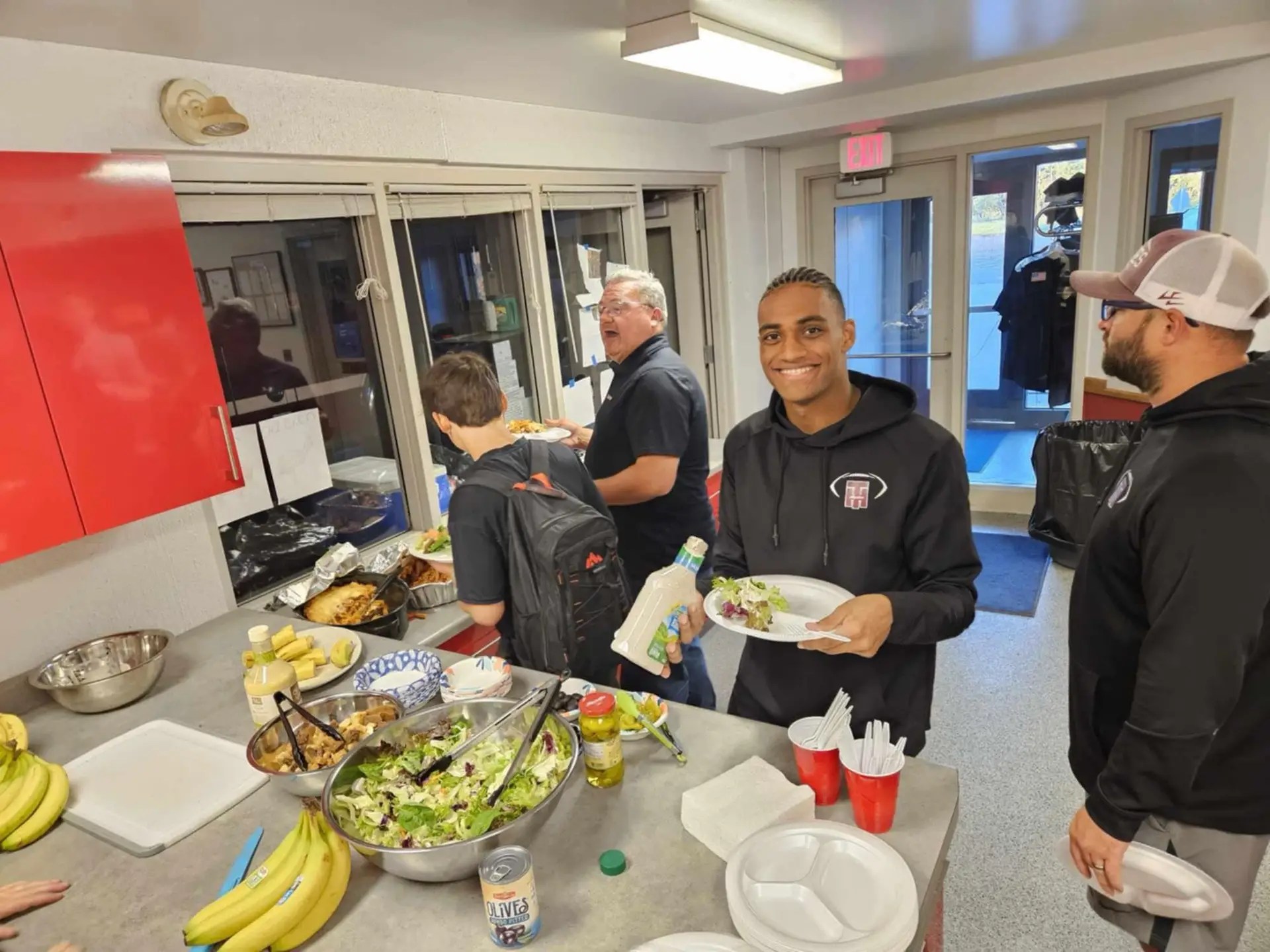
“Game Day” in Two Harbors begins 24 hours before the opening kickoff. Why wait? Let’s get the party started.
Some things are perfect combinations: thunder and lightning, ocean waves hitting the beach, movies, and popcorn. In Two Harbors, on the night before a football game, another combination rises to the top:
Football players and food.
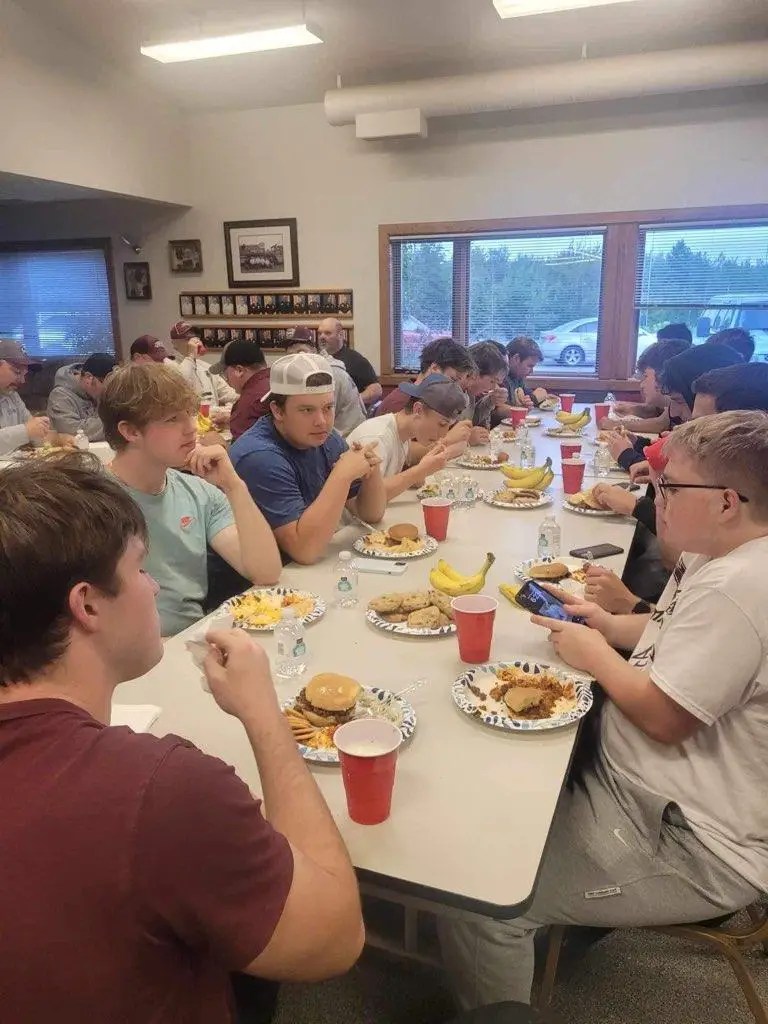
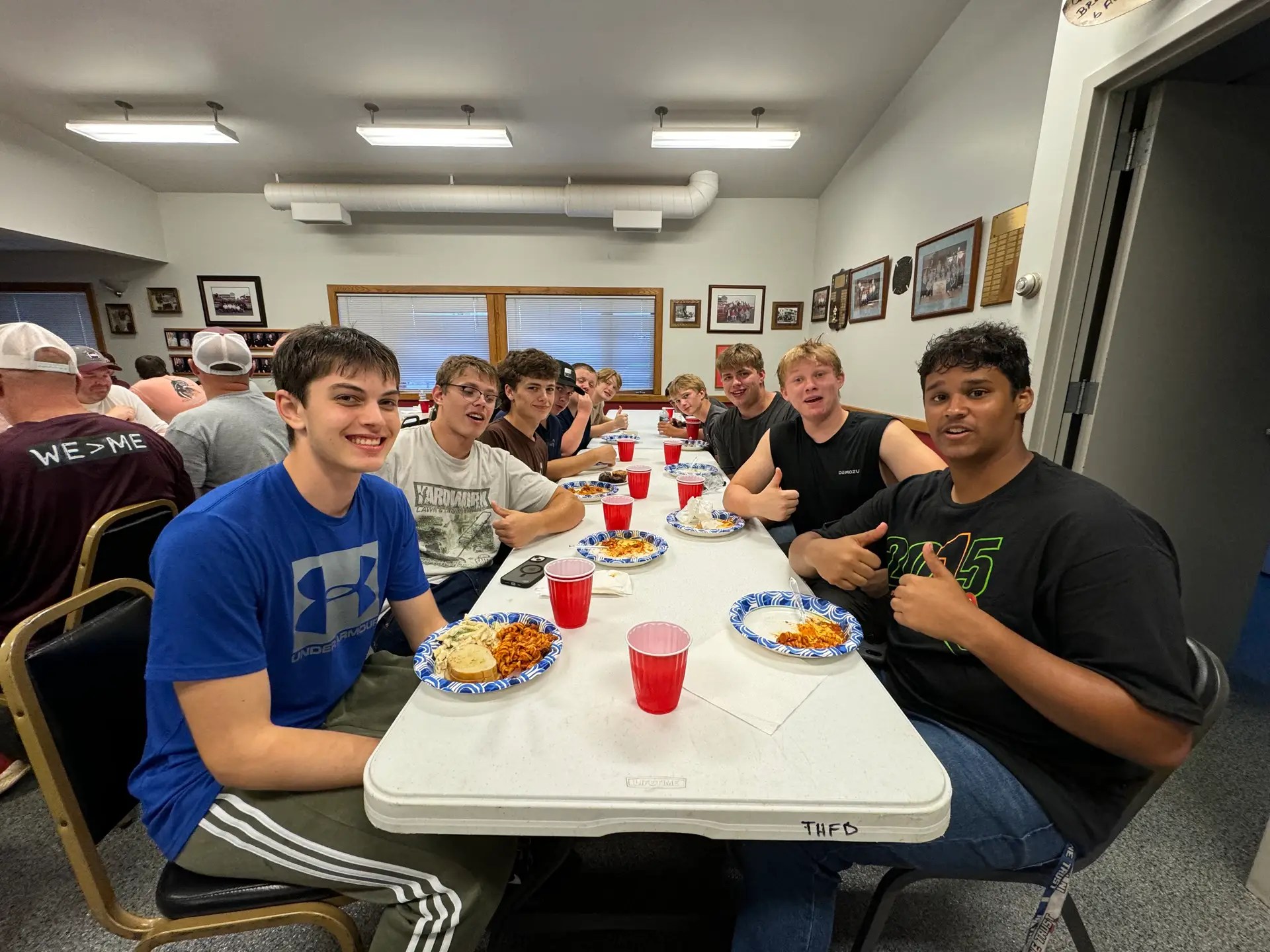
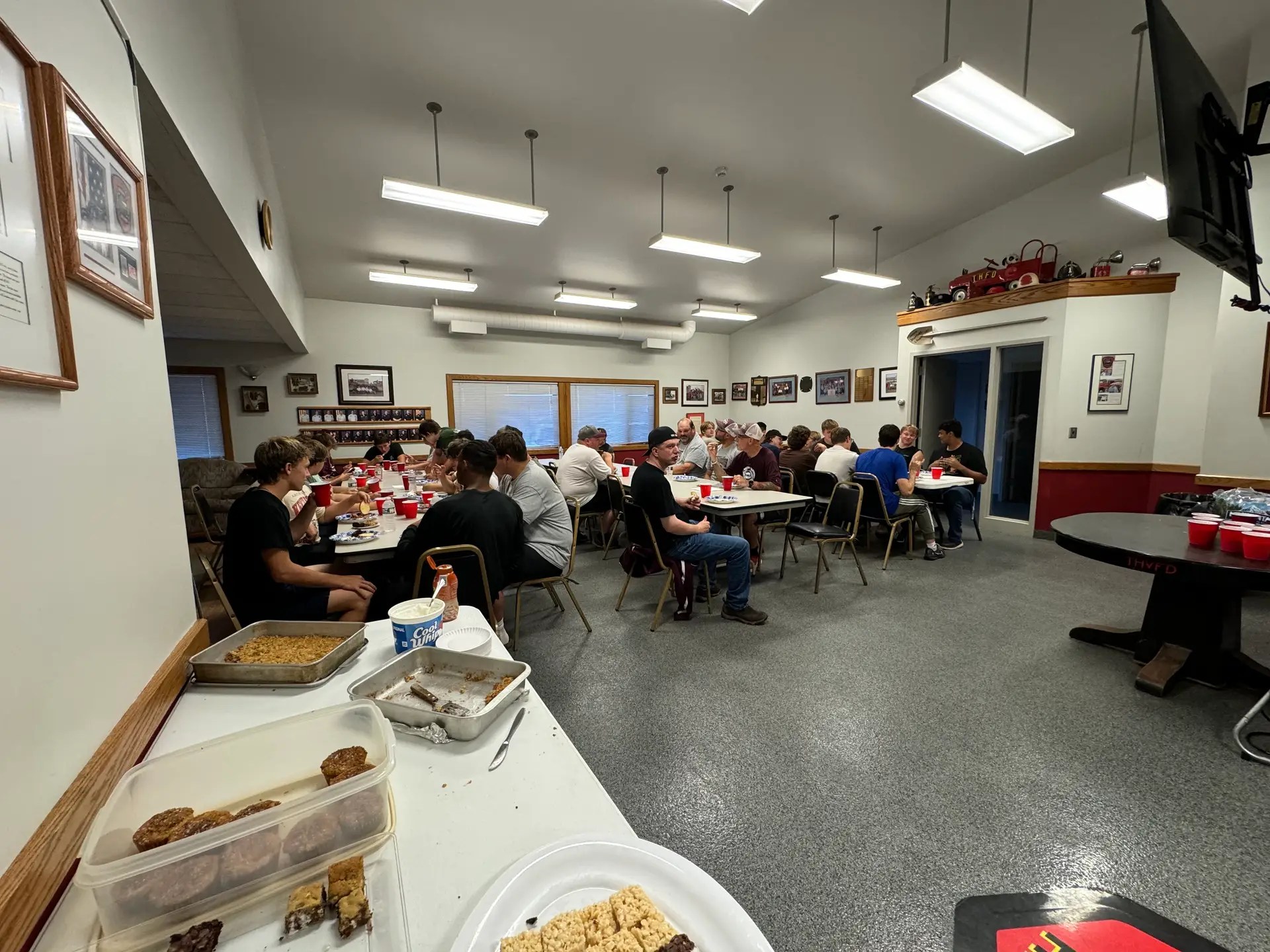
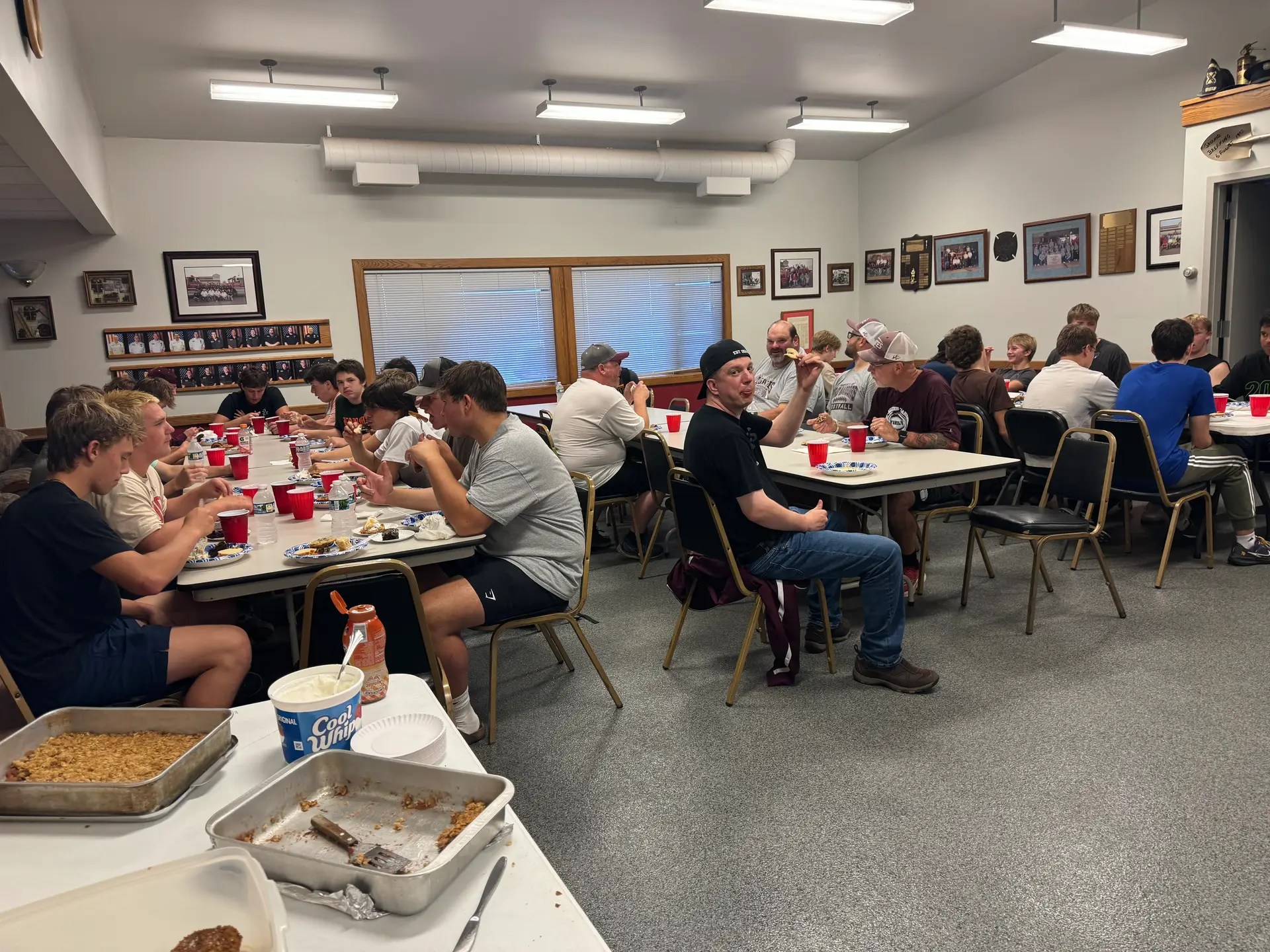
For some reason, parents are inclined to want to feed their kids. From what I hear, this can be time-consuming, stressful, and challenging when raising budget-crushing football players. During football season, relief comes one night each week when various parents associated with the Two Harbors Agates football team sign up to pay for, prepare, and serve dinner to the entire team and cheerleaders the night before a game.
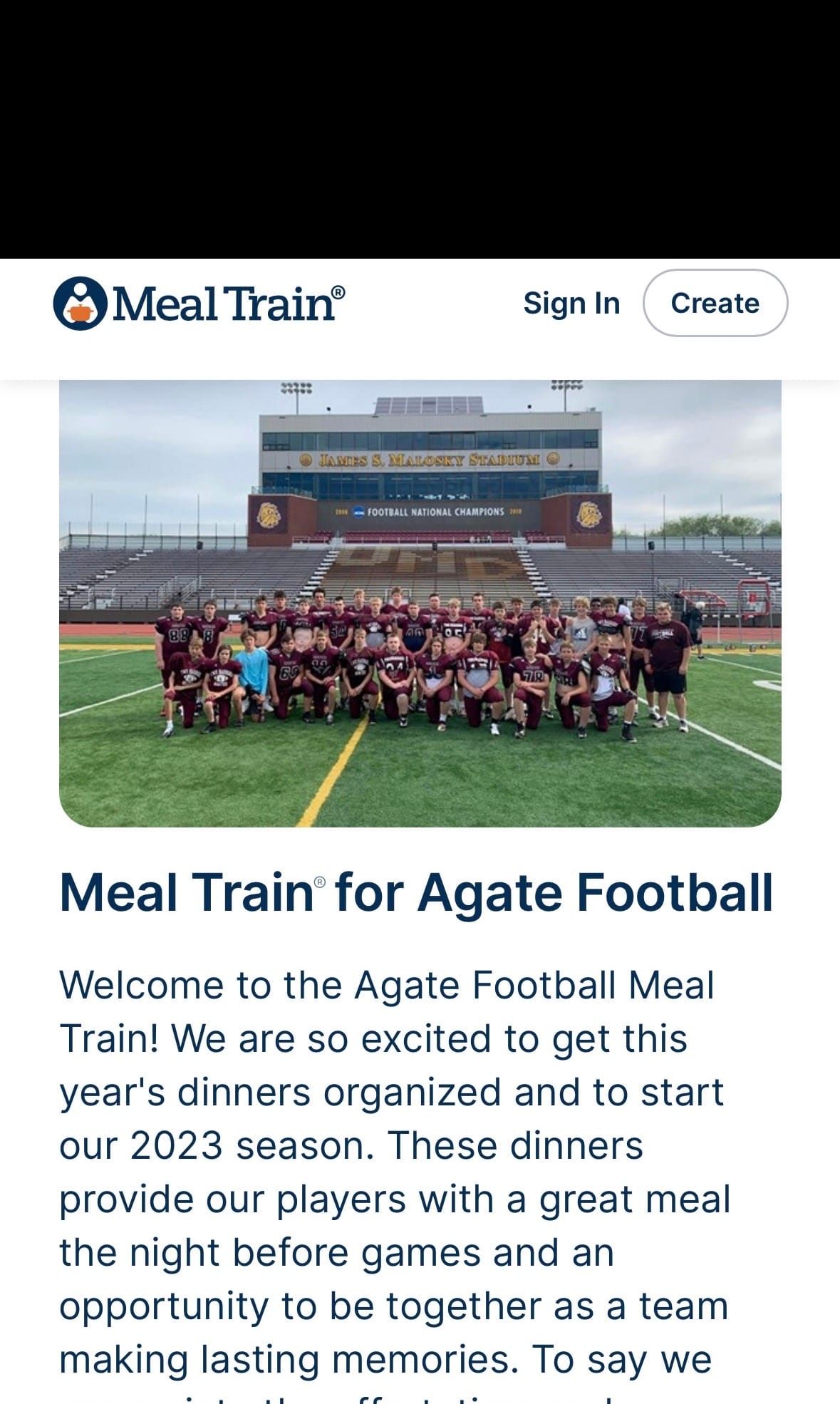
The message below was posted on the Agate Football Parents Facebook page:
“Welcome to the Agate Football Meal Train! We are so excited to get this year’s dinners organized and to start our season. These dinners provide our players with a great meal the night before games and an opportunity to be together as a team, making lasting memories. To say we appreciate the effort, time, and expense that goes into these meals is an understatement. Thank you all for helping us keep this tradition going.”
I intentionally omitted one word from that message. You’ll read plenty about that word in forthcoming pages—that single word holds everything together, serving as the program’s spirit.
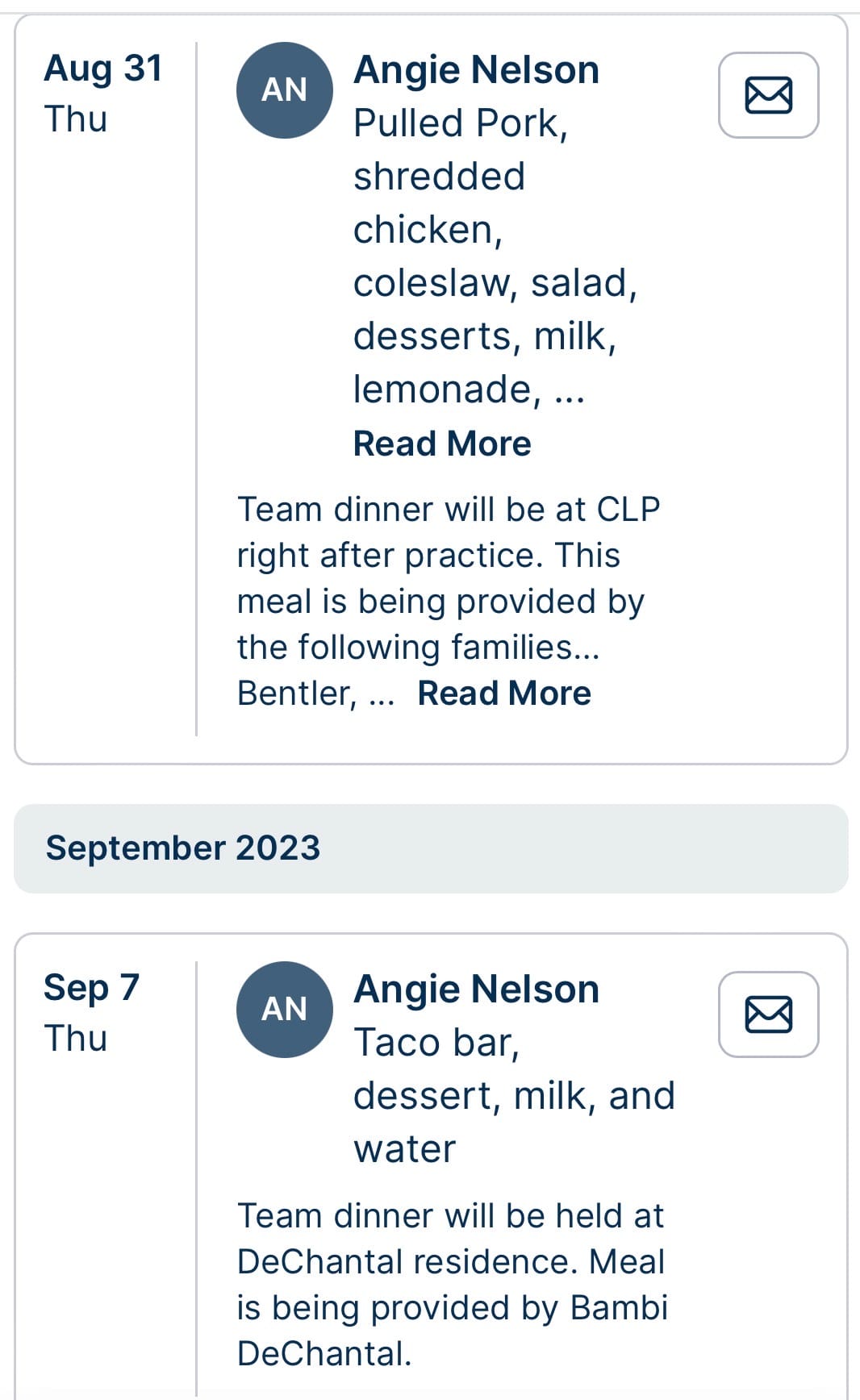
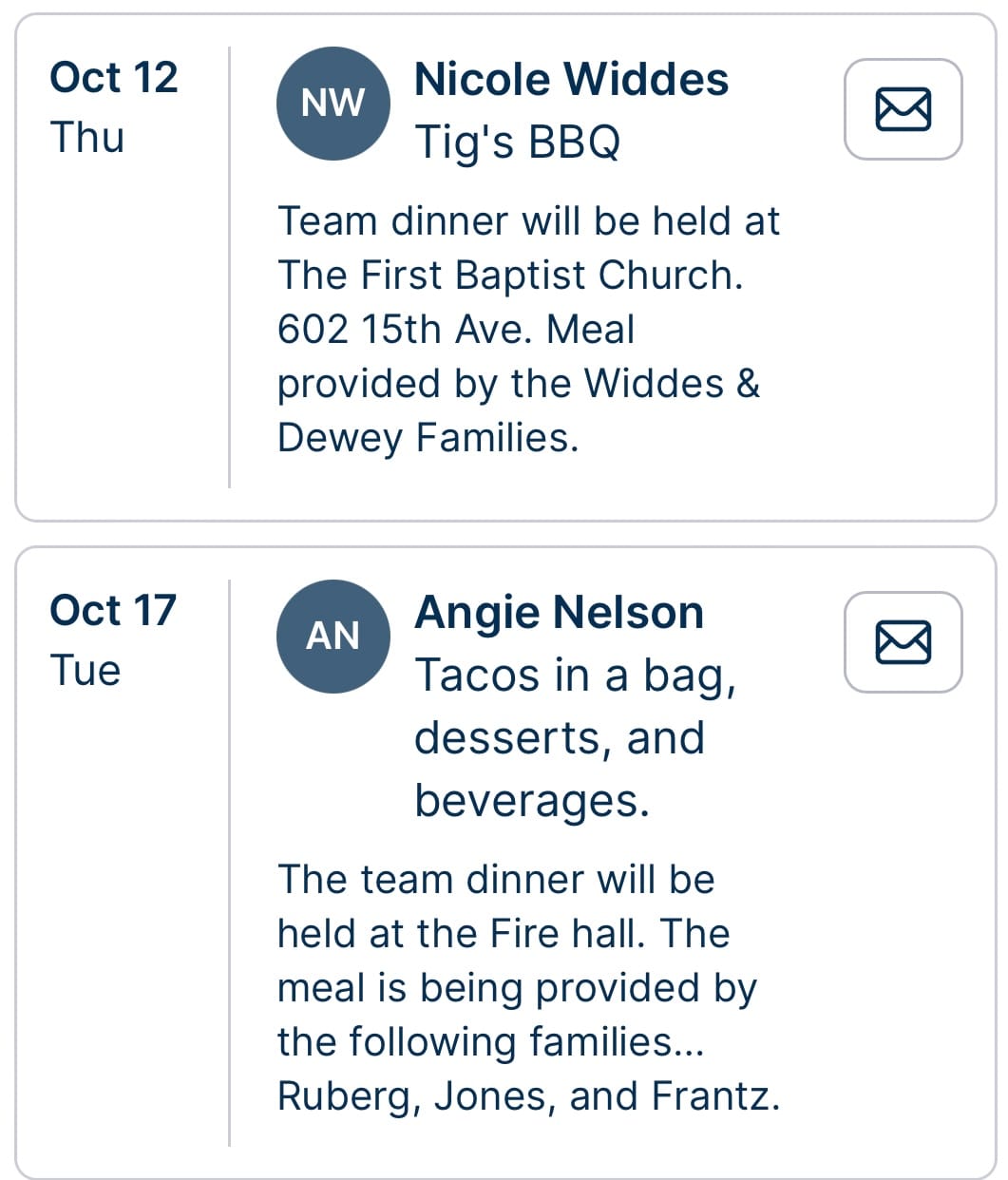
The athletes point their smartphone cameras at the “Meal Train” QR code posted in the locker room to easily access the schedule, venues, menus, and hosts. The venues range from the local fire hall, the school’s cafeteria, to the homes of local families. Recent menus have included:
- Pulled pork, Mac and cheese to pastas and desserts
- Taco Bar
- Ravioli Bake, Chicken Alfredo, Caesar Salad
- Do North Pizza
- Chicken Alfredo
- Pancakes, bacon, sausage, egg bake, fruit potatoes
- Tigs Bar-B-Q, pulled pork & chicken, Mac & cheese
- Hamburger rice dish, hot ham and cheese sandwiches, veggies
- Lasagna, dinner rolls, veggies & dip, desserts
- Pulled pork, shredded chicken, coleslaw, salads, desserts
- Sloppy Joes, pasta salad, chips, sweets
- Taquitos, rice, beans, salsa, guacamole, dessert
- Pizza hot dish, Chicken Alfredo, desserts
- Tacos in a bag, desserts
On the surface, the concept is noble: feed the kids.
Nothing more needs to be said.
However, the significance of this long-term tradition goes beyond serving meals to a group of athletes. The unspoken message delivered each Thursday night from the parents to the football players, cheerleaders, and coaches is as honorable as it gets—a message we all need to hear at times—but perhaps no group needs to hear it more than our kids:
“We are in this together. We are here for you. We care about all of you.”



Chapter 8: Sunrise on the Shore
Game day didn’t start well. My best-laid plans were foiled.
It was an honorable objective. I intended to capture a memorable photograph of the sun rising over Lake Superior on “Game Day” morning. If the right atmospheric conditions exist, it might be the most outstanding picture ever captured of the high school football field in Two Harbors. I devised this plan on Sunday, September 17, 2023, for execution on Friday, September 22.
Then Monday, September 18, stepped in and said, “Hold my beer.”
Electrons riding Alfvén waves at speeds up to 45 million miles per hour were racing 94 million miles from the sun towards Earth. Inevitably, they’d be deflected towards the North Pole, just down the street from Two Harbors. Hydrogen, oxygen, nitrogen, and carbon dioxide molecules would then collide with our ionosphere to create the ultimate photographic backdrop—Aurora Borealis. Better known as the “Northern Lights.”
When the electrons arrived, Two Harbors resident Pam Carlson was standing on the 50-yard line of Halsted Field. The author of this story, who had the grand plan to capture the ideal photograph, was sleeping. Carlson caught phenomenal pictures—northern lights over a northern Minnesota football field. My plan was foiled. I couldn’t possibly compete, but I still tried.
When Joseph Nicephore Niepce—don’t feel bad, I don’t know how to pronounce that name either, invented the camera in 1816, taking a picture of sunrise over Lake Superior on game day morning on this parcel of land two miles from the shore of Lake Superior would have required scaling of the tallest tree—branch by ever-weakening branch, until reaching the top as the tree wavered precariously to sustain my not exactly height-to-weight proportionate mass.
Those trees have aged, fallen, and decayed, and their offspring have been harvested. Where they once stood, tall aluminum bleachers now rise towards the sun. The evolution of this parcel of land has had a detrimental effect on global warming but has eased the process of sunrise photography, the latter of which is most important for this writer.
Before its transformation into a field, this was a forest of birch and pine trees. Beyond that, it was nondescript, with no nearby streams, ponds, lakes, or rivers. Even the indigenous Anishinaabe tribes had no reason to explore here unless they sought shelter from Lake Superior’s chilly, northeasterly winds. The tribes figured it out. One mile inland from the shore necessitates one less layer of clothing. Two miles inland—discard another layer. Eight miles inland–well, modesty always has its limits.
At least, it used to.
A different type of field now exists: a treeless center encased in a forest. Two treelike structures face each other, 120 yards apart. White, equidistant gridlines separate 12 segments of manicured grass carpet instead of moss. This looks like a place where happiness might happen.
It also has a name: Halsted Field.
This field now comes to life four—maybe five, Friday nights each year as young athletes pursue and fulfill their dreams. Odd dreams, these are. Difficult to describe.
One group wears black, armored disguises with an identification code on the front and back. In contrast, the other group wears similar costumes but in a white motif. The object of these dreams appears militaristic—align in various formations and then recklessly run into each other. An oddly shaped orb seems to have a significant role, but they treat it disrespectfully. They kick it in all sorts of ways, throw it as if it’s undesirable, pounce on it as if they want to kill it. When one orb seems useless, they insert another into the scrum and abuse it just as its predecessor. Actions at one end of the stage prompt one group of non-participants to celebrate while others are sad. Then, when a similar event happens at the other end of the stage, the sad group celebrates. At the same time, the previously happy group is sad.
It’s all very confusing but seems to boil down to one thing.
Those who excel at this chaos receive free college education.
FRIDAY NIGHTS and NORTHERN LIGHTS
I parked the car nearby, climbed the bleacher steps, cleaned my iPhone camera lens, and pointed it eastward towards Copper Harbor, Michigan, to capture the birth of a new day. At precisely 6:52 am, I tapped a red button, heard the synthetic camera-click sound effect, and then sheepishly looked at the picture. Sometimes, you know the outcome before the event, like when the Minnesota Vikings play in a Super Bowl.
The outcome of this “a picture is worth a thousand words” contest was clear:
SCOREBOARD
Pam Carlson 1,000
Tom Smith 0
Pam Carlson won the first contest of the day. The main event would begin at 7 pm. But the curtain on Game Day in Two Harbors had indeed been raised.
Game Day Morning in Two Harbors
SIDEBAR - Tom's Northern Lights Redemption - May 10, 2024 - North of Duluth, MN
Chapter 9: Parking Lot Full
As it has for multiple generations, pregame planning for the Agates’ football game was conducted at the large round table inside Judy’s Cafe on 7th Avenue in Two Harbors. The starting lineups for tonight’s Homecoming Game were finalized, the first 15 offensive plays for the Agates offense were identified, the scouting reports of Proctor’s personnel were dissected, and a final review of the Agates’ best defensive strategies concluded.
Seven cups of hot coffee had been poured. No cream. No sugar. Straight-up rocket fuel. The game-planning was interrupted only when the eight breakfast orders were majestically frisbeed onto the table:
Diner 1: Corn beef hash, eggs over easy, bacon, a stack of pancakes
Diner 2: Kropkakor (a potato ball salt-pork in the center), eggs—sunny-side up, link sausages, wheat toast
Diner 3: Corn beef hash, scrambled eggs, ham, steel-cut oatmeal
Diner 4: Kropkakor, sausage patties, homemade sourdough toast
Diner 5: Corn beef hash, eggs over medium, homemade cranberry wild rice bread
Diner 6: Two caramel rolls, six pads of butter, slab of bacon
Diner 7: Mile High Omelet, homemade cranberry wild rice bread, with an entire stick of butter
Diner 8: Two hard-boiled eggs, wheat toast-dry, decaffeinated Lipton tea
Football was the last thing on Diner #6’s mind. Diner #8 had concerns far beyond tonight’s football game.
The keys to winning tonight’s game were identified, breakfast reduced to crumbs, diners left their tips tucked under plates, paid their bills, and then walked out the door just as the Agates coaching staff arrived. Coach Nelson held the door as the senior citizens headed home for a nap.
Sitting at the same table vacated by the seniors, Nelson and his assistants were greeted by Vera, the ever-present Judy’s Cafe staffer.
“Good morning, Coach Nelson.”
“Good morning Vera, do they have it all figured out for us again this week?”
“Some things never change, Coach. They’ll be back tomorrow morning to review every play from tonight’s game.”
“Well, some things never change with me either, Vera.”
“So, it’s your usual: corn beef hash, over easy, cranberry wild rice bread, black coffee?”
“You got it.”
“Sure thing, coach, comin’ right up. And good luck tonight.”
“Thanks, Vera.”
Hopscotch the country on a Friday morning, land in any town. Find the local restaurant with the most cars parked outside. Park your car. Walk inside. Announce your presence with authority:
“Anybody in here want to talk football? I’m buying breakfast.”
Chances are good you’ll make new friends. Chances are just as good: the restaurant will serve lunch before you and your new friends finish your pancakes.
It’s a bummer if your town’s favored local breakfast restaurant is a national chain such as IHOP, Corner Bakery, First Watch, Snooze, or Yolk. It’s also a bummer for your kids, friends, neighbors, neighbor’s kids, their friends, and everyone’s enemies.
The food at those places is excellent. No doubt. Workers at those restaurants work hard. No doubt.
But your hometown is too synthetic and sanitized, lacking character and characters. Your town’s Farmer’s Market has never hosted an actual farmer. Your choice of restaurants is sadly influenced by pompous, self-absorbed social media keyboard warriors whose purpose in life—or so they think, is to write snobbish Yelp reviews.
“We dreamed of dining alfresco to rekindle memories of our midsummer nights in Tuscany, but this lousy town and restaurant offered nothing of the sort, nor did its bolognese sauce evoke memories of my loving, Sicilian grandmother who worked day and night to feed her 18 starving grandchildren. Furthermore, our waiter offered no proof that the tomatoes were grown in sustainable, organic gardens. We were furious. I only give this restaurant one star because zero isn’t an option.”
Close “Yelp.” Delete the app from your smartphone. Drive around town to find the restaurant with the fewest available parking spots. That’s the one. Park down the street if necessary. Walk inside. Wait a few minutes for a vacant table. If the “daily special” for the last 30 years of Fridays has been “Pork Fritter Sandwich with Chicken Dumpling Soup, “order it. It must be worth ordering if it’s prevailed on their menu for this long.
Sit back. Enjoy the morning. You’re in the right place. You’re home.
Chapter 10: Beyond the Game
Low Aspirations
The following paragraphs were the original premise for this story. Nothing you’ve already read. Nothing you’ll read in subsequent chapters. Just this stuff.
My low-aspiration top priorities for the story were to identify the top-selling item in the concession stand and take the riding lawnmower for a spin around Halsted Field. I’ve yet to pilot that lawn mower.
The Friday night football field remains dormant for all but four, five, or six weeks each year, depending on the dates set forth by The Committee. On this homecoming weekend, there’s no dormancy at Halsted Field. There’s also no vacancy at the local hotels. However, the latter is more attributable to Twin Cities hordes pursuing fall color pictures than alumni returning home to see the maroon and white.
Hours before the local high school students change from their football and cheerleading uniforms to their favorite dress-to-impress dance attire, Halsted Field undergoes a makeover as its stylists and attendants primp and groom the field before it poses for its customary pregame, in-game, and postgame photo ops.
“Hey, writer. It’s a field. It doesn’t know it’s going to have its picture taken!”
We will agree to disagree.
My Dream Job
The football field needs a haircut. There is no plastic carpet here. This is not the job for a 16-inch, human-powered, walk-behind reel mower that launches clippings onto the operator’s shoe tops. Enter the Toro 75750 50″ TimeCutter Zero Turn 23 hp mower. It could win a car race at Monte Carlo, but today’s task is to run laps up, down, and around the football field. Its operators—who serve as the Activities Director and Head Coach of the football team, pass the time entertained and distracted by podcasts and playlists.
Two Harbors native Gary Molitor, who, in his younger days, could run the 100 yards from one end of the field to the other as fast as any local native, adorns the field in its formal pinstripes.
Reminiscent of Jennifer Aniston’s character in “Office Space,” Halsted Field needs some flair. Two Teacher’s Assistants ensure it happens by affixing yard markers and end zone pylons to their traditional sentry posts encompassing the field. The makeover is complete when they affix the corset-like maroon and white, padded “Agates” goalpost sport coats.


Step Right Up
When the sentry of the ticket office outpost isn’t upstaging a fledgling writer with Ansel Adams aspirations, Pam Carlson greets eager patrons who present their season passes or offer a few dollars for admission. She captures brilliant photographs during her spare time and has the privilege of seeing the images—forever residing only in her memory—of anticipatory faces approaching Halsted Field to experience a small-town tradition.

Lights On, Lights Off
The seasons change rapidly up here. For the first game of the year, when the sun sets around 7:48 pm, the stadium lights might not be turned on until the second quarter. By the end of October, as sunset occurs hours earlier, the lights start warming while the athletes eat lunch. THHS Activities Director Scott Ross brings his sundial compass—or perhaps just a smartphone weather app with sunrise and sunset details, to the referee’s locker room before each game to collaborate on the optimal time to activate the stadium lights.
Nobody knows how much it costs per hour to light those lights. Maybe the school’s Robotics team—or another group geeked out by data analytics calculations—will deliver the answer via a booth at next August’s Lake County Fair.
North Shore Nachos
At halftime, a long line snakes to patronize the Na-Cho-Bizness food truck, where Amy Goerdt serves the world’s most incredible nachos— the best I’ve ever had. I’ve been eating nachos for 40 years—including 10 Texas years. I’m something of an expert. A northern Minnesota food truck is not where I imagined finding America’s best.
Goerdt’s food truck is the best thing to ever come out of Silver Bay—our small town rival up the shore.

Workin' on the Chain Gang
Mike Johnson and his comrades on the chain gang know the far sideline better than anyone. They manage the first-down markers and eavesdrop on the sideline conversations of the opposing coaches and players. They didn’t tell me they did that, but I would.
Regulars include Rick and Nick Osbakken and Chad Nordean. Johnson and the Osbakkens have been doing this for more than 20 years. Derek Peters, Brian Bentler, and Joel Heller filled in for tonight’s Homecoming game, perhaps because the Osbakkens saw torrential rain forecast during the game.
“Every year, I say, this is my last year, but I keep coming back. We all do. It’s fun to watch the games, support the kids, and be part of this,” said Johnson.

Band of Brothers...and Sisters
Here’s a story that’s never been written:
“The horns section of the Two Harbors High School marching band stole the show during Friday night’s Homecoming football game with a rousing rendition of Stevie Wonder’s “Superstition.” Meanwhile, Tate Nelson led Two Harbors with four touchdowns as the Agates defeated the Proctor Rails 47-8 at Halsted Field.”
Ya, that story has never been written.
Not yet.
Romantics have long glorified the ritual of kids playing backyard football amid the falling leaves on Saturday mornings and Sunday afternoons. Folklore of aspiring musicians hitting the wrong keys on their first flute, tuba, or keyboard—never mind the soothing tones of an 8-year-old banging the drums in the basement or garage, seems comparatively sparse.
Crashing into things, as footballers do, requires little trace of the evolutional progress of homo sapiens. Displaying the mental, physical, and emotional elements necessary for musical mastery certainly does. In other words, on Friday nights, perhaps a few stadium lights should be pointed at the bleachers section where the band resides with as much intensity as those pointed at the football field.
The “band room” was always one of those off-limits spaces at school. It might be the only room in school I never ventured into. I’d see my classmates carry their oddly shaped suitcases inside, hear noises from behind the walls, and then watch as they ventured back into the hallways with the rest of us. Inevitably, they emerged smiling—a happy bunch.
Fast forward more than 40 years, and not much has changed. According to THHS Senior Nola Motschenbacher, the positive vibes in Room 2420 of Two Harbors High School still reverberate. “Multiple times each day, Mr. Kelley—our band director, has to tell us to “simmer down.”
So, band members still emerge happy from Room #2420 at Two Harbors High School—especially on game days—hours before they take the stage at football and basketball games. While their audiences neither rival the size nor fanaticism delivered by the Swifties, it’s gratifying for them to reward the patient—will-she-ever-learn-how-to-hit-the-right-keys tolerance offered by moms, dads, brothers, and sisters—even the neighbors, by nailing the opening bars of a song popularized on Top 40 radio decades before she was born.
As I ponder the previous paragraph, I’m speed-bumped into considering the miracle. Mom loved a song long before she became a mom. Now, her daughter is a member of a band playing the song mom loved before her daughter was conceived. The daughter recreates the music and sends Mom back to a time before she became a mom. I now finally understand why they created the word “serendipity”—the faculty of making fortunate discoveries by accident. Girl. Song. Mom. Daughter. Song. Mom. A circle of life-ish musical miracle.
How does it work for musicians? Boys turn on the TV, see football players, then tackle each other in the living room. So, the music version must be; a girl goes to the record store, brings home the vinyl, is captivated by the second song on the B-side, and immediately asks Mom and Dad to buy a keyboard. Is that how it goes?
Wait, skip the time travel—stay in the present. The girl hears a clip—a sample—a beat—a hook—feels the fire from an Instagram reel, then realizes her life just changed—she sees her future—a life of looking out at the thousands of adoring fans while she stands on stage behind her keyboard.
Mom’s credit card soon triggers Amazon to deliver a Hammond SKX Pro Dual 61-key Stage Keyboard keyboard to the family’s doorstep the following morning.
And so it begins? Do I have it right?
Getting 11 football players coordinated for a single play is one thing. I’m guessing it’s infinitely more challenging to get 20, 30, or 70 band members on the same page while performing a complex song. But when Grandpa sits in the bleachers, tapping his toes to Deep Purple’s “Smoke on the Water,” while he’s telepathically transported back to the exact night and location where he drank his first beer listening to that song followed by “Don’t Fear the Reaper” and “Limelight,” those in the band should give themselves abundant credit for bridging the gap between a past life and present existence.
Credit to Band Director Max Kelley for a 2024 playlist of songs that include throwbacks to the 70s and 80s, including one of Nola’s favorites, Tommy Tutone’s “Jenny,” released in November of 1981. This song is notable for indelibly imprinting the most prominent phone number of the last century in the minds of many: “867-5309.”
It’s good to know your audience. Nola cited football and basketball games as highlights among their opportunities to emerge from the room where they practice, with the Homecoming Game being the highlight of each year.
Whether it’s the Pep Band, Marching Band, or Jazz Band, our town’s young musicians provide the soundtrack and a festive element to every event they attend. Friday nights wouldn’t be the same without them.

Franklin Field to Halsted Field - NFL Films to THHS Films
The late Ed Sabol and his son, Steve, founders of NFL Films, both enshrined in the Pro Football Hall of Fame, revolutionized sports coverage in America. Football was their subject. Film was their medium. Football is alive and well. Film is long gone.
In the early days of NFL Films, they employed three cameramen whose roles were “the mole, the weasel, and the tree. The “tree” filmed from a perch above the 50-yard line. The mole was the ground-level cameraman who focused on each play. The weasel patrolled the sidelines looking for unique images detached from the on-field plays—focusing on the fans, coaches, cheerleaders, players on the bench, and even the consumption of concession stand delicacies by ravenous fans.
THHS has a tree and a mole but no weasel, though weasels likely roam outside the stadium.
An unmanned motion-detecting camera sits atop the press box to emulate the “tree” of NFL Films. Via YouTube or Hudl, this camera delivers video streams of Agates football games to smartphones, laptops, and television screens anywhere on the planet. This cybernetic “tree” is the first encroachment resembling artificial intelligence at Halsted Field. It won’t be the last.
The midfield “tree” is supplemented with an end zone camera. This camera, which attempts to mimic Sabol’s “mole,” is governed by a joystick and rises 30 feet above ground instead of burrowing under. Its video is used primarily for postgame coaching purposes. Enter four junior high school students. Two boys sit in the end zone to operate the camera. The other two boys reside comfortably in the press box, monitoring the video on a split-screen iPad. These boys are junior high football players in command of some of humanity’s most significant technological advancements. They require no training manuals–they were born with the cerebral ability to “figure it out.”
NFL Films had the Sabols and guys named Hank McElwee and Phil Tuckett on their staff. Two Harbors has kids approaching their teenage years named Ziggy, Axel, Isaac, Junior, and Ryan, managing the mystical process of transmitting real-life, live images from a football field to our living rooms.
We’re not in Kansas anymore, Toto.
The Sabols would be fascinated with the technology currently deployed at high school football games. Even more, they’d be proud of the evolution of video coverage of their sport—from Philadelphia’s Franklin Field in the 60s to Halsted Field in Minnesota in 2023.


"Rub Some Dirt On It" Is Now Frowned Upon
All athletes—including cheerleaders, are susceptible to injuries. Gone are the days of “rub it with dirt, the pain will go away.” In the last century, we had a fully stocked medical kit: ice packs, white athletic tape, a couple of elastic ace bandages, Curad bandages, a bottle of aspirin, salt tablets, scissors, smelling salts for the concussed, and a manager who once saw a fake skeleton in the biology lab.
Scan the sideline on any Friday night to find the person wearing apparel bearing the “St. Luke’s Orthopedics and Sports Medicine” logo. Two Harbors High School, along with many others in northern Minnesota and Wisconsin, contracts with St. Luke’s Hospital in Duluth. One of their professionals attends every varsity sporting event in Two Harbors—not just football.
St. Luke’s team members also travel to the high school on Wednesdays. There are rarely any games on Wednesdays. Their midweek appearances are to monitor our athlete’s recovery from previous injuries.
We all know about the staggering costs associated with healthcare. THHS recently renewed a five-year contract with St. Lukes for their medics to support our athletes. As you might imagine, the price for such outstanding service is overwhelming, yet the school district didn’t ask for a tax increase to pay for it.
That’s because the cost to the school district is zero.
Nothing.
In an era of healthcare providers gouging consumers at every opportunity, St. Luke’s provides this care free of charge.
Imagine that.

Picture This!
Now, imagine a high school football game absent cameras or telephones. It’s not impossible.
At Halsted Field’s predecessor, a football field also known as Halsted Field—a mere 848 feet from Lake Superior—male patrons once entered while carrying only Costanza-sized wallets and either a tin of Copenhagen or a pack of Marlboros. Rumors of men carrying flasks of “antifreeze” also persist.
Women were more refined, yet they had no phones or cameras.
Cameras are now omnipresent at sporting events. Homecoming night in Two Harbors was no exception. While most carry iPhones and Androids, a few carry cameras and lenses made by Canon and Sony. Megan Loppnow arrived in Two Harbors as the Proctor Rails sideline photographer. Kim Kosmatka, representing Marshall High School Social Media.
Lisa Malcomb provides coverage for our friends up the shore in Silver Bay. “I often attend games where Silver Bay students are playing as I do their yearbook. I’m also the art teacher up there. I have shot football and basketball for the last two years and Storm hockey for about as long as it has been the Storm.”
This game was between Proctor and Two Harbors. Why would anyone from Marshall attend and take pictures? We’ll get to that later!


Who's in There?
We often hear the term “best seats in the house.” On rainy, windy, cold early October evenings in northern Minnesota, I contend that the four guys, with their sheltered seats in the press box, are sitting in them.
From their sheltered nest, they provide essential support:
Carl Freund serves as the Public Address Announcer
Kevin Pettis captures the statistics
Mike McGrath serves as “the spotter.”
Gavin Bopp operates the scoreboard.
They may be cozy, but they can’t be lazy. On each play, McGrath identifies who carried the ball, caught the pass, made the tackle, or scored the touchdown. He relays that information to Pettis, who documents the stats, and Freund, who informs everyone at Halsted Field.
Pettis compiles and shares the information with Ryan McIntyre, who informs everyone in the state of Minnesota and beyond of the game’s outcome by entering the data into an administrative portal provided by the Minneapolis StarTribune for entry into mnfootballhub.com.
Meanwhile, we all pay attention to Gavin’s work.
The scoreboard comes to life with the flip of a press box switch. Game time was once tracked on a wristwatch—then a stopwatch—now, we all watch. Tick, tock, tick, tock.
An observer watching the spectators from field level might think they are at a tennis match. Everyone looks ahead. Everyone looks to their right. Ahead. Right. Ahead. Right. Back and forth after each play. They look down to the field of play, then to the southeast corner of Halsted Field, where they see Bopp’s work on the scoreboard. Time remaining. Down and distance. Time outs remaining. Which quarter? And, of course, the score—us versus them. By the way, the scoreboard was donated by Coca-Cola Inc. following negotiations by former Athletic Director Bob Nyberg.
Bopp’s work answers many questions:
- How long before I push people out of my way to be first in line at the concession stand or food truck?
- Some parents think, how long before we can go home?
- Kids think, how long before we have to go home?
- The boys on the bench watch more intently. As the clock winds down, thoughts of “Will I get to play tonight “ramp up. They hope to make a tackle, pancake an opponent, or catch a pass before their time expires. Laws of nature insist these minutes don’t elapse quicker than any other, but they do.

Super Heroes
Guys in the locker room are getting ready for the forthcoming match. Joking around. Giving each other some grief. Then, moments of silent contemplation. Eventually, the side-by-side march to the field, stretching, then gathering at midfield for the coin toss. Adrenaline is elevated. Everyone is excited. It’s almost go-time.
But these weren’t the football players.
These are the grown men who still put on a uniform, stand at attention during the national anthem, find themselves in the middle of the action on every play, communicate regularly with the players and coaches, endure the elements on game night, and observe firsthand the emotional highs and lows experienced by the players on the field.
Undeniably, these games wouldn’t happen without them.
The opening kickoff was minutes away. I walked around the midfield, coin-toss gathering in Two Harbors as Referee Mike Schmidt set the tone for the night’s festivities. He introduced each member of his crew. His tone was perfect—authoritative, confident, yet cordial. When he was done, team captains representing the Agates and Rails said in unison, “Yes, sir!”
So did I.
Any plans I had to misbehave on this night—and I had several–were extinguished after Schmidt set the tone. It had been 45 years since I stood in a midfield coin toss gathering. It felt like yesterday.
Those of us in corporate America endure training videos each year during our annual Code of Conduct training. For some reason, they always made me do it quarterly. Suppose the Minnesota State High School League wants to create a training video to instruct newly trained officials in the art of the pregame midfield coin toss and commentary. In that case, they should deploy the cameras and microphones to Mike Schmidt’s next football game.
They endure the weather. Snow in Minnesota. Heat in other states. Everything in between. One referee said:
“We were doing a game up in Cook County—full-fledged sleet storm. Wind blowing 30 miles per hour off of Lake Superior. Ice pellets were bombarding us. As we were freezing, one guy on our crew said, “Just remember, it’s all for the kids.”
As much as any group in attendance at that game near the Canadian border or any other game, the “doing it for the kids” sentiment holds.
Five guys from around the northland left their homes in Duluth, Eveleth, and Esko and drove to Two Harbors, put their role-approved apparel on, then put themselves in a situation that typically involves them getting heckled by the crowd, yelled at by coaches, even occasionally-though very rarely, disrespected by athletes.
While visiting with this crew, I was surprised by the prevailing feeling I had. It was one of honor. I explained the nature of the story—probably talked too much about that then got around to my two questions:
How long have you been doing this?
Why do you do this?
“This is my 14th year of football and 26 years of hockey.”
“Football 14, basketball 10, lacrosse 4”
“I just do football. 13 years.”
“I’ve done football for two years and basketball for four.”
“Football for three, basketball for 18, lacrosse for three.”
Guys, why do you do this?
Mike Schmidt offered the first response: “It can be a thankless job sometimes, but when the clock hits zero, everybody is thankful and respectful for the most part. There will be words said at times during the game, but as long as it doesn’t cross that disrespectful line, it’s just passion—part of the game—emotion, it’s all good. If I took it personally, I couldn’t do it.”
The other referees offered their thoughts:
“When my kids left high school, I had to ask myself, what will I do next? They all played sports. I’m now retired, but I still do this. I enjoy being on the field with the kids. The kids are awesome.”
“I just love being on the field or the rink. It’s just fun to give back to the sport I grew up playing.”
“Most of the time, parents will just walk past you, but I’ve had two instances where that wasn’t possible.”
“I enjoy being out on the field. I grew up around the game and enjoy being around the kids. It keeps you young. The kids are what make it worthwhile.”
“I just want to give back to the kids. They are the future so you might help them as much as possible.
They aren’t there to serve as the dunk-tank target at the county fair. They have their assignments, watching this sector of the field or that sector. Parents and grandparents watch their son. If an infraction was committed against their offspring, they notice. Sometimes, the popcorn and expletives simultaneously fly. These referees perform amid 22 high-octane youngsters competing as hard as they can.
Five referees, 22 players. Each referee is accountable for every movement of 4.4 young, athletic, fast-moving high school athletes on each play. Try that at home. Some of you probably already do.
While attending a hockey game in Denver in March of 2023, the presence of numerous security guards was impossible to miss. Minutes after asking one of them why there were so many, the retired Colorado Highway Patrolman cited the inability of parents to control themselves in numerous previous tournaments in the Rocky Mountain region. Almost on queue, he interrupted our conversation when he received a call on his radio to deal with a fool verbally abusing the officials.
This wasn’t at a Colorado Avalanche or Denver Pioneers college game. It was a youth hockey game among 12-year-olds.
In a video circulated on TikTok in January 2024, a prolonged fight broke out on the court during a high school sporting event. It was disturbing to watch, but listening to the applause from far too many in the bleachers was more troubling. Therefore, in our society of screamers, we see increasing stories regarding the lack of referees for youth sports.
Their black and white striped shirts need an overhaul. Look to 1967 episodes of “Batman” for design ideas. I’m thinking capes. Superhero capes. Batman had one. Robin too.
Give these five guys a cape with black and white vertical stripes. Ensure the capes are light enough to fly behind them as they run up and down the field, monitoring the behavior of your town’s finest.
Heroes. All of them.
On Friday nights, when you see school busses leaving parking lots to bring their teams, bands, and cheerleaders back to their hometowns, perhaps it’s worth a moment to think of these guys—and all the women who also officiate, as they drive home.
I’ll take an unconventional route for a writer amid a story like this and, on behalf of the thousands of people who will read this story, express our appreciation to Austin Erickson, Matthew Erickson, Brent Kubis, Justin Niemann, and Mike Schmidt for being good citizens and supporting kids in Texas and Minnesota as they pursue their dreams.
They didn’t have to do this, but they did.


The Top Seller is What??!?
Now, the moment you’ve all been waiting for.
Kids rush to the concession stand, eager to purchase the fuel to propel them around Halsted Field for the next few hours. While she manages the concession stand, Jenny Falk’s motherly instincts activate as kids order the popular mainstays such as Skittles and Mountain Dew, but the current best-selling item is something I’ve never heard of: Trolli.
“I need a bag of Trolli, I need a bag of Skittles, and I need a Mountain Dew.”
Jenny offers an option: “Can I interest you in water and carrot sticks?”
“No, ma’am. Trolli, Skittles, and Mountain Dew. Make that a large Mountain Dew.”
At least Jenny tried.
Next in line is the Joey Chestnut of Two Harbors, identity withheld. He impatiently taps his toes as Nathan’s hot dogs and buns simmer in the steamer.
Falk doesn’t have to ask—two dogs, mustard only.
And a “100 Grand” and large Mountain Dew.
Some “kids” never change—even when they’re 63 years old, no longer reliant upon a weekly allowance from mom and dad.
New concession-stand sales leaders have emerged. Milk Duds, M&Ms, and the all-time best, “$100,000 Bar,” now known as “100 Grand,” were the preferred sugar-delivery staples of our generation. Trollis snuck up on me. Before this Agates’ concession stand revelation, they stealthily avoided my radar. And trust me, I’ve spent plenty of time in the candy aisles of grocery and convenience stories. Now, I see them everywhere. Trollis even have disturbing, 15-second video clips on their site and YouTube—mini horror movies where Trollis demand to be eaten.
Trolli, Trolli, Trolli—crush us with your teeth!
Trolli, Trolli, Trolli—eat us piece by piece!
We had “100 Grand” and Alfred Hitchcock. This generation has Trolli candies and Trolli horror flicks.
We win that one.
My goals for this story were achieved. I had my answer—Trolli are top sellers at the concession stand at Halsted Field.

It Takes a Village
The Agates walk, hand-in-hand, down the path from the school to the field. Will this be their night? Will I play? Will I make a good play? Will we win? Will Dad be here tonight? Will Mom? Will they be together? I should have studied more for that test yesterday.
Families sit in their favorite location. Same row, same seat as last week, last year.
In previous years, they walked this path on Tuesdays, Thursdays and Saturdays for JV and junior high games but Fridays are different. Some might say, sacred. If they make the varsity roster in 9th grade, they’ll walk this path maybe 20 times.Twenty dominoes lined up, knocked over week-by-week. The problem with this game is once they’re down, they can’t be picked back up. The calendar only moves forward. The athletes can’t fully comprehend. The adults do.
Many people enable these games to happen. They could have been anywhere. At home watching a movie or reading a book. Sitting on the end of the dock at the cabin. Walking to the end of the breakwater at Agate Bay. Hiking the trails at Gooseberry Falls State Park. The options are endless. Out there, up there, down there, over there, in there, everywhere, anywhere.
Anywhere, but here.
They didn’t attend football practice this week or last, maybe ever. They don’t know the plays, or rules—well, one group of them better. They don’t wear the jerseys of the Agates or Rails. Never receive media recognition. But here they are—some for three years, some for 30, some for 40. There are multiple ways to define a family. All of these people are part of the Agates football family.
Game night becomes part of them.
Beyond the football coaches and players Activities Director Scott Ross coordinates most of this.
5 Referees
5 Lawn Maintenance/Prep
1 Scoreboard Operator
26 Cheerleaders and Managers
1 Cheerleading Coach
1 Ticket Office Management
3 Concession Stand
3 Food Truck Staff Members
5 Honor Guard
1 Public Address Announcer
2 Statisticians
1 Spotter (Assists the PA Announcer and Statistician)
4 Chain Crew/First Down Markers
15 Choir Members to Sing the National Anthem
17 Band Members
1 Band Leader
1 Videographer from Northern News Now
2 Trainers from St. Lukes
3 Sideline Photographers
4 Staff members at Do North Pizza
Approximately 101 people to support 48 minutes of football.
Chapter 11: End of the Story?
My internal voices returned, volleying from one side of my skull to the other as if I was watching Rafael Nadal and Roger Federer, or for the older folks reading this story, Navratilova and Evert, or McEnroe and Borg.
The daily battle: “Agitator versus Sensible”
Agitator started the fight:
“Stop—that’s enough. That’s all you intended to write about. The story ends here. Publish it. Then get back to that baseball story you put on the shelf.”
Sensible responded:
“You know there’s more to this. We heard traces of some amazing stories related to these students, coaches, and this town. We can’t stop here. We have to dig deeper. Rod Carew, Harmon Killebrew, and Catfish Hunter can wait.”
The back and forth continued.
“That makes sense, but it will take forever to finish. People will lose patience. They’ll doubt you’re even writing. Even a real writer would struggle to put these pieces together.”
“Could you repeat that?”
“You mean—taking forever—or struggle?”
“No, the other one. Something about a “real writer.”
“Well, you aren’t exactly a real writer like Steven King or Steve Rushin. You never will be.”
“True. But there are too many good stories that aren’t getting told. Even if I flounder and this takes forever, it will hopefully be better than nothing.”
“This story will be too long. Nobody will read past that nonsense you wrote about “if, you, see, and say. Can’t you just summarize this whole thing with a TikTok?”
What to do, what to do, what to freaking do? Football, baseball, or beer hall?
Then, I made my decision.
Chapter 12: "Take Me Out to the Ball Game" Can Wait
When I feel that chill, smell that fresh cut grass
I’m back in my helmet, cleats, and shoulder pads
Standing in the huddle listening to the call
Fans going crazy for the boys of fall
They didn’t let just anybody in that club
Took every ounce of heart and sweat and blood
To get to wear those game day jerseys down the hall
Kings of the school man, we’re the boys of fall
Well, it’s turn and face the Stars and Stripes
It’s fighting back them butterflies
It’s call it in the air, alright, yes sir, we want the ball
And it’s knocking heads and talking trash
It’s slinging mud and dirt and grass
It’s I got your number, I got your back when your back’s against the wall
You mess with one man you got us all
The Boys of Fall
In little towns like mine that’s all they got
Newspaper clippings fill the coffee shops
The old men will always think they know it all
Young girls will dream about the Boys of Fall
Kenny Chesney – “The Boys of Fall”
SECTION THREE: MORE TO THE STORY
Chapter 13: Turning Point
At the turn of this century, the sport of football at Two Harbors High School was in dire straits. Low participation. Community apathy. Headwinds increasing annually. This was an athletic program approaching the crossroads. Other teams in Minnesota previously traversed this road. For some, it became a dead end.
Game over. Lights out.
These were astonishing circumstances for a football program that earned a reputation for excellence from the 1960s into the early ‘80s. Back then, when “The Committee” put Two Harbors on your schedule, you knew your school would have its hands full. As their mascot implied, the Agates were a tough, rugged, weathered team to play against.
But now, the Agates’ ship was taking on water.
A skateboarder, who’d probably never thrown or kicked a football, let alone put himself in the path of a linebacker, unwittingly lit the spark of cultural change and consequently may have saved football in Two Harbors.
Two boys were walking in the hallway towards the football locker room at the old high school on 4th Avenue. The skateboarder was ridiculing the other boy—a starter on the Agates football team.
“You guys suck. You’re going to get your asses kicked again on Friday night.”
Mr. Skateboard was giving him the business.
In an act of restraint, admirable to the likes of Mahatma Gandhi, the football player remained silent. Eyes forward. Kept walking. Resisted understandable impulses tilting towards violence.
Unbeknownst to both boys, an adult trailed close behind, easily within earshot. The adult was triggered long before “triggered” became ubiquitous in modern American vernacular. The adult was about to make Gandhi’s spirit nervous.
The adult stepped between the two boys, then gave Mr. Skateboard a lecture about bullying that Braveheart’s William Wallace would admire. He then reassured the peaceful one—the football player, that he’d always have his back.
At that moment, the adult confirmed his suspicions that he’d found his purpose in this life:
Pack leader. Part-time patriarch of this group of other people’s kids. Eleven years after graduating from Two Harbors High School, he was now a teacher and the newly anointed Head Coach of the Two Harbors Agates football team.
That adult was Tom Nelson.
Nelson recalled, “At practice after the incident in the hallway, I told the team, we aren’t looking to beat people up physically, but we have to fight for each other—we have to stand up for each other. If one of your teammates is in the same situation, we expect you to stand up for your brothers—your teammates.”
“In hindsight, they lacked confidence as football players at that time. They probably didn’t feel a strong sense of unity. Most were probably looking at me, thinking, ‘You’re nuts.’”
Nelson found his purpose but needed to identify the foundation for his platform. He initiated a search and rescue mission. Hiding amid the billions of neurons and trillions of synapses sheltered underneath his baseball cap were the coaching and leadership lessons he’d learned. As an athlete, he’d been coached by many. He’d been a basketball coach. He studied other leaders. Read books. Self-coached himself. Evolved.
But this football coach didn’t find his ultimate inspiration while reading about Vince Lombardi or Bill Belichick. He found it in church. Before his second marriage in the Catholic church, Tom was a willing participant in counseling with his future wife, Angie. During those sessions, Nelson was introduced to an expression around which the rest of his life would revolve:
“Forget about me; I love you.”
Forget. About. Me. I. Love. You.
Forget
About
Me
I
Love
You
F
A
M
I
L
Y
FAMILY
One word, and all it symbolizes, would be the North Star Nelson would chase. Other terms like culture, team building, and identity fit within the general construct, but “FAMILY” is the mother ship.
Nelson reflected, “I was thinking, why do kids in some areas join gangs? It’s because they want to be part of something. They want to feel like someone outside their family loves or needs them. We worked to create an environment where kids were welcomed, not driven away—no matter their size or strength. We intentionally placed our older, more experienced weight-lifters in groups with our younger student-athletes. This has been key for us to build mentorship opportunities, for the older kids to take more ownership in the program, and make everyone know they are part of our family.”
Everyone has a critic. While writing this story, one person insisted that Tom Nelson has his flaws. He’s made mistakes. He continues to make mistakes. But even the person criticizing Nelson acknowledged that Nelson seems to be pretty good at learning from those mistakes.
The person telling me about the imperfect Tom Nelson was Tom Nelson.
That self-awareness and introspection are reasons he’s perfect for his role. It took him a while to find his purpose in life. He chased it. He found it.
Some never do.
He now lives with the understated blessing of being anchored. He leads from a place of personal peace—his safe harbor. From there, the “forget about me” foundation is solid—it’s real. He’s no longer chasing for himself. He now chases for others. He’s not trying to become someone.
He’s already there.


Photo Credit: DMP Sports, Derek Montgomery
Chapter 14: Nowhere Else to Go
"Every moment of your life is a second chance."
Rick Price
On October 21, 2014, Marshall School of Duluth, Minnesota, scored a thrilling six-overtime victory, 64-62, over Greenway/Nashwauk/Keewatin in arguably the most exciting football game in the school’s history.
One week later, they played in—and lost, the final game in school history. The costs of illuminating the field on Friday nights would be eliminated, as would the electricity supplied by a 64-62 shocker.
Declining enrollment and corresponding interest in football led to a terminal decision. Game over. No more football for the Marshall School Hilltoppers. The ball had rolled down the hill with no one to retrieve it. There, it would sit for five years.
Enter a pair of high school Athletic Directors—Kevin Snyder of Marshall and Scott Ross of Two Harbors.

After the 2014 season, parents and staff affiliated with Marshall faced a precarious situation. They knew their current enrollment and interest levels among students were insufficient to field a football team. Each year, the number of boys interested in playing was stuck at 14. Never 15. Never 13. Always 14. Marshall didn’t have enough kids.
That didn’t stop Kevin Snyder from looking for options. Athletic co-ops had been around for a while, but could he find one for football?
Snyder recently reflected, “We look for fit instead of competitive edge. We were looking for culture. I thought, what would be the one school I most admired that was available, relatively close geographically? I only made one phone call. That was to Scott Ross in Two Harbors. If, for whatever reason, they couldn’t or wouldn’t partner with us, I didn’t have anyplace else to go to provide our students with the opportunity to play football.”
“Scott liked the idea. He told me to give him a week to talk to our principal and the superintendent. Within a couple of weeks, he got back to me. This was in the spring of 2019.”
The proposal was approved.
With that, Snyder, Ross, and Tom Nelson scheduled the first “get to know each other” meeting between the Marshall and Two Harbors athletes. Snyder expected Nelson to bring his captains to Marshall’s gymnasium to meet the boys interested in playing. He was pleased to see some Agates team members enter the gymnasium. He was surprised when they kept coming, and coming, one after another.
“To Two Harbors boy’s credit, they did not sit with each other. They purposely sat with our boys. They intermingled with them. There was nothing said—they just did it. Coach Nelson sat in a chair instead of standing above, so he was at eye level with all the boys from both schools. I’m like—he’s a teacher. He’s an educator. He gets it.”
“After that meeting here at Marshall ended, the boys stood around, mingling before Two Harbors drove back north. They were all still talking to each other. It was a memorable start to a great partnership.”
Co-ops provide opportunities for kids to compete in sports. If that wasn’t enough, parents benefit by being able to watch their kids play and, perhaps most importantly, reap the benefits afforded by their kids being part of a team. These co-ops also provide opportunities for cheerleaders and band members to participate.
Snyder added, “I don’t think of it as a co-op anymore. When Two Harbors drives south to a game, like in Esko and beyond, their school bus goes out of its way to stop here at Marshall and pick up our athletes. That doesn’t happen everywhere. All credit to Two Harbors for taking us in and making us feel part of their family. I know that’s not true everywhere. My wife, Karen, and I go up to Two Harbors to watch the games, and you cannot tell by how they act on the field or on the bench which kids belong to which schools. They are one.”
In 2022, two more schools— Silver Bay and Lakeview Christian Academy (LCA) from Duluth joined the Two Harbors/Marshall co-op. Internally, the co-op became fondly known as the “Quad Cities Agates.”
LCA Athletic Director Melissa Milroy is firmly committed to the relationship.
“If we had a year where nobody from LCA expressed interest in playing, I’d still pay the fees to keep the co-op in case someone changed their mind. Then we’d still be able to give them the opportunity. Based on how well things are going, I don’t see that happening any time soon.”
Elementary and junior high school students whose families are aligned with Marshall, LCA, and Silver Bay now know they can still dream about playing high school football because the pathway is in place.
“Two Harbors doesn’t have to do this,” said Milroy. “Out of the kindness of their hearts, they are extending this gift to us. They are giving these kids a chance to play.”
“Tom Nelson is a phenomenal human being, and Scott Ross is a great.”
Tom Nelson shared his thoughts regarding the early days of the co-op with Marshall:
“When we created the co-op, we brought a group of about ten guys down to Marshall for a meet-and-greet and Q&A so the players from both schools could start building connections. Before meeting with them, we met with our team members in Two Harbors to discuss the best ways to make our new teammates feel welcomed and truly part of the program. We held informal team gatherings where guys could build relationships. Angie and I hosted a summer preseason gathering at our place for team members, their families, cheerleaders, etc, where everyone could eat, hang out, and talk. We met with parents to answer questions and sent multiple informational emails. When the season started, we assigned lockers and purposely mixed guys from the different schools with each other.
I’ve heard of other co-ops that neglected these aspects—their team chemistry was doomed from the beginning. We were going to do everything we could to avoid that.”
The “Quad Cities” boys travel at least 30 minutes each way for practice and games in Two Harbors. Why do they do it?
Scout Pfeffer, who attends LCA by day, dresses as an Agate by night, answered with conviction: “I love football and get to be around great people. Guys in Two Harbors, like Troy Carlson and Amir Ali, are a lot of fun to be around. So, even though we go to different schools, we can still connect every day. It’s not one person or one school. It’s LCA, Marshall, Silver Bay, and Two Harbors coming together—we are the Agates family. We might not be best friends with everyone, but we’ve constantly got each other’s back on the football field.”
“Homecoming” will forever hold new meaning for the Quad Cities boys. Two Harbors has become a second home.
“I’ve honestly actually compared it to that. I’ve just spent so much time up there; it truly feels like home,” said Hugo Helstrom. Zach Johnson replied, “I think I have more friends in Two Harbors than at LCA,” to which his fellow teammates offered a few good-natured jabs towards Zach.
LCA sophomore Josh Johnson said, “My dad played football in high school and college. I’ve loved football all my life. Due to various circumstances, the last time I played was in 7th grade. Leading up to my 10th-grade year, I received a call from my Athletic Director saying that a coach was coming up and they were wondering about a co-op with football. During that meeting, I met Tom Nelson for the first time. When we learned the co-op was officially approved, I felt excited, even if it was for a team that was far away, a long drive, and expensive gas. It was worth it to us.”
Co-ops provide opportunities for kids. Still, they aren’t always viewed positively. One coach in the upper Midwest cited them as “necessary evils.” It’s one thing for the school district to approve and mandate cooperatives. Making them work is another. Coaches, kids, and parents must engage, compromise, and be supportive.
Starting with a good foundation in the host town might be most important. Two Harbors and Silver Bay have had a co-op with hockey for many years. “Turbulent” might be the word to best describe its early days. Football has been different.
“I think what’s happening with this is fantastic,” said Joel Heller, father of a Marshall student/athlete. “The biggest thing is they all come from different areas, with different education objectives, but they have all become one giant family. They are teaching my son to be a team player. You can see the family concept even during cross-country and track events where the co-op isn’t involved. You’ve got these kids competing against each other from Two Harbors and Marshall, but because of the football co-op, they all sit together talking at Track meets. They talk about football, what they will do, who’s dating who, and what they are doing this summer. It’s just a family-orientated program, and that’s what brought Marshall to the table. Honest to god, it’s kids first in this program—everything else is second. That’s what people care about.”
The success of this co-op teaches an invaluable lesson to the kids involved. This generation’s grandparents and parents rarely, if ever, socialized with athletes from neighboring towns. They were conditioned to believe their rivals were their enemies. This group of kids learning there are good people in that town 32 miles down the road. There are more good people in that other town 25 miles away. When the graduates of 2024 leave high school, they will venture into a world with knowledge—a real-life experience, which taught them they’ll find good people beyond their hometown. Life becomes less scary. Moving on, more welcoming.
This lesson is far better than the isolationist lessons of the 1970s, 80s, and 90s.
Agates football player Tommy DeChantal added, “When I look at a guy on our team from another school, I never think about how they are from a different school. I just think, straight away, they are on my team. I think that goes back to the bonding we do. I see them so much, hanging out with them so much outside of football. I just see them as friends and family.
One of the parents from Duluth, Nate Pfeffer, offered his thoughts regarding the impact of the co-op. “My son, Scout, is a better student and a better human being during football season than any other time. Conversations with him are even better during the football season. He carries the lesson of “respect” into those discussions during football season that might not be there when he’s outside of the environment up in Two Harbors.”
Nikki Meeks is the mother of two boys from Silver Bay who play on the football team in Two Harbors. She was impressed that during the initial meeting, not only athletes from Two Harbors traveled to Silver Bay but also football players from 25 miles further down the road in Duluth.
Her eldest son, Trenton, will graduate in 2024. He lost half his sophomore year football season when COVID-19 changed everyone’s lives. Then Silver Bay disbanded its football team. Two Harbors provided a safety net.
“I’ve been playing football for so many years; if it wasn’t for this co-op, it would feel like a part of me was missing. It would have been a boring life with nothing to look forward to other than playing Xbox, eating, and sleeping.
Regarding favorite memories, Trenton spoke for high school teenage boys across America when he cited food. After games or practices, he’ll fondly remember stopping by Culver’s, postgame pizza on Friday nights, and the Thursday night team dinners. Asked which team dinner was his favorite, he cited the dinner held on Thursday, September 14, at the Fire Hall in Two Harbors. The entree was “sloppy joes”—an astute answer considering his Mom, who was on the call with us, teamed with the other parents from Silver Bay to prepare that dinner.
Besides, who doesn’t love sloppy joes?
Trenton also spoke of his pride in wearing his Two Harbors Agates football jersey to William Kelly High School in Silver Bay on game days. He closed our discussion with an enthusiastic “Go Agates!!”
To recap:
- Two Harbors, Silver Bay, and Duluth have been eternal sporting rivals.
- Parents from Silver Bay prepared pregame dinners for boys from Two Harbors and Duluth.
- Parents from Duluth prepared pregame dinners for boys from Two Harbors and Silver Bay.
- Parents from Two Harbors prepared pregame dinners for boys from Silver Bay and Duluth.
- Athletes in Silver Bay—and Duluth proudly wear Two Harbors Agates football jerseys in their schools when it’s game day in Two Harbors.
- Melissa Milroy – Athletic Director at LCA, also wears Agates gear on game days!
- Then, this young man from Silver Bay—Trenton Meeks, closes our conversation with an enthusiastic “Go Agates.”
There’s minimal ice on most northern Minnesota lakes this winter, but something else has definitely frozen over.
Chapter 15: Welcome to the FAMILY
On April 16, 1929, Major League Baseball’s Cleveland Indians became the first professional sports team to place numbers on the backs of jerseys. Thirty-one years later, the Chicago White Sox became the first team to put a player’s surname on the jersey backsides.
These innovations improved the game-day experience for broadcasters and fans. It became easy to identify the individuals. A prominent cliche eventually surfaced: “It’s not about the name on the back of the jersey; it’s about the (team) name on the front.”
Enter Two Harbors. It was no longer about either. It was less about the name of the town on the front or the name of the individual on the back—those didn’t exist. It was about the foundation.
The back-of-the-jersey nameplates of the Agates uniforms were now uniform: FAMILY.
Admittedly, when I saw FAMILY everywhere, I was skeptical. It’s easy to put a word like that on a uniform or a social media post, but are they doing anything to back up their words with actions?
It felt like this was too good to be true.
I’ve rarely been more wrong.
The foundation of FAMILY was identified. Implementing it wasn’t rocket science. Coach Nelson summarized the approach with a single sentence:
“There is a deliberate and conscious effort to get our team members—as many as we can, to understand the importance of making others feel as though they are welcomed into our football family.”
Three words in that statement stand out: feel, welcomed, and family.
Everyone can relate to the anxiety of walking into a room full of strangers. The sooner the anxiety balloon bursts, the better. Nelson, his wife Angie, and their coaching staff lead by example. Be nice. Take the first step. Break down the barrier. Introduce yourself. Listen. Learn about them. Show interest.
The evolution didn’t happen overnight, but this was not a fleeting whim. Nelson was committed. One by one, others bought in.
Nelson continued, “When the student body, community, and alumni noticed the changes, bleachers began filling up, and kids were proud to wear Two Harbors Agates apparel again. People were talking about games and had hope in their voices. But most importantly, they were proud of their football program and what it stood for. That was awesome to see. Our cheerleaders, band, and fans are fantastic. It all combines to create a family atmosphere and make the games an authentic American high school football experience.”
The on-field performance has also improved dramatically.
“Over the past years, we have been fortunate to win numerous conference championships. That hadn’t happened in Two Harbors since 1979. We have been section runners-up several times and Section champs in 2018 while making our first trip to the state tournament in 41 years.”
“We are not a powerhouse football program with multiple state titles, but I would like to think that we are well respected. Our kids work to be the best they can be, and with that, they represent themselves, their families, their team, their school, and their community in the best way possible. I have always believed that if you can get a player’s heart bought into what you are doing as a program—bought into our foundation of FAMILY, they will go farther than they ever thought they could.”
Once again, Tommy Dechantal offered his perspective as a high school sophomore and member of the Agates football team.
“A lot of the guys on the team are so close. Some people think you have to be blood to be family. I don’t believe that. Family is about love and loyalty. It doesn’t have to be about you actually being related to somebody. You can be family without that, and that’s what our team is because of our bond together.”
Chapter 16: More Than One Man
January 8, 2024 – Sammy’s Pizza – Hermantown, MN
Five members of the LCA/Marshall School co-op with Two Harbors agreed to meet to discuss football. Two fathers chaperoned. The lure was free pizza. The reward for me was a better insight into the environment surrounding the Two Harbors Agates football program. It didn’t take long for me to be impressed.
Josh Johnson, a sophomore at LCA and member of the Two Harbors Agates football cooperative, delivered a wisdom-beyond-his-years, unscripted dissertation to describe the environment:
"The Agates family isn't just about one person. If Tom Nelson was the only person advocating for this family there would be no family. It would just be a football team and a coach who has a really big dream. But because people respect coach, trust coach, rely on coach, and actually love him so much, they buy into what we call family—'forget about me I love you,' which means putting yourself down to lift someone up.
When the whole team does that, you get an entirely different level of competitiveness. People see that. We buy in because we know it works. It's worked in the past, and it works now. It can't just be Tom Nelson or it can't just be Jake Widdes buying into this.
It needs to be a team thing—it needs to be every single person on board at all times and I think every single person has adopted the mentality of keeping it going even when it's hard. Especially last year when we added Lakeview and Silver Bay to the mix. It was really hard to keep the family going. We figured it out, and we pushed through. We got over the adversity of having new schools with different people from different schools, and it was just a great season. This season, the family has gotten even better and bigger."Josh Johnson
When Josh concluded, I asked myself: “What the heck was that?”
It took me a while to absorb the maturity and depth behind his comments. Coaches strive to develop culture. Few would reasonably expect one of their high school football players to convey its essence with such eloquence.
It didn’t stop with Josh Johnson.
Senior Jake Widdes, a Senior at Duluth Marshall, described his first moments as a member of the team following the Marshall/Two Harbors merger:
“There were about six of us from Marshall in the locker room in Two Harbors on that first day. The first things we were taught weren’t from the coaches or captains but by juniors, seniors, and sophomores who were already on the team in Two Harbors.
“They said there are two things you need to know about this team. It wasn’t about any football skills or positions or anything. It was: “Forget about me, I love you” and FTF Plus 3″ – For The Family Plus Three. Whatever you do, do three more. Reps (repetitions) in the weight room, three more. Reps on the field, three more. You do everything for the benefit of this family—plus more.”
“They said two things will get you as far as you possibly want to go in this program—not based on skill, not based on what you know, but based on what you believe in and how much you believe in it. Now that I’m a senior, I can say they were 100% accurate. Our coaches and fellow teammates look for that every year when they pick captains. They want four to eight people who truly believe in those principles. I think our ability to come together as a team has been the leadership not only in the coaches, not even necessarily in people with the titles of “Captain” but all the upperclassmen on the team that have experienced it.”
Jake’s dad, Josh Widdes, an assistant coach with the team, offered his perspective:
“As somebody who was involved as a student-athlete and as a coach in another program—I used to coach at Marshall for 12 years—as a parent coming in the first year, the first night they do “Father’s Night” and that was my first run-in with Two Harbors football. I walked up and knew a couple of people in the crowd but didn’t know many. Everybody came up and shook my hand. A couple of guys hugged me and said ‘welcome to the family.”
“I’m looking at it, thinking, is this a bunch hoo-hah-rah-rah? I’ve been involved in football for half my life. I’m thinking, “This isn’t like anything I’ve ever seen.” At the first game, we were sitting in the stands—actually in the student section—and the Two Harbors parents told us to come over and sit with them. Some might characterize it as “drinking the kool-aid” or “buying into the philosophy” but you’re not buying into anything—it just naturally becomes part of you.”
This family extends beyond the football locker room. It extends north to Silver Bay and southeast to Duluth.
The Pfeffer family of Duluth appreciates the environment and knows it extends beyond the football team. Nate Pfeffer said, “We have four kids: two boys, two girls—ages 7 and 11, and the cheerleaders in Two Harbors know who my girls are. We’ve even been looking for homes in the Two Harbors area because of things like the ‘forget amount me, I love you,’ family aspect of Two Harbors football.”
I’d previously met with five Agates football players at “Do North Pizza” in Two Harbors. Their stories established the foundation upon which the rest of this story was built. Is this “FAMILY” thing for real?
Agates football player Amir Ali offered the opening arguments: “I think it goes back to the “FAMILY” thing. Forget about me; I love you. We have to fight for each other when we are all on that field. It’s not just the linemen blocking, the backs running the ball, or receivers catching it. It’s not just the quarterbacks throwing the ball. It’s all of us being synchronized—coaches and players. We all have to do our jobs and fight for each other. At the end of the day, when we get off the field after going through all that with each other, that really ties us together as a team.”
Tommy DeChantal: “One of the best things is we have a good relationship and bond with our coaches. I feel like the coaches and players have a really good bond with each other. Much of that is due to those conversations before and after practice, our Thursday night dinners, going to Do North after the home games. We had a “Celebrity Day” at school, and instead of dressing up as a celebrity, I dressed up as one of the coaches. I just feel like the coaches and players have a really good bond with each other.”
Chase Pierce agreed, “The coaches make an effort to spend time with the players. It’s not like, “We are here to control you guys to play football.” Not at all. They often walk on and off the practice field with us. We talk about how school is going and other things like the Vikings, Gophers, or fishing. They work at building that bond with us.”
Troy Carlson shared insight about his trust in Coach Nelson and the other coaches: “I was involved in a difficult situation over the summer, but I was comfortable after it occurred to come forward and talk to coach. He understood and was supportive of my decisions—well, kind of,” Troy said while suppressing his laughter. He continued, “Coach Nelson makes everything feel like a safe space to talk.”
Amir Ali nodded in agreement, then summarized, “It’s like having an extra parent. The coaching staff really works to make us comfortable with them. We can talk to them, whether it’s about playing football or just life.”
A strong case could be made that the most consequential activities related to this team’s unity don’t occur on Friday nights—they occur on the adjacent practice field, on the bus rides, in the locker room, and at the team dinners–the places where those with every reason to be uncomfortable soon feel comfortable.
While writing this story, I’ve experienced many moments that will stick with me forever. The summations of the “Agates Family” experience offered by the high schoolers at Sammy’s in Hermantown and “Do North Pizza” in Two Harbors will reside near the top of the list.
Assistant Coach Andy Morsette, father of a football-playing freshman, offered his thoughts:
“When I think of football in Two Harbors, the first thought is FAMILY, but it’s more than that. This team has become part of the identity of this town. The program is well thought of. It’s respected. We build on that respect every year with the way Coach Nelson leads.
When you look at other communities, you see them try one slogan and then another, hoping something gains traction. It’s different here. FAMILY has stuck for 20 years now. Tom faced resistance in the early years but stayed with it because he firmly believed in it. The kids started buying in. The parents and community followed. His philosophy is the glue that holds everything together.
It takes everybody–the players, their family members, moms, dads, grandmas, grandpas, and guardians who take the kids to practice and weight room sessions. It also takes coaches who buy into what the leaders teach the kids.
Nelson sets the tone with the varsity team. Then we teach the same values to kids playing at every level–flag football, Pony League, and Junior High. At all levels, they break their huddles with “FAMILY!!” By the time they get to varsity, they have nothing to adjust to.
The young kids see how the varsity players act, how they carry themselves, how they treat others. It has to have an effect.”
None of this happens without an outstanding group of assistant coaches

TWO HARBORS AGATES COACHES
Left-to-right: Jim Anderson, Scott Libal, Ben Eliason, Mick Nelson, Bryan Carpenter, Kyle Anderson, Todd Beck, Bill Anderson, Tom Nelson (his head resting on top of Bill Anderson’s), Ryan McIntyre, Josh Widdes. (Several coaches not pictured).
Chapter 17: Respect
At 5:30 p.m. on September 22, 2023, a potentially unsettling assembly commenced in a classroom above the football locker room at Two Harbors High School. This gathering seemed destined to fail. 38 high school-aged boys were present, but iPhones and Androids were absent.
I waited for the inevitable chaos.
By prohibiting smartphones, Coach Nelson created a void. The laws of nature mandate something must fill that void. Something did, but not what I was expecting.
Coach Nelson stepped to the front of the room. Roughly six feet tall. Sturdy. The son of a logger. It’s easy to imagine one or two red and black flannel lumberjack shirts in his closet. Probably a set of matching pajamas—even a onesie. He’s the opposite of slick. This guy is authentic, grounded, and eminently relatable. That combination works in this town—and in that locker room.
Coach Nelson delivered a 15-minute, stream-of-consciousness speech. Twenty years of pregame speeches were encapsulated: Game plan, proper mindset, support each other, do your job, take care of business. He’s into it. Really into it. As you listen, you wonder—does he think he’ll be in uniform and on that field tonight?
He talked of the possibility of running only five plays all night but running them to perfection. My thoughts immediately shifted to a hospital 100 miles away in Brainerd, Minnesota. My high school coach, Charlie Halsted, who is now 94 years old, was a patient there. Nelson didn’t play for Halsted, but you wouldn’t have known it. Separated by four decades, Nelson echoed Halsted. Keep it simple. Do it well.
All eyes—except mine, were on Coach Nelson during his speech. I was monitoring the boys in the room. The voices representing the “preconceived notions” segment of my brain were at full attention. They anticipated fidgeting, impatience, negative body language, and lack of attention. I thought, “Those three boys in the seats of obscurity in the back row will be napping before this ends.”
On the contrary, the room was calm, athletes attentive. As Coach Nelson spoke, all eyes were on him. There were no side conversations. Full focus. This was not what I expected.
Nelson created a void. I can only conclude that his reputation filled it. Years of his work—and the support of his assistant coaches—even former players who’d graduated and passed the baton to this team, have established a standard of behavior accepted by all.
"It's just kind of a love and respect thing we have for our coaches because our motto is "Family," and he's the leader, so we have this love and respect for him, and we feel obligated to show that by paying attention, listening and doing what he says. It's also respecting others—we all have to buy into it. Beyond our coaching staff, it's about respecting others because if you see your brother on the other side of the room paying attention, it makes you want to pay attention. Then somebody will see you, and they'll want to pay attention. We're not distracting them. We're not taking away from anybody else."
Zach Johnson
Sophomore, Hugo Helstrom offered, “Coach Nelson shows that he respects us. Respecting him feels like the right thing to do.”
Jake Widdes added, “It’s about showing respect. If we buy into him and everything that our football program stands for, he’ll buy into us, no matter what–now, and after we graduate. If you are willing to give everything you have for the team, he’s willing to give everything he has for you, the program, and the community. I know a lot of people get behind that. All of our coaches—the entire staff, preach that. They show it. They do it. They act on it. It helps all the players do it, too.”
Amir Ali said, “Everybody on the team respects Coach Nelson. It’s easy to respect him as a coach and a person.”
Chase Pierce:
“He tries to bring everyone together, and in doing so, he shows that he’s a trustworthy person to serve as our coach.”
Sophomore, Scout Pfeffer:
“Some of us might not play as much as others, but we won’t distract the other guys. We have to be respectful because Coach shares crucial information that can help them. So, we all stay focused in case one of them gets injured, or we get our chance. We need to be equally prepared, if not to the high standards of our starters, but at least so we can do our job correctly to help the team.”
Sophomore, Hugo Helstrom:
“The respect is for every single coach, even if they are just a Special Teams coach. They still have an extremely important role.”
Hugo’s comment generated a round of laughter as Two Harbors Special Teams coach Josh Widdes sat at the opposite end of the table from Helmstrom.
“What do you mean, just a Special Teams Coach?” Josh asked Hugo, trying to restrain his laughter.
The banter between Coach Widdes and the boys continued. Eventually, I echoed their thoughts, “This sounds a lot like they’ve got your backs; you’ve got their backs.”
The responses from football players were concise:
“Exactly. 100%. Oh ya. 100%. Yes!”

Chapter 18: Stacking Wood
GAMEDAY – 10:00 am
Earlier, I mentioned something else that happened in the hours leading up to the Homecoming Game.
September mornings in Minnesota are a prelude to polar temperatures. The first morning chill of fall catches everyone’s attention. Winter preparations commence. Squirrels gather nuts. Bears make their beds—or something like that, in caves. Deer and foxes grow a thicker coat of fur. Canadian geese get out of town—perhaps some ride the wind to a city whose name resonates with theirs—Canadian, Texas.
Humans also prepare.
Early in the week, an elderly local citizen contacted Two Harbors High School. A pile of firewood had been delivered to their unsheltered backyard. Their wood-burning stove would keep their family warm and offset the costs of other heating alternatives.
“Could any of the kids from the school stack our winter woodpile for us?”
Two boys and their dad answered the call on Friday morning, hours before their 7 pm game. Two Harbors High School operates on a four-day schedule. There is no school on Fridays for the students. Eight hours available to complete their homework or just sit around playing mindless video games (writes a snobbish, grumpy old man who happens to know every single nuance of “Medal of Honor: Frontline” Playstation 2 video game. The “Derailed” mission is best). Or, perhaps the brothers and their dad would opt to use these hours to make a difference—to leave an impression—and, in their small way, to make this town a better place.
The family fell into traditional roles during this 46-mile round trip. Dad managed the gas pedal, brakes, blinkers, and steering wheel. The brothers would argue over the road trip playlist. This trip from “the country” would be sonically accompanied by country. One fought for Luke Combs—the other for Morgan Wallen. The young passengers were known to be swift, but their music wasn’t.
This was an exceptional day for all involved. The weather was unseasonably cooperative—68 degrees with a few clouds. The wood pile was stacked in short order. Later that night, one of the boys—a sophomore, played very well in the Homecoming game. The other brother scored four touchdowns. The father, who spent quality time with two of his sons during the day, coached his team to victory.
Pregame rituals of rest, stretching, and hydrating were taken to the woodshed.
Meanwhile, a local family felt comforted—by the warmth of their wood stove and the peace of knowing they weren’t alone.

Carter and Tate Nelson after stacking a wood pile taller than them on game day morning.
September 22, 2023
Chapter 19: It's Not About the Couch
“At the end of the day, it’s not about what you have or even what you’ve accomplished, it’s about who you’ve lifted up, who you’ve made better. It’s about what you’ve given back.”
Denzel Washington
The school administrator’s phone rang on Friday morning:
“Hello,” he answered.
“I’ve heard your football players sometimes assist local residents with projects. Is that true?” the citizen asked.
“We sure do. Other kids help, too. Basketball players. Cheerleaders, and others.”
“Well, how does it work?”
“You tell us what you need, and we’ll see if any kids are available. We ask you to limit your expectations to a maximum of two hours of their time. Some kids have other jobs, need to do schoolwork, and need time to be kids like we did when we were their age. We also ensure that we have at least one adult with the kids. Sometimes that’s a coach; sometimes it’s one of their parents.”
“Oh, I completely understand. I can’t believe they’d even offer two hours of their time. Does it cost anything?”
“No, we don’t charge anything—it’s a community service initiative. But if you’d like to make a small donation, that’s OK. We put that towards the budget to pay for sports uniforms and other equipment. So, what kind of work do you need to be done?”
“Well, my late husband and I cleaned our gutters for years, but I’m no longer confident about climbing the ladder alone. All the leaves have fallen from the trees, and I’m sure the gutters are full. Can they help with that?”
“Sure! Give us some time to round up a few guys, and I’ll get back to you. How soon do you need this done? “
“Oh, no hurry. Whenever they are available.
“OK, stay tuned.”
Fifteen minutes later, the administrator called the homeowner. “We’ve got three boys and a coach available tomorrow morning at 10:00. Will that work for you?”
“You’re kidding. You already found kids willing to help?”
“Yes, we have a great group of kids in town. They are happy to help. We even have one boy from Duluth Marshall who plays on our football team and volunteered to drive up here to help. We’ll bring our ladder.”
“Wait. Did you say he drives 25 miles from Duluth to help and then drives back home?”
“Yes. Other kids from Marshall and Lakeview Christian Academy and Silver Bay have come to Two Harbors to help with some of these projects.”
“Wow. Well, this is fantastic. I’ll be waiting for them tomorrow morning. Thank you so much.”
As promised, the boys and the coach showed up at 10 am, then clowned around a bit while cleaning the gutters and packing the leaves into large paper bags. Within 30 minutes, they were near completion of the job.
The homeowner handed the coach an unnecessary but much-appreciated donation. Then, the coach grabbed the ladder and loaded it into his truck. He turned around in time to notice some peculiar behavior.
The homeowner stood near the dwindling pile of leaves as the boys raked and bagged them. As each boy dumped a handful of leaves into the bag, the coach noticed a series of handoffs deftly performed reminiscent of the Agates Double Wing misdirection offense. One boy walked this way and appeared to have received a handoff. A second boy walked in the opposite direction and seemed to accept a similar handoff.
As the third boy approached the appreciative woman, the coach used his outdoor voice yet in a whimsical, lighthearted tone:
“Hey, what’s going on here?” he questioned.
The players, accustomed to following orders from their coach, now barked out the orders:
“You stay out of this, coach!”
“This is none of your business, coach.”
The homeowner expressed her appreciation by giving a few dollars to each boy. Later that day, rumors circulated that they’d seriously damaged a local restaurant’s inventory levels of chicken nuggets and French fries.
Help had been requested, provided, and appreciated. Strangers would forever become familiar faces—maybe even friends. Once again, the Agates Family expanded its reach. Some days are better than others. This particular Saturday started well for everyone involved.
"Since you get more joy out of giving joy to others, you should put a good deal of thought into the happiness you are able to give."
Eleanor Roosevelt
To extend the concept of “FAMILY” beyond the playing fields to the rest of the community, athletes/cheerleaders/other students have assisted in many ways:
- Moving families from one place to another
- Moving furniture, such as a dresser, from one room to another or moving exercise equipment.
- Raised funds for AEDs (heart defibrillators) for the school by hosting and serving a pancake breakfast at the Fire Hall.
- Friends of the Library – Each October, the library has a sale of excess books. This occurs in a conference room at the hospital. The books are boxed at the library, carried out to vehicles, and transported to and from the hospital. Anyone who has moved books knows this is hard work. The kids do this.
- It’s a longstanding tradition for the Masonic Lodge to make, bake, and sell pasties. Cheerleaders spend the entire day in the kitchen at THHS to assist in the making of thousands of them. For every person who grew up in Two Harbors, the day our parents and grandparents brought those home for dinner was one of the greatest days of the year. For the record, the pasties with rutabaga in addition to potatoes are the best.
- Serving meals for Veteran’s Day—and other events at the American Legion Post
- Serving meals for various events at the local Moose Lodge.
- Shoveling snow for local senior citizens
- Supporting the event when “Thomas The Train” rolled into town
- Assisting annually with crowd management for Grandma’s Marathon, an event from Two Harbors to Duluth, with 8,000 runners in 2023.
- It’s not just the athletes: The high school choir visited with—and sang to, seniors at the Barross Cottage Senior Living Community.
- As they’ve done since 2014, the THHS Trap Team placed United States flags beside the graves of veterans at Lakeview Cemetery on Memorial Day, 2024.
- In June of 2024, organizers of “Grandma’s Marathon”—a race with nearly 7,000 humans willing to run—not drive—but run 26.2 miles from Two Harbors to Duluth needed volunteers to install hundreds of feet of snow fence for race security. The work involves pounding fence posts into the ground. It’s hard work. Ten volunteers stepped up and got the job done. The volunteers were cheerleaders.


Chase Pierce said, “I like seeing the recognition people get on the Facebook page. It makes me feel good that I could help someone get something done to improve their life.”
Amir Ali:
“I’d have to believe it makes the people we helped feel pretty good. Maybe we get a few more fans of our football team. It extends our bond from our locker room and our coaches out to the community, and then they feel closer to us, so we have more support. It just creates a better overall vibe for the town.”
Mike Pierce, Chase’s father:
“It’s great to see them volunteering. I know people appreciate it. I know how hard it is to just move across town.
Troy Carlson:
“It’s scary when you mis-maneuver something, and it bumps into their wall! We moved an elliptical from a garage to a basement. We made sure there was nothing on the walls. We had to take paintings down to ensure that if we did hit the wall, it wouldn’t break anything. There were five or six of us, but only three of us could carry it at any one time because there were some tight turns in the stairway.”
Staying true to his much-appreciated comedic form, Troy Carlson said, “It was difficult, but I think we’d all volunteer to move another elliptical machine again. We know how hard it is for us younger guys to do this.“ Then, while looking at the far end of the table at Do North, directly at his Athletic Director—Scott Ross, Carlson added, “We can imagine how hard it would be for someone as old as Mr. Ross to do this.“
Hoping to capitalize on his one-on-one time with his AD, Carlson asked, “Mr. Ross, when can we get a real playlist for basketball games? I don’t want songs from the 1940s. I want modern music.“
After overcoming his laughter, Ross cited a situation where he’d received a voicemail from a local resident requesting help. Less than two hours later, when he called the resident back for additional information, they already had a crew of guys who’d volunteered for the job. The resident’s daughter had contacted one of the coaches directly. The call went out. The volunteers signed up.
While pointing to the football players at the table, Ross said, “These guys are amazing.“
Even Troy Carlson.
It’s impossible to watch college football games without noticing that most colleges have their team logo and smaller helmet stickers indicative of the athletes’ achievements.
If you grew up in the Midwest in the 60s and 70s, one of your earliest exposures to helmet stickers occurred while watching the Woody Hayes-led Ohio State Buckeyes. Stars like Archie Griffin, Cornelius Greene, Jack Tatum, Jim Stillwagon, and Pete Johnson wore helmets covered with those flowery-looking stickers. Multiple sources—including the ultimate insider—Two Harbors native Jerry Emig, “Associate AD- Football Communications,” indicate that helmet stickers are currently awarded to Ohio State football players based on the following criteria:
- Most importantly, Buckeye stickers are awarded for winning the game.
- Players also receive Buckeyes for grading out as a “game champion.”
- Each player also receives stickers based on achieving individual performance objectives.
That’s all good. The Two Harbors Agates award helmet stickers, too. The criteria are a bit different—none related to individual on-field performance.
- Community Service Hours
- Honor Roll
- Merit Roll
- Weight Room Participation
- Team Wins
The message the school administrator sends while requesting assistance from the student-athletes seems effective. Perhaps it’s a text message, something like:
“Is anyone available to help a resident move to an apartment on Saturday?”
If it isn’t already, perhaps the message should be:
“Is anyone available to make this town a better place to live?“
“Is anyone available to remind a resident they aren’t alone?“
“Is anyone available to make a difference in someone’s life?“
“Is anyone available to do something you’ll probably never forget?“
“Is anyone available to do something for a local resident that they will surely never forget?”
One family, who asked not to be identified, shared their thoughts:
“We hope the kids and coaches understand how much they are appreciated and how meaningful this is. It’s been years since they helped our family. Our appreciation hasn’t faded. We don’t take what they did for granted.
Like all of us, these kids will have ups and downs—some bad days. When they do, we hope they remember when they helped our family. We hope they remind themselves of the kindness they’ve offered others. We hope they know their kindness will forever be remembered and appreciated. Maybe it will serve as a boost for them. It sure has inspired us.
They moved our family member’s furniture from one apartment to another–the bed, dresser, clothes, desk, couch, and more. But this wasn’t about that couch. With each act of assistance, they unite this community. They are more than football players–they are good kids–learning important life lessons. Maybe even teaching adults some life lessons–like compassion and unselfishness. I wish we had done the same when we were their age. If one of the goals of their work is to illustrate the value of belonging to something bigger than themselves, then their mission was most certainly accomplished.
This town has something to be very proud of.”
In the early years of implementing the FAMILY concept, Coach Nelson decided to rally his athletes around the nobility of helping families move from one home to another. What was the deep-seated motivation for choosing that option? Honestly, I never asked him. It didn’t seem like a big deal.
Fifteen months after writing my first sentence, I made a final phone call. During that call, the pathway for Dot A to connect with Dot B, then Dot C became clear. I didn’t know I was missing a piece of the FAMILY puzzle. I accidentally found it.
Everything finally made sense.
Click on any of the images below then scroll left or right for enlarged, clear views of each picture. To exit the Image Gallery, click on the “X” in the upper right corner
Photo Credits: All photos below courtesy of “Two Harbors Agates Football” Facebook page.
SIDEBAR: Fund Raising
School districts face budgetary constraints. Lake Superior School District is no exception. Unfortunately, it’s not only basic school supplies that aren’t fully subsidized. Despite well-known, undeniable benefits of participation in high school sports, reasonable expenditures such as essential equipment and uniforms are not covered. In the Lake Superior School District, each family pays a $170 participation fee per athlete per sport, with an annual cap per family of $700.00. The families of the athletes absorb the remaining balance—some of those costs are defrayed via fund-raising activities and donations.
Donations are distributed to the teams on which the athletes are aligned. For example, suppose two football players and two basketball players assist a resident, and they receive a donation. In that case, the donated funds are split equally between the football and basketball teams.
Fund-raising is difficult. Uncomfortable. But, there are undeniable physical, social, societal, and mental health benefits delivered when kids participate in sports. If you can help, please help.
“We make a living by what we get. We make a life by what we give.”
Winston Churchill
Chapter 20: Cheer Up
It’s not what you think.
They show up for their first day of practice, eager for their opportunity to proudly represent their school and their town on Friday nights. One physically, mentally, and emotionally taxing practice after another. Two weeks to the season opener. Practice one skill, then the next. Rest. Repeat. Sleep well tonight. Go again tomorrow. Summer is winding down; these athletes are ramping up.
Everyone has to understand their role. When I’m here, you need to be there. When you do this, I’ll do that. Line up in proper formations, then execute with precision. Regroup after each play, then do it again. The competence and confidence of each individual and the overall team build daily.
Speaking of roles, they know they’ll be role models for kids who watch their every move except when the youngsters aren’t searching for their favorite Trolli.
Courage is mandatory. Bumps, bruises, sprains, broken noses, concussions, and more—it all goes with the territory. They know the risks. Those are offset by the rewards, which include the cheers and smiling faces in the crowd. At the end of the game, win or lose, it’s gratifying to have been part of the team.
The foundation of their courage is their trust in each other. Courage and trust are traits among this group that are possibly unsurpassed among high school teams. Helmets and shoulder pads don’t provide their protection. Their trust in each other provides it. Courage to lift. Courage to catch. Trust you’ll be caught.
Did you catch yourself?
Read that section once more. Forget about football players for a bit.
This is about the cheerleaders.
Yes, the courageous, prideful athletes who work relentlessly for their opportunities to perform, support and inspire youngsters in the bleachers, and provide an essential boost to the football team.
While football players run their plays, protected by modern equipment, cheerleaders perform their “stunts”—building towers of humanity from which front flips, back flips, pirouettes, aerials, and tucks are launched.
I couldn’t do it. Wouldn’t try. Too scared.
We see Friday nights—the fun part—their opportunity to perform. We miss the grind—the Monday through Thursday practices in the closed-door obscurity of the high school auditorium where tedious, careful repetition leads to the precision of their routines. We see the finished product—the cheers and the smiles. We don’t know the strain, pain, and stress. I plead guilty to underestimating the magnitude of it all.
Between cheers throughout the night, they look to their right and left and see their teammates standing beside them, exuding positivity. The band plays—they enthusiastically dance. Then, they have those moments when they begin cheering, and the little kids in the front row of the bleachers flash that “I know this one” look on their faces, then try to mirror the Cheer Team’s actions.
It’s hard to imagine a football game without them. Seriously. Imagine the silence. What would fill the void? The possibilities aren’t all positive. People tend to become a bit too tightly wound at sporting events. No, not me—everyone else. In an understated way, cheer teams set the tone. Like, “Hey folks, we are here to have fun.” Festive Friday nights start with them and their buddies in the band, then radiate to everyone in attendance. Those who stay home and watch via an internet stream, which rarely, if ever, shifts its focus from the field to the sidelines and bleachers, miss all that.
It’s simplistic to suggest the cheerleaders cheer for a singular football team. It’s more than that. Those guys under the helmets are their friends—the classmates and neighbors they’ve gone through this part of life with. That childhood bond can be replicated in few, if any, other places. They have followed each other around town, down the hallways, and—they don’t know it yet—many will follow each other for the rest of their lives. Friday nights are only a small chapter in their stories.
They are forever connected.
Three cheerleaders cited situations where students, football players from other schools, and even Two Harbors made inappropriate comments to other cheerleaders. Who’s been there to intervene? The football players. Those perhaps a bit further down the right-from-wrong path of maturity than the others. Kids are kids—they’ll make mistakes—say inappropriate things. Ultimately, these cheerleaders know that the football players will defend and support them. By definition, the cheer team does precisely the same for the football players.
I would eventually hear of the bond between the football coaching staff and players. It was clear that this same bond extended to the cheer team.
It wasn’t always like this.
And it wasn’t always like their collaborative Pep Fest performance the day before the Homecoming game. A song and dance routine was performed in front of a standing-room crowd in the THHS gymnasium. Choreography, lip-syncing, and stunts were required. The football players would have been helpless without the aid of the cheerleaders who coached them through every detail. This symbiotic relationship is locally known as “manleading.”
It’s pretty much the same as a marriage.
Speaking of marriage, “Bad Romance” by Lady Gaga was chosen as this year’s song. Dressed as cheerleaders, the football players performed a dance and stunt routine. Multiple weekly collaborative practices were required to get it right.
What type of reaction did the event generate? A video captured the moment. Early in the recording, a voice captured what most in attendance were probably thinking:
“You have got to be #*%* kidding me.”
It was glorious.
Senior lineman Jake Widdes, deemed by the cheerleaders as the MVP Dancer of the football team, brought years of dance experience—and an abundance of “let’s have fun every day” attitude into the session. Later in this story, he will offer an emotional, depth-filled comment about his football experience in Two Harbors. But nothing got him more animated than his enthusiasm for describing his participation in the Manleading event:
“I was a competitive dancer for 16 years, so I have a lot of experience in it. The Cheer Team recruited me so they’d have some quality dancers. We led the rest of the football players. It also showed the strength of the relationship between the cheer and football teams. The football players respected the cheerleaders enough to have fun with this.”
The cheerleaders interviewed for this story commended all the football players for their participation. Still, they cited Jimmy Reinarz, Will Fransen, Zack Libal, Chase Anderson, and Jake Widdes for their exceptional dedication and enthusiasm.
Manleading. An unforgettable concept and a vivid depiction of the good-natured, healthy bond prevalent between teams.
When asked about the highlights of being a cheerleader, I was told a story combining prestige, influence, and a bit of heartwarming gratification.
It went something like this:
As the cheerleader walked the grocery store aisle, a girl, maybe eight years old, came from the other direction, tugged her mom’s jacket, and whispered, “Hey, Mom, I think that girl is a cheerleader.”
Mom looked, then confirmed, “She sure is. Do you want to say hello?
“Can I?” Sophie asked as she bounced up and down on her tip-toes with the unabashed enthusiasm only a child can render.
“Sure, do you want me to introduce you?”
“No, I’ll just say hi.”
“Hi, my name is Sophie. I saw you cheerleading at the football game last week. I want to be a cheerleader, too.”
“Hi Sophie, my name is Savannah. Are you coming to the game tonight and Cheer Camp next week?” the cheerleader asked.
Sophie looks up at Mom, “Are we going?”
“Of course, we’ll be there, Sophie.”
Savannah then told Sophie precisely what she wanted to hear: “I’ll be looking for you in the bleachers tonight so we can say hi at the game.”
You don’t need me to tell you what happened next. Every young girl would respond similarly.
Hours later, from the seventh row of the bleachers, Sophie tracked Savannah’s every move, standing up on the row of bleacher seats when the cheerleaders below were prepping for their next cheer, then doing her best to imitate all of Savannah’s movements. Sure, she’s a few seconds behind with each movement, but she eventually catches up.
Sophie and Savannah hugged at halftime. A dream come true for Sophie.
It was one of those “what if this didn’t exist” moments.
Football players aren’t the only competitors performing on game nights. From tryouts in Spring through summer workouts and annual, regional summer Cheer Camps in places like the University of St. Thomas in St. Paul, where multiple schools gather to demonstrate their skills, our cheerleaders constantly strive to improve and represent the town in a positive light.
While competing in those cheer camps, local cheerleaders have received numerous individual and team awards in recent years—including finishing ahead of some of the largest high schools in the Twin Cities. They get to travel, stay in hotels–or even in campus dormitories, have a few big-city experiences, then put their game faces on. While those game-faces include constant smiles, there’s no shortage of determination to perform.
In the last two years alone, 13 local cheerleaders earned “All-American” medals, which include invitations to participate in prominent national parades. “All-American” medals are presented to Camp cheerleaders who demonstrate proficiency with various jumps and stunts, execution of the All-American Cheer, and exceptional adaptation of the Camp’s dance routine. In 2022, seven girls traveled from Two Harbors to Honolulu to participate in the “Pearl Harbor Memorial Day Parade.” In 2023, six participated in the “Disney Christmas Parade” in Orlando.
Childhood is filled with “I want to do that someday” moments. Maybe it’s to visit Disneyland or become a doctor, pilot, or teacher—dream dominoes waiting to be knocked down. For some, it’s to become what they see at high school football and basketball games.
Someday came sooner than later for Lake County elementary and middle school students. The annual Cheer Camp was held during the week of February 5, 2024. Approximately 85 kids flowed into Two Harbors High School for a weeklong Cheer Camp. The Camp culminated with their high school basketball game performance on Friday, February 9, against Moose Lake-Willow River.
Cheer Camp. Can there be a better week?
- You are seven years old and want to become a cheerleader someday.
- You get to practice with the Varsity and Junior Varsity cheerleading teams.
- During those practices, you danced, “went down to the river,” played tag, built banana, hey’d burrito, rode that pony, went to Kentucky, and played Mr. Mumbles.”
- You performed with the cheerleaders at halftime of a high school basketball game. Hundreds of people watched.
- You were gently led out of your comfort zone by your role models.
- You overcame fears.
- Gained confidence.
- Learned to trust.
- You made friends.
- This big world became smaller and friendlier. You became a more significant part of it.
- One more life-experience box checked. Enthusiasm likely generated to check more.
- You had fun.
I don’t know what Mr. Mumbles is, but the world would likely be better if adults were required to play it daily. A pair of Two Harbors moms seemed to agree.
From Tina Marie Beck-Jones: “My daughter, Liviann, is only in her first year of preschool and was the “baby” of the Camp. She’s been tumbling for almost a year and has been in dance class since September, so she was ready for this. She isn’t afraid to be in front of an audience!”
“With four older brothers, she’s spent the first few years of her life following me to her big brother’s sporting events such as football, basketball, & hockey. Liviann didn’t miss a football game last year and would always watch the cheerleaders and often copy their moves. Her leader at Cheer Camp was Scarlett, and she loved working with her. It helped that Liviann recognized her from the high school games.”
“We could see her pride during the performance—it was written all over her face. She was in her glory, having us cheer for her this time!”
“I loved watching my daughter cheer. Mel, Mazzy, and the rest of the cheerleaders did such an amazing job.”
After the Camp, Livian said, “Mom! I want to be a cheerleader all the time! It’s the best!”
Heidi Lynn Holbeck shared:
“This year was my daughter Maddie’s third year participating in the Cheer Camp. Every year, she tells me she can’t wait to do it again. The cheerleaders are so good with the girls. They are attentive, kind, and encouraging, and they make it so fun for them.
“The kids learn how to take directions, follow instructions, get along with all the other girls, practice stunts safely, and just have a great time! There were nerves involved the night of the game, but these girls rocked it. I’m so proud as a mom watching these girls expand their skills every year. They love the cheers, but the games and dancing are also a big hit!”
“Maddie’s cousin, Atlanta Ness, is a varsity cheerleader. Maddie looks up to her and can’t wait to be a cheerleader like Atlanta. She also participates in the Camp each year with her best friend, Allie, so they bond and make more memories.”
“Melanie Ross is encouraging and supportive of Maddie’s participation in the Camp. Mazzy DeFranco was also amazing and is a wonderful addition to the coaching team.”
“Cheer Camp is truly a blessing for everyone involved–it’s great that we have this in our community. We’re already looking forward to next year.”
Reflecting the high level of participation in Cheer Camp, the most enthusiastic crowd the Cheer Team has recently performed for was at the Minnehaha Middle School on October 5, 2022, during “National Do Something Nice Day.”
They performed cheers and stunts as special guests of the “Be Kind” assembly, whose objective was to minimize bullying. A teacher updated the words to an old cheer to a “be kind” theme. The cheerleaders then did what they do best—inspired a gymnasium full of elementary school students to bounce around.
The “Be Kind” Cheer:
Hey Minnehaha
Hey, what?
Hey Minnehaha
Hey, what?
Let me see you be kind
Ok
Let me see you be kind
Ok
K-I-N-D
And that’s the way we be kind!
K-I-N-D
And that’s the way we be kind!
Striving to check the dream boxes from “want to” to “did that” is what the progression from childhood through adulthood is all about. Replenishing those checklists keeps us going. With the help of Melanie Ross, Mazzy DeFranco, and the current cheerleaders, 85 youngsters transformed one of their “I want to do that someday” moments into an “I want to do that again someday” aspiration.
Cheerleaders uplift the cheer-campers. Cheer-campers uplift the cheerleaders. It’s a good revolving door to be stuck in. Cheers to “Agate Cheer” for making dozens of those little dreams come true.
Cheers to the cheerleaders. Now, more than ever.


We’re going to win this game another time
For the Northshore teams we yell and yell
For the colors that we love so well, so well
We’re going to put them on the top
We’re going to fight for our dear
High School, High School
Rah! Rah! Rah! A G – A T – E S
Go Agates!
Chapter 21: Turn Out the Lights
The switch was flipped, the stadium lights dimmed, and Halsted Field faded into rest, recovery, and cleanup mode. Concession stand and food truck aromas drifted away. Echoes of the high school band’s outdoor, locality-defining rendition of the school song were now subsumed by the thumping trance in the nearby gymnasium as Taylor Swift lyrically reminded everyone, “You Need to Calm Down.”
On this Homecoming night, girls will dance well. Boys will dance—well—they’ll do their best. A date once circled on the calendar was now a memory awaiting placement on a scrapbook page. Those alumni who had come home have gone home.
We choose what to do with our lives. Some decided to spend a few hours at Halsted Field. They were rewarded. Happiness happened.
While this game day in Two Harbors ended with the Homecoming Dance, most game nights conclude on Waterfront Drive, a short walk from the “Edna G” tugboat and the ore docks in Agate Bay. “Do North Pizza”—the recipe descendant of Cudda’s Pizza and Dick’s Pizza, is the destination. “Do North” keeps staff on hand later than usual to sustain the tradition established countless years ago.
The “Cudda’s” iteration of this establishment was known for a friendly owner—Cudda Johnson, outstanding pizza, a safe local hangout, classmates working part-time jobs tossing pizza dough, and the scene of a streaking incident or two, which occurred on the street in front of the pizzeria. Yes, kids—your moms and dads, or even grandparents, may have witnessed—even cheered, such frivolity. It’s good for old-timers to be reminded that younger generations aren’t the first to engage in eyebrow-raising recreational festivities.
Football players, cheerleaders, and coaches gather postgame at Do North Pizza to discuss the game, the week, their lives and watch video highlights of games in the vicinity of the north shore on the sports report provided by KBJR or WDIO television stations in nearby Duluth. Booths are full; tables rearranged for an optimal social experience. Talking, shouting, laughing, perhaps a bit of secret-sharing whispering—all while enjoying some of the best pizza in northern Minnesota.
A symbolic picture postcard postgame gathering of family.
Jeffrey McClure, a student at the University of Wisconsin—Superior (UWS), might underestimate his role in this postgame tradition. In this era when every team—and a substantial number of parents—review video of their performances, McClure’s work is anticipated more than any.
It’s natural for a coach, football player, or cheerleader to scan the sidelines for a familiar profile: Press credentials draped around the neck, advanced video camera perched on a shoulder, the logo of a television station embroidered on a shirt, jacket or hat.
On Homecoming night in Two Harbors, it was “Northern News Now” from Duluth, also known as Channel 6. McClure, a Multimedia Journalist, was one of several assigned by the station to capture video at seven football games in Minnesota and northern Wisconsin.
“Normally, it’s teams like Duluth East and Denfeld, but when we have enough people, we get to come up to places like Two Harbors,” said McClure.
While he’s covered basketball games and general interest assignments, this was only his second football game alone. Nestled on the shore of Lake Superior, Two Harbors is generally an excellent place to get your feet wet. This rainy night was no exception.
“I’m a senior this year at UWS, and I’m going to keep riding this. I like to do sports, but I’m happy with any assignment as I strive to gain reporting experience. I love doing this.”
Well, Jeffrey, many people love seeing your work and that of your peers in Duluth.
One week, it’s Channel 6. The next might be ABC affiliate WDIO, Channel 10, in Duluth. Either way, sports teams across the Northland are blessed to have television stations willing to feature games on their nightly broadcasts.
Do North is one of those rare places where they understand pizza is best served in bite-sized squares instead of triangular slices. The squares hosting a chunk of fennel-laidened Italian sausage are typically first to disappear.
No such squares are typically available when the final few people arrive for the evening’s festivities. Their first move upon entry isn’t to find an empty seat at a table or booth. Their priority was to wash their hands. After everyone else left Halsted Field, this crew stayed behind to gather every empty Trolli and Skittles bag, sweep popcorn from atop and beneath the bleachers, and gather lost mittens and stocking caps for safe keeping in the “lost and found” box at school. Preserving the present and, by extension, honoring the past by taking care of Halsted Field.
This noble work receives no headlines. Television station camera crews are long gone. Newspaper stories don’t include vivid descriptors about this essential part of game day. We take the work of too many for granted. Someone else will clean up after us.
Early in this story, an emailer mentioned how impressed she was to see a couple of volleyball players from Two Harbors helping to clean a gymnasium in Duluth. One had the last name Nelson. Members of the oft late-arriving crew at Do North also have that same last name.
No, not Tom, Tate, and Carter.
This group of Nelsons was named Angie, Brooklyn, Delaney, and Owen. Dad coached, and the family chipped in.
While watching her daughters play basketball at the high school gymnasium, I asked Angie Nelson if there was any truth to this rumor.
“Yes, there have been times we have done that. Sometimes, it has been just me and the girls. Sometimes, all five of our kids & me, or there have even been times that it’s Tom, the kids, and me Saturday mornings to get it done before a Saturday morning game. It’s just what you do.”
I keep thinking about those words: “It’s just what you do.”
I keep imagining: “If only we all did.”
The final square of pizza was gone. Floors swept and mopped. Ovens cooling until tomorrow. When the last Do North employee walked out the door, locked it, then hopped in their car to drive home, this game day in Two Harbors was officially over, never to be repeated.
The last dance. The last pizza square. Lights out.
Until the next circled date on the calendar.


Chapter 22: The Pioneer
I’ve been to hundreds of high school football games without thinking, “Well, that was ground-breaking.” That changed in September of 2023.
We live in a world where we readily fly above the clouds and across the oceans, where humans have driven a go-cart on the moon, where video chat with grandma on the other side of the planet via a gizmo typically stored in our pockets is now commonplace.
It’s easy to wonder if we still have any pioneers. We’ve seen it all, done it all—there’s nothing left. Neil Armstrong, the Wright Brothers, Jackie Robinson, Althea Gibson, Frank Robinson, Art Shell, Sylvester Croom, Eddie Robinson, Nancy Lieberman, Billie Jean King, and many others broke down barriers or mainstreamed their persona on the largest stages. Meanwhile, thousands of brush cutters are knocking down trails in small towns. Low-profile folks in low-profile towns doing high-profile, goose-bump-elevating things.
Look no further than the sideline at a Two Harbors Agates football game this fall to find one such soul.
The experience of football in America changes from Friday nights to Saturdays —from a minimal wait in line to purchase a five-dollar ticket and two-dollar hot dog at a high school game to spending hundreds to experience the tailgating frat-party environment before, during, and after a major college football game.
Same game. Different vibe.
Cheerleaders are omnipresent on the Friday and Saturday sidelines, but there’s a significant difference. Saturday’s cheer squad rosters at most universities have nearly as many men as women. The same can’t be said of Friday nights.
It seems fitting that our north shore pioneer—Max Byzewski, spent time in Nebraska, close to the Great Platte River Road where the intrepid began their march alongside Conestoga wagon trains towards the Pacific Ocean. That pioneering spirit seems to have traversed a different trail—this one known as Interstate 35, better known as I-35, northward from Nebraska to Minnesota’s North Shore.
Max’s father, Jim, knew the mid-school year move from one town to another could be daunting for his son. When Max returned home from his first day of school in Two Harbors “in very high spirits,” Jim was relieved. Months later, the happiness in Jim’s voice still resonates. This was a happy parent.
Some towns may be predisposed more than others to provide soft landings. Two Harbors seems as well-equipped as any. Before his first full day on campus, Max was taken on a school tour by a teacher and another student. This surely helped. But this wasn’t all about the students and teachers in Two Harbors.
An old adage is cited in Richard Bolles “What Color is My Parachute” but is mainstreamed by Oprah Winfrey. In essence, it goes:
“Take responsibility for the energy you bring into this space.”
When Melanie Ross introduced me to Max, the vibe—by high school freshman standards, seemed unique. He didn’t exude the vibe of someone whose personal path is rooted in dusty, bumpy, rutted trails. Just the opposite. He carried a calming, peaceful presence to the conversation. Maybe that’s why his first day sitting at a table in a high school cafeteria with a group of kids he’d never met went as well as expected. One student peacefully sought to find his place. Other students reciprocated by peacefully welcoming him.
A societal dream come true? Where’s the Disney movie for that?
It’s likely that good parenting from Jim and his wife, Patrice, had much to do with it. Maybe add some of that “wisdom beyond his years” stuff on Max’s part. Maybe luck played a role or a combination of all the above.
Max cited a difference between his previous school and THHS. The dynamic in Nebraska was small groups of friends. A bit more tribal—my word, not his. Two Harbors was more globally welcoming. “Here, you can talk to anyone, and they’ll say something back; they’ll welcome a conversation,” Max said.
Does this happen everywhere? I’m no sociologist with expertise in “Migration of Teenagers from One American City to Another.” Still, I’m guessing that Day 1 at THHS was better than at most schools across America. I’ll reiterate a point made elsewhere in this story. The environment at THHS isn’t perfect. I’m well aware that bullying exists. However, based on insight offered by many while researching this story, it seems that Two Harbors might be better equipped to welcome newcomers than many other schools.
While moving to a new location can be riddled with anxiety, starting over in a new city also provides opportunities. A fresh start. A chance to reinvent yourself.
Max recalled, “I developed a friendship with a cheerleader—Scarlett Hietala. During the last week of school, she told me, ‘You should join cheer.’ I had a couple of immediate reservations, but I gave it serious thought during the next couple days. Like, what if I actually do? No one else has done that here.”
That’s what we all thought. While rumors abound that a few guys have served as mascots or temporary cheerleaders, it is believed that no male has been an official member of a THHS cheerleading squad since a young man named Harold Congdon served in that role in 1957—that’s 66 years ago!
It remains fair to say that Max is breaking new ground in Lake County.
“On the last day of school, I decided to flip a coin—if it’s heads, I’m going to join the Cheer Team; if it’s tales, I’m not going to.”
There’s something admirable regarding this “don’t overthink it, roll the dice, toss the coin, let life take you where it may” approach to decision-making.
Max flipped the coin—a quarter he’d found in the library. With each of its ascending revolutions, his anticipation heightened. As gravity pulled it earthward, his “join/don’t join” life-at-the-crossroads fate would imminently be revealed.
It landed.
Heads!
Max would join the Cheer Team. He took those first steps down the path rarely traveled, then enthusiastically kept moving forward. With that, his place—his role—his performances on Friday nights are as admirable as anything I’ve ever observed at a high school football game.
During his first year in Two Harbors, Max was on the cheer team for both football and basketball, worked at the Dairy Queen, and made pasties with the rest of the cheer team for the Masonic Temple’s annual fundraiser. These experiences qualify Max as a full-fledged Two Harbors citizen.
With previous experience in swimming and volleyball, Max brought an athletic background to his participation with the Cheer Team. With that, he fit right in. Emma Churness described the dynamic. “It was definitely new to have a boy on the team. But we were so excited. And he’s like best friends with all of us,”
Atlanta Ness added, “Maxx (the adopted spelling of his first name) is always making us laugh, and having him on our team is a lot of fun. He fit right in ever since he joined and come so far skill-wise. We are so glad to have him.”
Savannah Anderson agreed, “He’s part of our family.”
Hmmm. Family.

Chapter 23: Checking the Boxes
"A good coach can change a game. A great coach can change a life."
John Wooden, Former UCLA Basketball Coach
Opportunities in this life are traditionally granted by how many boxes you can check. Are you this? Are you that? Do you know this? Do you know that? Have you done this? Have you done that? Each box checked opens another door. Unchecked boxes lead to speed bumps and dead ends. Individuals who might be capable of making a difference but unable to check that one key box are forced to knock on one dispiriting door after another—all while trying to find their place.
Then, someone comes along with their fingers on the societal scale of opportunity allocation—someone with a different view of the world and its people. They see individuals turned away and think:
“Maybe the problem isn’t the person. Maybe it’s the boxes.”
The scale-tippers associated with a football team in northern Minnesota follow a different methodology. Boxes traditionally reserved for rigid forms of pedigree-driven certification are supplemented with those representing empathetic forms of compassion. Rather than looking for ways to exclude, they make room at the table for those who can bring value to their team in non-traditional ways.
Sure, that “Did He Ever Play Football” box is on their list, but there are other boxes that most Head Coaches and Athletic Directors don’t include. Boxes like:
Does this person love football?
Can he make a difference in the lives of our team members?
Can we make a difference in his life?
Four individuals affiliated with the Agates’ coaching staff were able to handle those boxes with “check, check, and check.” None of those four individuals can check the following box:
“I Played High School Football”
Yet, at various intervals during the past 30 years, Todd Beck, Andrew Schreyer, Ben Eliason, and Kyle Anderson have adorned Agates’ attire on Friday nights while supporting the Two Harbors Agates football team and coaching staff.
For most, life isn’t best lived in isolation. It’s good to be part of something meaningful—something real—something fun. Listening to Kyle Anderson’s mom, Carol, is to understand that all those boxes are checked relative to Kyle’s affiliation with the Agates football team.
“We were just so fortunate to have raised him in Two Harbors. From elementary school on up, everyone has been so supportive. Even beyond Two Harbors, Kyle seems to know people from everywhere, all because of sports. There was a moment during Kyle’s senior year when he scored a three-pointer “granny style” at the end of a basketball game against Virginia. Their coach and team members understood what our coaching staff was trying to do and were “all in” with their support. When he made that basket, it meant so much to him, and it seemed to mean even more for Virginia players and coaches.”
“I can’t say enough about Coach Nelson and how he embraces the family concept. It’s just so huge because that’s exactly what it is. It’s “forget about me, I love you.” Kyle is now 34 years old. He didn’t go to school with any current football players, but they still have a strong connection. Last weekend, I asked Kyle what he’d miss most if he couldn’t be a manager anymore. Kyle loves football–he loves being at the games, but his answer was no surprise.”
“I’d miss my friends, Mom.”
Sophomore football player Zach Johnson said, “All I have to say is I love (those guys). They’re just the best. They’re super encouraging—nice—and funny. They are great to have around.”
Jake Widdes – Senior – Class of 2024:
“They add so much to our program in a way that most people don’t realize or wouldn’t think about. They add a lot of energy and take care of so many things to support us. It adds so much to our game. They’re so fun to have in the huddle during timeouts, and they just lighten the mood when you know things are going wrong. Coach Ben is out there providing his thoughts, and he’ll fix our equipment whenever we need it. They want to be active in our success, and having them there is so fun because they bring different elements and perspectives to our team. It just wouldn’t be the same without them.”
Josh Johnson added, “All I hear Kyle talking about is football! He’s probably the most bought-in person I’ve ever seen about this program. Kyle loves the team, loves everyone, and always talks about football. It doesn’t matter if it’s a high day, low day, win, or loss—he could put a smile on your face in just a few sentences. He’s an amazing person to have on the team, such an uplifting character, and someone who really improves our game by keeping us energized and not letting us give up. It’s awesome to have him on the team.”
They face the exact expectations as all team members, including discipline. During a game a few years ago, Todd and Kyle loudly expressed frustration with the team’s lackluster performance. Coach Nelson heard them voicing their frustrations.
Todd and Kyle watched the next two games from the bleachers while serving two-game suspensions. Coach Nelson offered them a “we’re all in this together and need to always support each other” speech, then suspended them.
This doesn’t prevail as a negative aspect of the story. Just the opposite. All of the guys involved look back and laugh about this learning experience. Carol Anderson appreciates that Kyle is held to the same standards as the football players. One everlasting takeaway is that the emotions expressed by Todd and Kyle exemplify how deeply they care about this team—and, in an unspoken way, how much they value their opportunity to be included.
Chase Pierce: “When they help us, it reminds us to always do the right thing and be better people, too. They’re just always positive—always encouraging us. We know that all of them want to help us. They’re constantly pushing us to do our best. They talk to us and listen to us. They are definitely contributing. It’s nice to know that even if they didn’t play on the varsity team when they were younger, they get to experience what it’s like to be part of a team like this. Our team wouldn’t be the same without Ben, Andrew, Kyle and Todd.”
Will Fransen agreed. “It’s nice to have so many people looking out for us. We know that all four have our back whenever we need them. They are always there for us on the sidelines to get us whatever we need. It’s nice to have these guys who never actually played football to have the chance to be part of this team. They always hype us up, and all our guys respect them.”
While talking to managers Ben Eliason and Andrew Schreyer, the word “opportunity” was often offered.
Eliason: “We’re like a big family. We work together as a team. We accept each other for who we are. Fridays allow us to come together and be a family, learning bonding skills in a safe, happy place. We work together and spend time together. If this didn’t exist, we’d lose all those opportunities. “
Regarding Tom Nelson, Ben said, “He was just what we needed. He also has all the assistant coaches on the same page. We are a family from the lowest on the totem pole to the top. No one is above another. Their titles might be different, but no one has been lowered. Everybody bought in, and everyone knows they gotta’ roll with it.”
Andrew Schreyer has been a manager for the past 18 years. He played youth football until a weight room injury sidelined him. He cited the importance of the many friends he’s made along the way—watching those kids grow and move on, some even coming back to town to coach.
“Now my wife is here, and she’s watching the games. It’s a wonderful opportunity to learn and experience things few other people would allow you to participate in. It’s all about the word on our hats—FAMILY. Getting together and giving guys a chance. If I didn’t have this opportunity, I would find another thing to do, but it wouldn’t be as fun, and I guarantee you it wouldn’t be as rewarding.”
Schreyer, a talented musician, even helps the horns section of the band when they are shorthanded.
Josh Widdes – Special Teams Coach:
“They bring a couple different elements to the team. As a coach, they will do whatever they can to help. They are there for us with all the best intentions. It’s important for the boys because there are all sorts of people in this world from all walks of life, and it helps them realize that sometimes people have some challenges. It’s helped these young men accept these guys and accept all people.”
If anybody was ever to say or do anything negative to any of those guys, you’d have about 55 football players that would (fiercely defend them). “
The half-dozen football players sitting at the table with us all agreed with Coach Widdes.
This is a good family.
Meanwhile, if you ever need a boost, drive up to the North Shore, stop in Two Harbors, and ask someone if they know where to find Todd Beck. They’ll know. Sit down for a cup of coffee with Todd, then ask him how he feels about his decades of association with the Two Harbors Agates football team, which includes Tom Nelson, the assistant coaches, and all the players.
My brief encounters with Todd remind me of a specific line from my favorite scene in “After Life.”
“Happiness is amazing. It’s so amazing; it doesn’t matter if it’s yours or not.”
Two Harbors Agates football makes Todd happy…really, really happy. It’s contagious. For me, Todd Beck is a game-changer. He doesn’t know that. Nobody does. Well—nobody aside from you and me. He puts this world in perspective. His presence reminds me to appreciate the people I’m surrounded with, the opportunities I’ve been given, and the importance of belonging.
Todd checks the gratitude box with a big, bold, bright blue Sharpie.
With that, he reminds me to check that same box every single day.

SECTION 4: The Family Still Stands
“Even beyond football, the family still stands.”
Zach Johnson / Junior / Lakeview Christian Academy, Two Harbors Agates Football
Chapter 24: Miracle Minutes
During one conversation for this story, someone said something intriguing. Still, we rapidly bounced from one topic to the next and the next. I made a mental note to revisit the expression, but the invisible ink faded. It gnawed at me. It could have been a good component of the story. It seemed lost forever.
Two months later, someone repeated it. It was a miracle. Well, actually, it was. The words that had slipped my mind were “Miracle Minute.”
Tragedies happen—it’s a sad facet of our lives. Afterward, family members lean on each other for support. Some tend to isolate in subsequent days. Friends and other families eventually rally around them.
It’s always challenging to know what to say or do. As we get older, that doesn’t get any easier.
There are times when sporting rivals even drop their guard and cross county lines, state boundaries, and city limits to lend a hand. There’s time for competition and time for compassion. Good people mobilize around the latter.
Support can be delivered in many ways: hugs, cards, phone calls, text messages, and a big one in Minnesota—delivery of a hot dish—also known as casserole, to the family. There are also times when financial donations help. That’s where “Miracle Minutes” enter. Retiring Superintendent Jay Belcastro shared this concept with THHS staff back in 2014. Since then, folks in Two Harbors have occasionally conducted Miracle Minutes for families in duress.
The concept is simple: Hometown families are informed via Facebook that a Miracle Minute will be conducted during a forthcoming game for a specific family. This is a good reminder for folks to bring cash in addition to debit cards. Then, between quarters or halftime of a football or basketball game, Activities Director Scott Ross—or a substitute–offers a few thoughts regarding the family to be supported. The scoreboard clock is set to one minute. Cheerleaders and other athletes then race up and down the stairs, passing donation cups to all who hold a dollar bill or two in the air.
There are those in attendance who might not be able to donate. Budgets are tight. Everyone associated with the school completely understands. Prayers help. Positive energy delivered telepathically in the form of well-wishes is appreciated. It all counts.
Miracle Minutes can lead to goosebump moments. A longstanding tradition remains at high school football and basketball games. Spectators supporting the “Home” team sit over here. Fans of the “Visitors” sit over there. As expected, when the Miracle Minute commences, arms are raised in the Home section of the bleachers. It’s enough to get the emotions churning. Pushing those emotions over the top is when the first hand—followed by the second, third, fourth, etc., raised hands emerge from the Visitors section.
Complete strangers offering donations.
Can it get any better?
Actually, yes.
On multiple occasions, the following has happened. A week after the Miracle Minute, an envelope arrives at Two Harbors High School.
Paraphrasing:
“We were at the game last week in Two Harbors when you had the Miracle Minute. Neither my wife nor I had any cash with us, but we were moved by the story shared and wanted to help. Please see that the enclosed donation makes its way to the family. We are hoping for the best for them.”
It would be easy for people like them to return to their hometowns with good intentions slowly fading away. Free to move on with their lives. But they seem to be wired consistent with an old expression:
“Character is the ability to follow through on a resolution long after the emotion with which it was made has passed.”
They didn’t have to send the donation; few people will ever know they did. That’s not important to them; helping others is.
Families helping someone else’s family. Strangers helping strangers.
Is that a miracle?
Close enough.
In one recent Miracle Minute, the people of Two Harbors and surrounding communities rallied to support a family from a town 50 miles away. The scene was the boys and girls Polar League Conference All-Star basketball games hosted by Two Harbors High School. Janae Sjodin of the Carlton-Wrenshall Raptors was nominated to play in the game but was involved in a terrible car accident a few days before the game.
Do these Miracle Minute moments move society forward? Do they matter? Emma Grover is Janae’s basketball coach. I’ll let her answer that question:
“You guys!!!!! Tonight was so amazing!!!!!! The Polar League Conference All-Star game was nothing short of incredible. Janae, you are so loved, supported, and cared for.
People LOVE YOU GF!!!!
The evening started out by acknowledging this past Friday’s accident. But then by honoring J, since she couldn’t play, by announcing Jaela as her honorary player!!
Little J did so great and is such a strong kiddo – just like her big sister!!!
Janae had a spot on the conference home team bench, right next to coach! All of these outstanding athletes showed incredible support, sportsmanship, respect, and honor – all for you J!!! You’re a fighter and people know that!! They can’t wait to see you back up on your own two!
Towards the end of the girls’ game, the Two Harbors coaches and athletics staff provided us with a MIRACLE MINUTE. The scorekeeper put ONE minute up on the clock. During this minute, the Two Harbors boys and girls basketball players ran around the gym and collected donations for the Sjodin family! You guys, our communities are AMAZING. In ONE MINUTE, just ONE, we raised $2400 for the Sjodin family. HOW INCREDIBLE IS THAT?!!! I absolutely love what people can do when they come together. J, you brought these people together on an entire new level! Simply amazing!!!
To finish out the night, the Wrenshall boys who participated in their All Star game, wore #30 to represent Janae as well. Uriah and Carter, we thank you and the boy’s coaches for making this happen for J!
I couldn’t be more proud to be a part of the basketball community tonight! This is what sports are about! Supporting each other, lifting each other up in those tough times, and representing!!! Absolutely incredible!
We thank EVERY. SINGLE. PERSON that showed up for support, wore some #sjodinstrong gear, donated money, asked how J is doing, and just loved on the Sjodin family. We thank you all!!! #blessings #janaestrong #proudcoachmoment
Miracle Minutes. Enough said.
“Helping others is perhaps the greatest joy! You cannot have a perfect day without helping others with no thought of getting something in return.”
John Wooden, Former UCLA Basketball Coach

Chapter 25: "67 Seconds"
September 1, 2023
Halsted Field – Two Harbors, Minnesota
Parent’s Night
Cloquet Lumberjacks vs Two Harbors Agates
The first football game of each year is symbolic. The end of summer. The beginning of a new school year. For high school seniors, the first day of the final year. For adults with children, another reminder that the clock relentlessly spins. Leaves that blossomed in spring, flourished during summer, will soon fall, then blow across the field before coming to rest.
On this night, the seasons of life converged at Halsted Field in the heaviest, yet most uplifting, of ways.
For the first time since kindergarten, one member of the Agates family wouldn’t have her Mom present to help decide what to wear on the forthcoming first day of school. For the first time in six years of cheering, the Agates’ cheer captain wouldn’t see her Mom sitting in her familiar spot on the top row of the bleachers, cheering along with her and smiling back at her. On this Parent’s Night, a daughter wouldn’t walk arm-in-arm with her Mom.
Tammy Churness was caring, vibrant, social—a force—a Football Mom—a Cheer Mom. She was ever-present at Halsted Field. She was undoubtedly present on this night, but sadly, only in spirit. Fourteen days before this football game, Tammy’s two-plus-year-long battle with cancer came to a peaceful end, surrounded by family.
In times like this, rallying around a community member and their family isn’t unique to Two Harbors or a football team. There are good people in every town. But in small towns like this, personal connections run deeper.
They just do.
When your graduating class is less than 80 students, your bond is inherently tighter than in larger schools. Everyone here knows everyone else. With that, when one family suffers a loss, everyone is rattled. The tremors are felt by all.
This small group of high school seniors knows this all too well.
Too darn well.
Aaron Churness grew up in Two Harbors. One high school football teammate was Tom Nelson. One of their coaches was Scott Ross. Churness and Nelson were kids together. Their kids are now together. On paper, they aren’t family. In life, they are.
Aaron and Tammy Churness met in Cloquet, married, and started a family. They eventually moved to Two Harbors because they knew it would be a great place to raise their kids.
Aaron reflected, “A huge part of that is the high school and the coaches. Most coaches are Two Harbors natives. They care deeply about the success of their athletes—not just winning but transforming them into good adults. That’s the key that happens in our sports programs.”
Aaron was a football captain in 1991. Eight months after Tammy’s diagnosis, their son, Alec, served as football team captain in the fall of 2021. In the Autumn of 2023, their daughter, Emma, was the cheer team captain. Emma followed her sister, Kate—a 2013 graduate—in the lineage of cheerleaders. The Churness family is an integral part of the larger Agates family.
With a solid foundation, it was no surprise to learn of the outpouring of support emanating from the folks in Two Harbors. Shared stories illustrated the back-and-forth, unbreakable elasticity of the bond. Moments for all—individuals and families—to move to the perimeter to grieve but also be pulled back in for support and to offer support to others.
Two Harbors isn’t a dress-up town—it’s a show-up town. Sightings of “Team Churness” t-shirts became common. At one football game, they held a “Cancer Awareness Night.” At another—a “Miracle Minute.” Meanwhile, throughout rounds of chemotherapy, Tammy found the strength to continue supporting others, including participating in preparing and serving team dinners.
This is where I’m supposed to convey what it must have been like for the Churness family in those 30 months following Tammy’s diagnosis. I won’t pretend to know. Each reader can imagine—what if it was your Mom, dad, brother, or sister? Unless you’ve been there, it’s impossible to know. I can only assume that it’s good not to be alone in times like these for individuals and families.
Emma affirmed the wisdom of moving to Two Harbors. “I lost my Mom in August, right before football season started, and it was horrible. I was nervous about going into football season because it was just horrible. But the way my Cheer Team and my football team carried me and my family through is something I’ll never forget.”
Amid an outpouring of support for the Churness family, the “forget about me, I love you” mantra was never more present at Halsted Field.
Emma continued, “Our first game of the season, the game representing our family and my Mom, also happened to be Parent’s Night. I was very nervous because the night was about us, and I’d be walking without my Mom. I couldn’t stand having one of my arms empty, so I asked my older sister, Kate, to fill in for my Mom. It seriously made me feel so much better. I know my Mom would’ve been very happy to know I had someone there for her, and that gave me strength for the rest of the night.
“My brother, Alec, was a football team captain, so they all knew and played with him. He graduated in ’22. They all worked to raise money for us, and everyone was always checking in on me—even guys on the football team who didn’t know me. I’ll just never forget that. That’s why I never want to leave town—it’s just so good knowing that if anything happens, you’ll always have that support.”
Alec recalled, “I greatly appreciated Coach Nelson throughout that time. He ensured I knew he’d do anything for me and my family. He’s defended me in the past—always had my back, reassured me I’d have his support. So, it was no surprise that nobody did more to help me get through this than him.”
“Tammy was very appreciative of everything the Cheer Team and everyone associated with the school did for us,“recalled Aaron. He singled out Cheerleading Coach Melanie Ross. “Mel is such a great role model and mentor for all the girls.”
Aaron mentioned something I had heard multiple times. The football season doesn’t end. The support system is in place year-round. As a dad, Aaron said it was comforting to know that Alec and Emma were in that environment.
“We just want everyone to know how much we appreciate their support. The football team, coaches, the school, and, of course, the Cheer Team. Everyone.”
“I can’t believe I’m no longer a cheerleader.”
Those were Emma’s words to Cheerleading Coach Melanie Ross soon after the high school football season ended. Athletes who have graduated from high school and played their final game know that deflating feeling. For Emma, cheerleading, as she’d known it for the previous six years, was over.
Or was it?
Ross started to remind Emma of the “Cheer Camp” scheduled for the first week of February: the following week, a Junior High Cheer Clinic. Before Mel could finish her sentence, Emma asked, “When are we starting?”
By definition, Cheer Camp is a comfort zone—a place for a broken heart to continue to heal while bringing cheer to others. “She loves cheerleading. Who better to spark an interest or a fire than somebody who loves it?” Ross recalled.
There was a lot of that “forget about me, I love you” stuff floating around during Cheer Camp. It flowed from the Cheer Team to the little campers. From everyone to Emma. And, even in this challenging time, from Emma to those young kids who dream to become like her someday.
Dawn Jones put it best when speaking of Melanie Ross, Mazzy DiFranco, and the cheerleaders who participated in Cheer Camp:
"You girls were just a machine. Strength, honor, love, and unity. You always raise up one of your own that is in pain. You're a beautiful unit. Mel, you and Mazzy are amazing. Emma Churness, your momma was proud. You were a pillar of strength."
Dawn Jones
The passing of time allows for reflection–for adjustments to narratives. Emma previously told me her story. She was about to tell the story of others to others. Weeks after our visit, the year-end Cheer Team Banquet was held. Emma stood before all who supported her through their shared experience. She spoke the words, but via their actions, everyone in that room had written this unscripted flow of emotion. This was their story, Emma their spokesperson.
She fought through emotions then delivered with a surge of unyielding conviction:
“The one thing I want to say is that in 30 years, I probably won’t remember all these memories we shared tonight, but I can say that I truly feel like you will never forget the way a person—or a group of people—made you feel at a certain time in your life. Even if I don’t remember getting pudding at St. Thomas in 30 years, I will always remember how my team treated me when I went through one of the hardest times in my life.”
“I just…I love you guys so much.”
“You should all be proud of the amazing humans you are. There’s no one like you. Every time I showed up to practice, I felt nothing but patience—and that was the one thing I definitely needed when I had my bad days. You guys should all be very proud of the people you are and the people you’re going to be because there’s no one like you. And yeah, that’s all I have to say.”
With those words—delivered in 67 seconds, the picture of six years of immersion in a nurturing environment was painted. Sixty-seven seconds of insight into our meaning, our purpose. It was 67 seconds of why we chase rainbows and sunsets—the most beautiful of moments.
It was 67 seconds of forget about me, I love you.
I’ve only met a few Cheer Team members, yet I can easily extend my respect to all of them. These are the people who inspired Emma’s message. Without them, she wouldn’t have found those words. They lived this story together:
Ellie Johnson
Alison Shaw
Alissa Winbauer
Atlanta Ness
Ava Bailey
Emerson Backen
Larissa Pitkanen
Madi Macfarlane
Madison Kuusisto
Pipa Beckstrand
Rebecca Blaisdell
Savannah Anderson
Scarlett Hietala
Sophia Ray
Photo Credits (below): The Churness Family


Chapter 26: I'll Get The Next One
Hundreds of people arrive at football fields on Friday nights. They will see the same game, but no two will have the same experience. Few, if any, come in the same state of mind with the same hopes, expectations, and worries. They don’t carry the same things in. They won’t carry the same stuff home. We don’t pack the same gear. For some, it’s cushioned stadium chairs—many pack blankets, mittens, or rain ponchos.
Others pack flags.
This field of battle was ready. The game was football. The Proctor Rails stood in formation on the east side of Halsted Field. The Two Harbors Agates on the west. Standing between them are a group of men who once were the kids playing games in our neighborhood. Tonight, instead of carrying apples, slingshots, marbles, and snowballs, they carry the stars, stripes, and other symbols of respect and honor. The men and women who serve in that role know more and have thought more about fields of battle than any of us.
Five men— Scott Adams, Chris Belfield, Doug Frericks, Rey Lakso, and Jim Latvala traversed the lengthy pathway from Two Harbors High School to Halsted Field on September 22, 2023, carrying those flags and an unspoken message of service, sacrifice, honor, and respect.
The service they signed up for or were called upon to perform may have necessitated their presence in harrowing, nightmarish experiences. Tonight, their presence is peaceful. Perhaps the possibility of the former compels them to seek the latter now. They served our country then; they serve our communities now.
On Friday nights, those at Halsted Field—or any other football field across America, arrive to watch kids play a game. As kids, we learn how much fun games can be. But there’s always that one person who trashes the Monopoly board when things don’t go their way. Somehow, a few board throwers eventually rise to positions of ultimate power–from playing games with their buddies to starting wars.
Game over.
Complex creatures, we most certainly are.
But for every board thrower, we have countless who gravitate towards upstanding citizenry, like those who return to serve on the American Legion Color Guard and symbolize the best traits of humanity: temperance, wisdom, transcendence, and compassion.
They also carry a title, arguably the most honorable of all:
Veteran
Their Friday night playlist consists of one song. They march. We stand.
“Gentlemen, please remove your caps.”
The band plays. The choir sings. We look at the flag. We sing. We think.
“O’er the land of the free and the home of the brave.”
The Color Guard leaves the field.
What did we think of that? Did we think of them?
Adams, Lakso, and Latvala joined me for breakfast at Judy’s Cafe in Two Harbors. Breakfast was served. Coffee poured. Heartfelt comments flowed:
“We are honoring the flag, the country, and the veterans. It’s amazing how much people appreciate it.”
“I’ve had guys say I served but wasn’t in the war. I wasn’t in Vietnam, I wasn’t in Iraq, but that doesn’t matter. You were there and would have done anything they told you to do. You still served, so be proud of that.”
“There are all kinds of support units. Some are up close to the action. Some are in the rear. But it took everyone and everything to make something happen—not just one small group.”
“Funerals are the hardest things we do. It never gets easy. We have to try to keep our composure. Sometimes we are playing ‘Taps’ or folding the flag—you fight it, but it gets very emotional.”
“These interactions are tough. There’s nothing easy about it. But their tears are a reward for us if that makes any sense.” (It certainly does)
“At every funeral, we’ve had people come over and hug us.”
“After a recent funeral, a young boy, probably around ten years old, came over and asked each of us which branch of the service we served. It was rewarding for him to show that type of interest in us. The families really appreciate it.”
“Related to funerals, there’s pride involved in paying respects for veterans who came before you. You are not just doing it for the veterans, but also their families.”
“You look at all the family members tearing up, and it’s hard for us to keep everything together.”
“These are the rounds from our volley. You can divide these among family members as you wish.”
“After the guys fire their weapons or when the flag is being folded…”
That comment wasn’t the only one halted as sentence-stopping compassion and patriotism welled in their voices. Those moments of silence spoke as loudly as any spoken words. Their presence in these ceremonies isn’t symbolic—it’s real, accompanied by a deep devotion to a worthy cause we humans can only hope to find during our lifetime.
I’m still searching.
Whether they served on the front line or the supply chain, their life experiences were infinitely more consequential than most of ours—certainly mine. Their presence on Friday nights and at other events around town provides an opportunity for us to pause, set the phone aside, and appreciate our privilege of living in this perpetually imperfect country—to value our presence in this version of the human experience—and to, if only spiritually, tell those veterans they are appreciated—that they matter.
The “I can only imagine” trope seems trite when considering our veterans’ life paths. Try as we might, we can’t come remotely close to understanding what it was like.
Jim Latvala started volunteering at the Minnesota Veterans Home in Silver Bay in 1991. He asked how he could help. Somebody suggested that a few veterans might enjoy fishing on Lake Superior. Latvala said he could take six veterans on his boat but knew many others would be disappointed if they couldn’t participate.
And so it began.
Word got out, and donations flowed in. The tradition continues more than 30 years later, when as many as 18 charter boats, whose captains donate their services, head out onto Lake Superior to take veterans in search of salmon, trout—and peace.
“It’s all about giving back. The veterans served our country. Taking them onto the lake is one small—yet greatly appreciated, way to show appreciation for their service,” said Latvala.
Somebody created a word to describe the initial emotions while meeting celebrities:
Starstruck.
I’ve met a few famous athletes. I know that feeling. I’m unsure what compels emotions to energize when you meet someone of their stature. I only know that I felt it again after departing Judy’s Cafe following breakfast with Scott Adams, Rey Lakso, and Jim Latvala. I continue to feel it every time I think about our discussion.
I realize “starstruck” might not be the best word to describe the feeling. A better word is “reverence.” The guys who represented American Legion Post #109 as the Color Guard at the homecoming game are the opposite of high profile. Their names aren’t announced when they walk onto Halsted Field. They don’t seek attention for themselves. On the contrary, they now selflessly seek to provide comfort to others.
One night, they are present at a football game. The next day, perhaps a funeral—maybe two—maybe three. On those days, their presence is accompanied by a different musical composition than we hear on Friday nights—24 musical notes assembled in a knee-weakening sequence. “Taps”—formally known as a “signal,” reflective of lights-out on a military base or day’s end at a veteran’s cemetery, resonates from the bell of a bugle during ceremonies commemorating the life and service of a veteran—the perfect match of solemn tone and solemn occasion.
We spent just over an hour together at Judy’s Cafe. Some hours are better than others. This wasn’t just time well spent. It was one of those experiences that re-wires your brain. It made me think about things differently. It gave me an even greater appreciation for our veterans. It also changed the answer to one question I’ve answered many times:
“What’s the best breakfast you’ve ever had?”
I won’t need time to think about it.
“Easy. Judy’s Cafe. January 13, 2024. Two Harbors, Minnesota. Two eggs—over easy, corn beef hash, wheat toast, black coffee.”
All served to me in the presence of heroes.


I was tempted to end this chapter here but felt compelled to go a bit further—56 years and 7,000 miles further.
When I think of veterans in my hometown, I can’t help but think of someone I never met. A former high school football player with a familiar last name. His name is Michael Smoger. His sister, Debbie, is two years older than me. I’ve long known Debbie. I never met Michael.
Michael lived the consummate Two Harbors life, even serving as a deckhand on the ore boats. His father, Arthur, was a ship captain. They were the prototypical Lake County family.
I learned that Michael, who graduated from THHS in 1964, loved football. It was his favorite sport. He was a freshman on the championship team of 1961, coached by Chuck Halsted. He walked that same path from the high school to the practice and game fields as we did years later. He likely ran up and down that diabolical hill behind the school many times—just as we did years later.
Some things never change. Others surely do.
The world calmed down after World War II ended in `1945. Born on December 13, 1946, Michael Smoger was a postwar, peacetime baby. A childhood spent in the era coined as “the fabulous 50s” by some American history romanticists. The 50s are remembered as a time of “peace and prosperity.” There was far more to that story. Strife steadily simmered somewhere. Nonstop. From 1946 through 1959, 87 wars, conflicts, and skirmishes occurred around the planet, just call them humans getting mad at other humans. They involved 57 countries. Some were internal. Some crossed borders. Several countries were combatants in many.
Humans being humans. Board throwers.
This kept folks in the Department of Defense on edge.
Then Vietnam.
In the 1960s and 70s, CBS news anchor Walter Cronkite delivered news of events from distant places to our living rooms. One such place was in Southeast Asia—the beautiful country of Vietnam. For most of us, the Vietnam War was of concern yet distant—impersonal. For 1,077 families across an astounding 362 Minnesota cities ranging from Ada to Zumbro Falls, news traveling from across the Pacific Ocean to Minnesota was as personal and devastating as possible.
Imagine being an ordinary citizen of Vietnam at that time—those moms, dads, and kids.
During the years of the Vietnam War, our military forces added as many as 40,000 men and women each month. The “draft” started in 1969. 365 capsules were dumped in a bucket. A Senator reached in. The capsule was opened. Your fate was determined mainly if your birthdate was on the first batch of selected capsules.
Pawns on a board.
Walter Cronkite didn’t personally deliver the news to Two Harbors. Others did.
Michael’s mom, Haily Smoger, was a distinguished veteran, serving as a reminder of the countless women who have served in our armed forces. Per Haily Smoger’s profile on vets-hall.org, “She was assigned to the 425th Bombardment Squadron based in Mountain Home, Idaho, which was a squadron composed of B-24 Liberators. Mrs. Smoger was honorably discharged on December 11, 1945, at the rank of Sergeant. She was awarded the following: Good Conduct Medal, American Campaign Medal, and World War II Victory Medal.” She was legit—the first female commander of the American Legion Post in Two Harbors, where, to this day, high school athletes serve dinners to our local veterans and their families.
I’ll never know what it’s like to be the parent or sibling of a military veteran who served in war. Always worried. Always on alert.
On a Spring morning in 1968, Haily drove into town from the family home on the outskirts of Two Harbors. She was driving uptown to see a friend. She passed the childhood home of her son Michael’s wife, Kathy. Michael and Kathy were newlyweds and proud parents.
Haily saw an olive green car parked in front.
Haily stopped her car. Turned around. Drove home. Then waited.
She waited for the inevitable knock on her door. Green vehicles. Military.
Michael’s mother knew.
Arthur Smoger was piloting his ship—the “USS William B Schiller” northbound through the Sault Saint Marie locks on the eastern end of Lake Superior.
Rain was pouring down—it was one of those piercing, dreary Lake Superior days of Spring where the wind and rain feel colder than December snow. As the ship slowly progressed through the locks, Arthur Smoger noticed a uniformed man following the ship, waiting for his opportunity to board.
Debbie said, “My dad told himself, boy, does he have bad news for someone.”
Michael’s father knew.
That same dreary morning, Debbie and her sister, Laurie, were called to the Principal’s office at the Minnehaha Elementary School. They were told they needed to go home but weren’t told why. A local citizen, Melroy Peterson, and his wife drove them home.
They arrived home and saw the somber faces.
Michael’s sisters knew.
They all knew before they were told—one of those military family things that most of us can’t imagine, no matter how hard we try.
Michael was one of 78 Americans killed in Vietnam on May 28, 1968. This was 16 days after Two Harbors native Steven Abbott was killed in action on May 12. Two young men from a town of 4,400 citizens lost at war. May of 1968 saw the highest death toll of American soldiers during the entire war.
Two young men lost the opportunity to be with us today, two for whom the opening and closing chapters of their lives were far too close—too many pages and chapters never written.
I never met them. I think about them more now than ever.
Below is an excerpt from Jamey Malcomb’s story about Michael Smoger and his wife Kathy from May 27, 2017, in the Duluth News Tribune:
“The couple married after Smoger’s graduation from OCS and moved to Fort Bragg, N.C., where Smoger was assigned to the 82nd Airborne Division. In 1967, Smoger received his orders to ship out for Vietnam and he drove Schyma back to Two Harbors eight months pregnant with their daughter. After a little more training, Smoger returned to Two Harbors in December 1967 and spent just two weeks with his newborn daughter before deploying for Vietnam on January 2, 1968.”
“The kicker is he was offered a job in Saigon and he turned it down because he said he hadn’t trained all this time to be in an office,” Schyma said. “He wanted to be with the infantry.”
Exactly two months before his death, Smoger was recommended for a Bronze Star Medal after entering battle to evacuate wounded soldiers from both the U.S. and South Vietnamese military.
In April of 2008, Bob Collins reported the following for Minnesota Public Radio:
“Haily wasn’t finished sacrificing. Her son, Michael, was killed in an ambush in Vietnam. She recalled the day in the late ’90s when she got a phone call from the Two Harbors tourist booth. It was from a Kansas attorney who had wanted for 30 years to visit her son’s grave. “He had been wounded and Michael gave up a spot on an evacuation helicopter.”
“He said Michael told him, ‘Don’t worry, I’ll get the next one.’
“There was no next one.”
Debbie recalled:
“Capt. Harbottle, the man waiting beside the ship to deliver the news to my dad, was there to relieve Dad of his command so he could fly home. Dad chose to sail the three days to Duluth to process his grief.”
Michael Smoger wasn’t one to leave his buddies behind. Even after receiving this harrowing news, Arthur Smoger wouldn’t leave his crew. Like father, like son. Both serving something bigger than themselves. Arthur would grieve alone in his cabin, amongst his crew, then with his family.
Back home in a town that rarely changes, nothing would be the same.
On various occasions throughout each year, high school athletes arrive at the American Legion post on First Avenue in Two Harbors. They are there to serve our veterans. Honorably serving those who honorably served. Every Memorial Day, the Two Harbors High School Trap Team places flags beside the graves of our departed veterans.
Now, during those moments on Friday nights when we honor the flag, my thoughts tend to drift away from the notion of “country” and predominantly towards the individuals—and their families, who—unlike me—served and sacrificed.
NOTE: I was unable to reach any members of Steven Abbott’s family before concluding this story.
On February 20, 2025--four days after publishing this story, my brother, Larry, asked if I remembered our first bicycle. I vaguely remember it but Larry and Steve were the primary riders. Big deal, right?Larry informed me that it was originally Michael Smoger's bicycle.


Chapter 27: Coincidence or Fate?
"The soldier, above all others, prays for peace, for it is the soldier who must suffer and bear the deepest wounds and scars of war."
~~Douglas McArthur
Some dates stick:
November 7
December 7
June 3
June 6
November 23
July 20
April 4
June 5
October 17
September 11
My birthday, Pearl Harbor, wedding anniversary, D-Day, JFK, the moon, MLK, RFK, Kirby Puckett, terror.
Then there’s Wednesday, April 3, 2024. The day fate walked in the door. I’m still bewildered. This chapter has nothing to do with football. It has everything to do with what this story has become–good people who do good things for others.
My daily “To-Do List” contained two activities:
• Start writing the chapter related to the veterans back in Minnesota
• Give our dog, Matty, a bath.
My To-Do List didn’t contain:
- Visit a cemetery
- Observe two families saying goodbye to their loved one
- Have lunch with a group of strangers who grew up in places like Michigan, New Jersey, Oregon, California, and Colorado
- Cry (again)
By 1 pm, I’d done everything except Matty’s bath. Matty was okay with that.
I’ve developed a habit. Write the lighter, easy stuff now. Defer the heavier stuff, the sections I feel ill-equipped to write until later.
Defer the daunting.
On September 22, I watched the Color Guard representing the Anderson Claffy American Legion Post109 from Two Harbors march onto the football field in my hometown, carrying flags and honoring our veterans and our country. They would become part of this story. That was 195 days ago. Six months plus 13 days. I still haven’t written a word about them. Nothing has intimidated me more. This wasn’t writer’s block. This was suffering from a bad case of inadequacy. How would I find the words to write about them?
Procrastinate no more. I finally started typing. An hour passed. Wrote one clunky sentence after another. Finding no rhythm.
In mid-thought or mid-paragraph, I saw a gentleman entering the door of Starbucks at the intersection of Highlands Ranch Parkway and University Avenue in the southern suburbs of Denver. He was dressed in neatly pressed gray pants, a white shirt, shined shoes, with symbols of service and honor appended to his shirt. Obviously, military.
I’m in this Starbucks almost every day. I’ve made new friends. A small group of us arrive daily, sitting in the same chairs as if it’s assigned seating. Nobody out of place. I know them; they know me. This guy was unfamiliar. I’d never previously seen him or anyone else dressed like him.
Okay, no big deal. He likes coffee. I like coffee.
It was the black cap that changed the course of my day. He walked directly in front of me, five feet away. I could now easily see two words on the side of that cap:
HONOR GUARD
Then the voices returned: “You can’t be serious. What were the odds of this happening TODAY?”
Forget coincidence. This is beyond that. This is fate. With the stars aligned, my horoscope probably indicated I’d meet an implausible stranger today. And here he was—waiting there for his venti black coffee.
I can’t stay seated.
“Excuse me, sir. You may not believe this. I’m sitting over in that chair and starting to write about the Color Guard in my hometown in Minnesota. Here’s what I’ve written this morning. It’s not much. Honestly, I’m a bit overwhelmed by this. I’ve been putting this off forever. Here are a few pictures and a video of the guys marching onto the field before a football game that serves as the basis for this chapter of the story.”
Ninety minutes later—at the invitation of that coffee-drinking Navy veteran from Albion, Michigan named Dylan Gregory, I was 16 miles away, observing the first two of four graveside ceremonies he and his team would preside over at Fort Logan National Cemetery in Denver. The first ceremony was at 11 am, and the next quickly followed at 11:30. They would honor two veterans who recently passed—one served during the Korean War, the other during the Vietnam War.
Fort Logan National Cemetery occupies 124 acres, seven miles southwest of downtown Denver. More than 140,000 burials have occurred here. I’d never been here before. When you arrive, you instantly understand the meaning of “reverence”—as Webster’s Dictionary describes it as “a feeling of profound awe, respect, and often love.”
Thousands of headstones—each worthy of reflection of the life lived by the honoree—each representing a young boy or girl who grew to travel to unexpected places in service of our country—each a lost opportunity for a “tell me about your life“ conversation over coffee, or while sipping a beer at the local bar.
Some of us arrive at Fort Logan National Cemetery with a blessing—the freedom to leave—a life to continue to live. For others, it’s the beautiful place where their travels end.
For me, a simple thought: “Sacred ground.”
The ceremony for the Vietnam Veteran was concluding. The Honor Guard fired their volleys during the 15-gun salute. The shell casings were gathered, then presented to the family.
The Honor Bell solemnly tolled.
An Honor Guard member approached the family member, seated 15 feet from where I stood. A dark gray scarf adorned her black dress. He bowed in front of her while sharing words of respect and appreciation. He said something that made her smile—then presented a tightly folded American flag. Family members and friends moved closer.
Then, the playing of Taps.
Tears flowed for all.
She remained seated, gripping the flag with her left hand while it rested on her lap. With the index finger of her right hand, she repeatedly—slowly—traced the outline of one of the stars on that flag. With each lap around that star, she was adrift. A lifetime of memories floating around. Which few were surfacing now? Where was she?
I’ll never know. This was a question I had no right to ask.
While the Honor Guard members tried to hold it together, I had no chance. Six months and 13 days later, as I type these words while thinking about her laps around that star, I still don’t.
The Honor Guard members invited me to lunch. Their map coordinates led me to the southwest corner of US Highway 285 and Federal Blvd in Denver. I was allowed to join the most honorable Americans in a restaurant symbolic of America.
Food placed in front of me at this—or any other restaurant typically gets my full attention. On this day, my Big Mac and large fries grew cold. The veterans had my full attention. I heard stories of their service, where they were from, and where they’ve been.
They grew up in places like Monterey Bay, California; Piscataway, New Jersey; Albion, Michigan; southern Oregon; and here in Colorado. I wondered where their participation in these ceremonies takes them—where do their thoughts travel?
Their responses were firm, consistent, and, in the purest sense of the word, honorable:
“Our first thought as a group is all about them—the veteran and their families.“
“We try our best to serve them.”
“We have to endure emotionally hard moments, but we think of the families first.“
“It’s all about the veteran and their family—to provide military honors to the departed veterans and some comfort to their families.“
“I feel like it’s an honor to be able to do this—humbled.“
“It’s always focusing on them—families—keep it professional, even light, just trying to be helpful.“
“When we are standing at ease during harsh weather, I think of the conditions they endured.“
“It also brings veterans together. It’s not just about the Army, Navy, Air Force, or Marines; it’s about these people who served their country—we are trying to do something special for them.”
They do their best to make a personal connection with the families. This is challenging when presiding at Fort Logan National Cemetery, where they’ve tended to as many as 11 military honors services in a single day. Yes…eleven. They’d read the obituary and, time-willing, visited with a family member. Then, during the military honors, they share a unique life experience or moment of fun from the life of the departed veteran. They are present and focused. They understand and beautifully execute their mission, balancing the regimentation of this ceremony with a profound depth of empathy.
The women and men in this Honor Guard served in the Army, Navy, and Air Force. They’d been to Saigon, Yakuska, the South China Sea, submarined under the North Pole, and beyond. One of these men was in the radio room of his ship when an alarm rang, signaling an incoming message. The North Vietnamese were attacking our ships in the Gulf of Tonkin. This incident deepened America’s involvement in the war.
I once piloted a small pontoon boat around Bassett Lake in northern Minnesota. Someone else had to steer it back to the dock. I brought no swagger to this session. This was so humbling.
I learned of ceremonies sparsely attended. Maybe their families and friends lived too far away. Perhaps none are still alive. Maybe only a caregiver attends; a caregiver who was with the veteran during their final hours—now here to say goodbye. Honor Guard members understand mortality as well as anyone. Today, it’s their turn to serve. Someday, an Honor Guard will assemble to memorialize each of them. This provides comfort. They know they won’t be alone.
While the veterans returned to Fort Logan National Cemetery, one lingered behind to share a few final thoughts. He told me that the veteran sitting at the far end of the table carries more with him to each of these ceremonies than the others. I just had lunch with a man who acutely understands the importance of comforting those in mourning. He knows grief as well as anyone.
His name is Sam Holder. Sam served in Vietnam. Sam’s son—Theodore S. (Sam) Holder II, was killed in action in Fallujah, Iraq in 2004.
Sam Jr. died on November 11.
Veteran’s Day
Theodore S. Holder’s Silver Star Citation:
The President of the United States of America takes pride in presenting the Silver Star (Posthumously) to Staff Sergeant Theodore Samuel Holder, II, United States Marine Corps, for conspicuous gallantry and intrepidity in action against the enemy while serving as Platoon Sergeant, Light Armored Reconnaissance Company, Battalion Landing Team 1/3, Regimental Combat Team 7, FIRST Marine Division, I Marine Expeditionary Force, U.S. Marine Corps Forces Central Command in support of Operation IRAQI FREEDOM on November 11, 2004.
While conducting a movement to contact through the city of Al Fallujah, Iraq, Staff Sergeant Holder and his Light Armored Reconnaissance Company were ambushed from the front and right flank. A heavy volume of enemy small arms and rocket-propelled grenade fire hit the lead vehicle, severely wounding one of the scouts. With no way for the scouts to remount their vehicle without exposing themselves to a devastating wall of machine gun fire, Staff Sergeant Holder, with complete disregard for his safety, skillfully maneuvered his vehicle directly into the enemy’s line of fire in order to protect them.
Even as a burst of machine gun fire hit the turret, wounding him, he continued to remain exposed and guide the fires of the gunner onto the enemy positions. As the enemy fire began to concentrate on the vehicle, he continued to fire an M-240G machine gun and control the fires of the vehicle’s main gun. As the enemy fire continued to build, he was seriously wounded once again. Despite the severity of his wounds, he continued to man the machine gun and return fire upon the enemy, eventually succumbing to his fatal injuries. By his bold leadership, wise judgment, and complete dedication to duty, Staff Sergeant Holder reflected great credit upon himself and upheld the highest traditions of the Marine Corps and the United States Naval Service.
In a story titled “Remembering the Brave,“ published in the Rocky Mountain News on July 22, 2006
Jim Sheeler wrote:
“Holder’s parents say they don’t know the entire story of what happened in the battle. They say they don’t need to. In some ways, Sam Holder says,’he’s heard enough war stories.’
As a Vietnam veteran, he says he’s seen how too many of the war stories end. He’s also seen how many are forgotten.
“I have friends whose names are on the Vietnam Memorial. You go there and you think of how much life that I experienced that they never will. That Sam never will.”
They say their son believed in the war and in what he was doing. The Holders say they do, too. Still, Sam Holder said, he also knows that on the battlefield, there are no lofty aspirations of saving the world – the Marines are too focused on saving each other.
“He didn’t die for the war,“ he said. “He died for his buddies.”
Sam Holder Sr. later shared the following thoughts with me:
“My son and my father received military honors, Sam being active duty honors was provided by the Marines. My father by local VFW veterans. My motivation for being a member of American Legion Post 1178’s All Veterans Honor Guard AVHG) is to provide fellow veterans and their families with Military Honors honoring their service. I feel honored to be able to give back to my fellow veterans. I plan on continuing as a member of AVHG as long as I am physically capable.”
In recent months, health issues arose and sidelined Sam from continuing to serve on the Honor Guard ceremonies at Fort Logan National Cemetery.
He’s given enough.
No one can possibly give more.
The pregame national anthem ceremony in Minnesota led me to Fort Logan National Cemetery in Colorado. This story will later lead me down the path of another American hero. I’m now trusting this story to take me wherever it leads.
I thank Dylan Gregory, Dale Fort, Sam Holder, Craig Bussard, Brett Pick, Tina Cosley, and Greg Fuller for allowing me to spend an unforgettable morning with you. And when I write “unforgettable,“ I mean unforgettable.


Active members of Post 1187 (Castle Rock, CO) Honor Guard
Chapter 28: If This Didn't Exist
What if…
The final school bus departed the Two Harbors High School parking lot at 3:30 p.m. on Friday, September 22, 2023. The campus in Two Harbors remained silent until daybreak on Monday when the first whispers of “Did you hear what happened down at Burlington Bay on Saturday night?” started circulating through the high school hallways.
The only things separating the east side of the high school from Lake Superior are a forest, deer, chipmunks, squirrels, Stewart River, and Highway 61.
If elementary school students want Trolli and Mountain Dew this Friday night, they’ll have to go to the Super One grocery store or Kwik Trip. There will be no ripple effects of inspiration from seven-year-olds watching 17-year-olds playing a game.
Halsted Field doesn’t exist. Football doesn’t exist.
What if?
Pose the question to football players and cheerleaders. Watch the wheels of contemplation turn.
Without saying a word, cheerleader Atlanta Ness provided an unforgettable answer. She looked at me, leaned forward, tilted her head and offered a quizzical facial expression like, “What are you even talking about here, dude?”
I reframed the question. What if this never existed—you were never that 7-year-old girl in the bleachers, inspired by the cheerleaders you once watched?
Atlanta, Savannah Anderson, and Emma Churness looked at each other then responded quickly.
“Oh god, I don’t even know how to answer this.”
“I can’t even imagine.”
“I wouldn’t have any friends.”
The clutch engaged, and Atlanta started rolling: “I don’t know what I’d do. I’d probably be a swimmer or something. One thing I know for sure is no matter what other sport I joined, I don’t think I could have had the same bond we have here with our cheer team.”
Savannah added. “I’d probably do a different sport, but I think that would be very hard for me, considering the bond of cheer and all the experiences I’ve had.”
From Emma: “If we never had cheerleading here, I definitely would be nothing like I am today because there’s an amount of confidence you have to have in cheer. For example, if you are stunting with your team and you go into a stunt and you don’t have the confidence to do it, that’s how people get hurt. So, you’re always giving yourself a baseline of confidence, and when you build on that for six years, you instill these values in you. I wouldn’t be who I am today without it.”
I looked at Savannah and Atlanta and asked, “Same vibe?” With the synchronized precision reflective of years of cheer practices together, they simultaneously tossed the same three words high into the air:
“Ya,’ for sure.”
Melanie Ross would have been proud of their impeccable timing. Olympic judges would have flashed “10.”

The football players were equally resolute with their thoughts:
Tommy DeChantal kicked off the volley. “Our coaches aren’t just teaching us to be better football players—they teach us how to be good men when we are older. Coach Nelson preaches discipline with football and outside of football, too. He always preaches that he wants us to be good sons and, someday, good husbands and good dads. We’d lose lifelong friendships like you and Mr. Ross have. We’d lose a lot of memories. It’s not just football. We’d lose all of that.
“It would be great to be the person who gets their name in the newspaper or being on TV, but that’s not the biggest thing related to being involved in football. I think the thing that keeps us going is having that bond with everyone.”
Amir Ali said, “Football teaches us so much more than how to be a good athlete. It teaches us how to be a good student, and as Tommy mentioned, it teaches us how to be decent young men. I really value all the stuff our program offers.”
Hugo Helstrom shared an understated, significant benefit to his participation on the team. “I deal with bad anxiety, and sports is a great channel for me because all the physical activity also helps my mental health. It keeps me focused and unstressed. I’m more physically fit with the work we do in practice and the weight room. It’s just been a great experience. It affects my life every single day.”
After further contemplation, Amir added, “All that work to build the family structure would be lost. It didn’t happen overnight—it was preaching and preaching and preaching, hoping people would listen and buy-in. I felt lost when I left football for my freshman year before returning the following year. There isn’t much to do because we live in a small town, so when I wasn’t playing, I had more time but nothing to do with that time. When we are in football, we have team dinners and practices, and just hanging out with all the guys makes a lot of good memories. If we didn’t have that next year, much of the bond we’ve created within the school would fall apart. I feel like all the other sports would suffer, too. Like last year, the guys on the football team went to a swim meet and supported them, and we later challenged them to a diving contest. We go to volleyball games after our practices. We’ve cut our practices short to watch the girl’s and boys’ soccer teams play. If football ended, that bond between the sports would be gone. Football is a big part of Two Harbors because we’ve worked hard to grow our roots in the community.”
Hugo: “Being part of this team has made me less judgmental. For example, in the weight room. Instead of judging someone, I know that I was once that guy who might be struggling, and now I go try to help, even if they aren’t an athlete or on the football team.”
Chase Pierce said, “I think it would take a big part out of me and out of the community. It would be tough because I wouldn’t have the same bond with the other guys. We wouldn’t have those Thursday night dinners, the postgame dinners, the time spent together in the weight room, the games, the postgame dinners here at Do North.
And with a bit of melancholy-laced introspection, he closed with: “We’d probably only see each other in the hallways at school.”
Troy Carlson added, “I think if we ended it, we’d lose a lot of guys who go to our school. They’d go to another school with football because there are a lot of guys who just live and breathe football. We’d lose a lot of friendships.”
Josh Johnson: “Without football, I would still be a two-sport athlete. I would still play basketball and participate in track. I would still do all my events, but the addition of football made me a better athlete, student, and person overall just because of the lessons taught–including the value of a strong work ethic.”
Zach Johnson: “Participating in football forced me to get myself in better shape, get better grades, really think about what I’m doing as a person. It’s made me think more about my future. Football has just opened up so many doors for me. I don’t know where I’d be without it—and without Two Harbors—and without this family.
“I don’t really want to know.”
Thoughtful answers. Impressive perspective. But something was missing. They rarely mentioned football during this ‘what if none of this existed’ segment. The game. Friday nights. They later explicitly expressed their love for the game. But the importance of their bond of family came first.
In a sporting sense, a genuine upset: family ahead of football.
Tommy DeChantal shifted our focus: “I don’t think I could stop playing football because I just love the game too much. It’s not about me being the best player on the team. I love football. We have fun practices. We’re always working to improve. I think we just want to help our team win.”
Troy Carlson:
“I play football for my grandpa—he encourages me to keep going. Football connects us. It’s also about the work you put in to succeed, like going to the weight room. You get that sense of pride when you continue working and get to show it off when you perform on the field. I want him to be proud of me.”
Agates Football Itinerary – Friday, September 15, 2023
1:40 p.m. – Kids dismissed from classes
2:00 p.m. – Busses depart Two Harbors
2:35 p.m. – Pick up athletes at Marshall/LCA
5:30 p.m. – Arrive in Pequot Lakes
7:00 p.m. – Game vs Pequot Lakes
9:30 p.m. – Bus departs Pequot Lakes
9:31 p.m. – Cheerleaders open the windows on the bus for ventilation
9:50 p.m. – Quick stop for refreshments in Aitkin
12:20 a.m. – Drop-off students at Marshall/LCA
1:05 a.m. – Arrival at Two Harbors High School
Every minute accounted for.
But like adding rocks, pebbles, then sand to a bucket, that which seems filled has abundant space for more. That proverbial bucket still has room for water. The Agates’ minute-by-minute itinerary still affords time for an athlete’s contemplation to travel down troubling paths and time for coaches to notice.
Someone once thought of the concept we now know as “school.” This was a good idea. Gather kids in a room. Teach them how to speak, read, write, and count. After a dozen years, give them a document symbolizing they knew the answers to all—or at least enough—of the questions posed.
That’s all good, but the most essential stuff they learn isn’t included in those surface-scratching textbooks. They may have demonstrated an aptitude for this or that, but nobody walks across that stage, then exits those high school doors with all the answers. School books provide a solid platform for content, questions, and answers. High School hallways are different. Navigating through the high school experience is smooth sailing for some and turbulent seas for others. Those hallways present unending questions but no study guide—and better stated for some, no survival guide.
Times have changed, but are the following classes now offered?
Handling Rejection
Handling Failure
Living with Loneliness
Finding Your Place
Do This, Not That!
Overcoming Mistakes
How to Cope With This Life
Mental Health Fitness: Best Practices
Empathy for Others
Am I Normal?
Optimizing Your Skills/Talents
When Things at Home Aren’t Peaceful
How to Properly Punch the Bully in the Nose
How to Dance
Some things are rightfully left for family. But what if family members are overwhelmed and ill-equipped to help? What if kids are hesitant to share thoughts with mom, dad, or their grandparents? What if family members are the problem?
Whether on the bus, the practice field, the cafeteria, or hallways at school, there are times when a coach might notice something isn’t right with one of the kids. In general, I’d surmise that teenagers might exhibit more of their true personality—their emotions—their mental state—while participating in sports instead of a question-and-answer session regarding the most important historical events of the 1950s. This makes coaches most qualified to even know whether to ask the simple question:
“Are you OK?”
Before answering that question, the student-athlete rapidly asks themselves several other questions:
“Am I OK?”
“Do I need to talk to someone?”
“Do I want to talk to someone?”
“Is this the right time and place to talk?”
“Is this coach the right person to talk to?”
“Do I trust them to help me?
Answering the final two questions with “yes” is much easier when the athlete has spent years in an environment whose foundation is based on acceptance, support, respect, and love. At times like this, trust is everything.
The coach—that ordinary person with more life experience—can become an invaluable resource for a student seeking guidance. Based on feedback from football players and coaches in Two Harbors, the coach doesn’t always have to ask the “Are you OK?” question. Years of honorable leadership from some of the coaches in Two Harbors have lowered traditional barriers. The students know they can approach the coaches for help.
“I’m not OK” becomes easier to express.
It’s not always as simple as “I feel bad that I dropped that pass during the game.” Sometimes, the weight our students carry is heavier. For a few, too heavy to carry alone. In recent years, there have been multiple situations when kids have relied on coaches for support in handling serious issues. I heard snippets of stories. Coaches admirably walked the privacy tightrope, never inappropriately sharing personal details with me. I respect them for that. Their body language and tone said enough.
School counselors can be valuable resources for support. But sometimes, the next level of support can only commence after years of trustworthy, personal relationship building between a student and an adult. Coaches and athletes are likelier to establish that bond than an office-bound counselor. Beyond that, some issues can’t wait until Monday or until September, when school is back in session.
When life gets too bumpy for a subset of THHS students, their path toward peace often begins with a visit to—of all places, the school’s library. Their search for answers doesn’t involve the Dewey Decimal system or a map of the world on the wall. Their “where do I go from here” questions aren’t answered by a travel agent. They are answered by the resident “school mom.” Their rock—their compass—their Librarian—their cheerleading coach–Melanie Ross. By all accounts, the right person in the right place at the right time. In other words, all the time. Making that little corner of the school and this world a slightly better place for all.
Cheerleaders and several parents enthusiastically confirmed the accuracy of the previous paragraph.
As executed in Two Harbors, football—and all that goes with it, isn’t just a sport. It’s a positive, optimistic culture, a safety net, and a social network based far more on personal bonds than digital interactions—a depth of connection, caring, and love for each other inconceivable to previous generations. In other words, it wasn’t like this back in the 1970s.
Back to the original question: What if the football program didn’t exist? Marshall School student Jake Widdes summarized it best:
"I have no idea where I would be without this program. I was not super involved in sports. I was just doing my own thing. I didn't have that many close friendships with anyone.My dad, Joshua Widdes, is one of the coaches, and it's strengthened our relationship and given us something to bond over and spend time together.I'm going to college and playing football, and if you had asked me six months ago, let alone three years ago, that I would be doing this, I would have said there is zero chance that I will ever be a college athlete. I'm also doing track, but that is purely because of Coach Nelson and Two Harbors football. I am the person I am today--even willing to have the courage to reach out to coaches and talk to other people because of what I've gained from this. I would not be in a good, successful place without the opportunity I was given to be part of this team. It really was the best possible thing for me.I really don't want to know what would have happened to me if this didn't exist."
Jake Widdes, Senior, Marshall School, Two Harbors Agates Football
Chapter 29: Sideline to Bedside

I was once one of those boys at the rail.
The first of my “bigger than life moments” of the football variety didn’t occur while standing beside the Minnesota Vikings at Metropolitan Stadium or the Golden Gophers at Memorial Stadium. Those players and venues were out of reach.
Other football players, less notable but just as inspirational and more relatable, were definitely accessible to this impressionable small-town boy. I’d waited in line behind them at the Dairy Queen. I’d seen them arriving at Harbor Theater wearing their lettermen’s jackets. They were at Lakeview Park for the Independence Day celebrations in July, then walking the frenzied First Avenue during “Crazy Days” in August. The sons of school teachers, railroad workers, store owners, and even the mayor’s boys. Ordinary guys from my town—and even as a third grader, it was definitely “my town.” My perspective of them changed on Friday nights when they changed into those maroon and white uniforms—from ordinary to extraordinary—the original Transformers.
Understanding the world involved more outside exploration than inside contemplation in our era. A youngster, after all, could only spend so much time flipping the pages of the World Book encyclopedia. Our version of social networking consisted of something best categorized as “a wide-ranging scale of general, outdoor mischief.” Most of it is legal. Some, by today’s standards, unthinkable.
On Friday nights, one trail of curiosity led to the football field. There, we were presented with one of countless “You mean, I can grow up to do that someday?” lessons. At halftime, I stood on the hill to watch them run in and out of the warming house of the outdoor skating rink, which also served as the football locker room. White pants with maroon and gold stripes. Maroon jerseys with gold, embroidered numbers. Jersey numbers stickered on the sides of the helmets, just like that team down in Alabama. It looked like fun. Would I ever become big enough—good enough—to wear one of those uniforms?
This seemed unattainable.
Soon after that, the cheerleaders caught my attention.
Definitely unattainable.
I don’t remember the score of a single game. I only remember feeling that somehow, someday, I wanted to be part of all of that—part of the team led by Coach Charlie Halsted.
Several years later, I was.
Charles Halsted was born in Cloverton, Minnesota, only a mile from becoming a badger instead of a gopher. Today, Cloverton isn’t a small town. It’s a country road intersection, not much more. A drive from Cloverton westward to the nearest “big” city—Askov—population 337, consists of a 12-mile stretch of organized dirt, quaintly named Rutabaga Road.
Charlie’s parents eventually moved the family to Brainerd, where he spent his childhood traversing Washington Street. After a long day of escapades with friends like Tom Hegstad, Charlie had no trouble finding his home—it was the only one in town with the family name appended to it in large block lettering:
HALSTED GROCERY
Later in life, it would be easy for him to find his way home again. The boy–born in something better resembling a field than a town, now had one of those fields named after him. Many young men entered this field—seeking direction—where do I go? Charlie provided the direction they sought. Now, once each year, many return. They know where they are when they arrive. Still, the large block lettering reminds them:
HALSTED FIELD
Charlie Halsted rose from the humblest of beginnings to eternal notoriety. How does this happen? I should know. I had a front-row seat to observe the requisites he possessed. It wasn’t a single trait. He was more than that:
- Presence
- Leader
- Communicator
- Caring
- Credibility
- Teacher
- Motivator
- Intelligent
- Humorous
- Passionate
- Fastidious
- Fair
The term “comfort zone” wasn’t yet en vogue, but moving out of one comfort zone to the next, and the next, was what playing for him was all about. Status-quo was a no-go zone. Another zone simplistically and symbolically defined him—that was the end zone. He masterfully taught us how to get in there and how to keep others out.
Charlie, like the rest of us, wasn’t perfect. But he and a long line of assistants established a winning culture. We wanted nothing more than to be part of it. I saw it as a boy, experienced it as an athlete, and then had a brief look behind the curtain as an assistant coach. My dream came true.
With age comes perspective. Earning the right to play on that team once seemed impossible. Then it happened. Years later, it’s easy to think, “It was only high school football.” I’d be remiss to be so dismissive. Each year of existence on that solid foundation lifted us higher, elevating us as young men while lowering the hurdles we’d face as adults.
It was a game, but it wasn’t only a game.
I couldn’t stay in Two Harbors forever. Responsibilities such as husband, employee, and dog-dad were calling. My road trip back to Denver included a 150-mile detour through central Minnesota. It was time to reconnect with Coach Halsted. Colorado can wait.
But Charlie can wait, too–first things first. There are football fields I’ve never visited along that road between me and him. I stopped to walk on the fields in Wrenshall, Cromwell, McGregor, and Aitkin. I’d walk those fields wondering who each town’s version of Charlie Halsted was. What became of the athletes who played down here and the parents who sat up there? Does this field have any abnormalities like the original Halsted Field, where the midfield crown was nearly as steep as the slide at the playground? What did it feel like—the vibe when the lights were on and bleachers were full? How many kids saw those lights then walked or biked to the field to see what was going on? Were their concession stand hot dogs good, and did they ever sell sloppy joes?
But also, this thing about rivals. These towns have cute mascot names like Wrens, Cardinals, Mercuries, and Gobblers. Somehow, when their fans walked past that ticket booth on Friday nights, the Wrens and Gobblers became mortal enemies. Tribal tendencies of humanity surfaced from the mere act of walking past the ticket-taker. Which side do they sit on? Which side do we sit on? I bet there were some nice Wrens and some nice Gobblers. Even some nice Cardinals and Mercuries.
Forbidden from intermingling, we’d never find out.
Enough philosophizing. I have a coach to see.
I first got to know Coach Halsted on the football practice fields on the north side of the arena in Two Harbors. Our friendship, which commenced on the sidelines, continued at his bedside on the third floor of St. Joseph’s Medical Center in Brainerd.
Charlie was never one to sit still. His 94 years of perpetual activity have occasionally landed him on the civilian version of the NFL’s “injured reserve” list. It could be said that, figuratively, Charlie is in overtime. It’s been 43 years since Coach Halsted led a team onto the old field at the convergence of Highway 61 and Burlington Bay. It’s been twenty years since the current football field was named after him.
But Coach continues to coach, continues to lead—even at age 96.
When I focused the conversation on him, he pivoted to others—including me. He wanted to know how my family members and I were doing. What was I hearing about other teammates? He talked about many athletes who performed for him, winning games and delivering championships. He signaled that those large block letters overlooking a field near the North Shore of Lake Superior weren’t only about him—they were about everyone who repeatedly ran up and down that steep hill behind the old high school.
Visiting Hours were ending. It was time to leave, to say goodbye. It was a nice discussion. But there was that other thing. That thing I don’t know how to handle. Will I ever drive these roads to see Coach Hasted again? I don’t know. I just don’t know. Actually, we both probably know. How do I wrap this up–what ribbon, bow, or expression of words is adequate?
I jsut don’t know.
This was time well spent–a significant, meaningful detour. But there was still one more thing.
Hours earlier, while Taylor Swift, Usher, Sean Kingston, and a team of manleaders inspired high school football players to move outside their comfort zones, a well-worn leather football also do-si-do’d its way around a Homecoming embroidered dance floor 100 miles away. Its dance partner, a silver Sharpie. Few, if any, of the boys signing that football have ever met the person they were honoring. They don’t know him but are connected, each sitting on their perch of the Agates football family tree.
Ninety years ago, after a full day of playing at Gregory Park and around town with his buddies, little Charlie hopped into bed in their home above Halsted Grocery on Washington Street, a football resting beside his pillow. He will do the same tonight—a fulfilling life later, a few blocks away from his childhood home.
Halsted once handed a football to me:
“You are now our quarterback. It’s your team to lead.”
Forty-five years later, while standing beside his hospital bed, I handed a football to Coach Halsted—the “Game Ball” from Two Harbors’ homecoming victory over the Proctor Rails.
The names on this football set the stage for a good bedtime story–one we all want to hear someday. It started with:
“Charlie, you made a heck of an impression. They are still thinking of you…”
The wipers swiped away steady rain throughout the next four hours of zig-zagging travel through southwestern Minnesota. Plenty of windshield time to think. It struck me that the visit wasn’t about football. It was about two people among billions on this planet. Two who somehow randomly crossed paths and shared something meaningful. It was about two people who became part of each other’s stories.
The Charlie Halsted chapter of my personal story is ongoing. As I walk one football field after another and think about what it all means, my connection to Charlie will never end. No, it’s not a Tom Clancy thriller or a New York Times best-seller. Still, it’s a nice story, a page-turner of high school memories, an unlikely intersection of two people who love a game.
In that, we are not alone.


Chapter 30: Influencers
One of the great challenges for high school kids is to “figure it out.” “It” can be many things. They look for answers from their parents, friends and beyond. “Beyond” includes the digital world.
Digital “influencers” on TikTok, Instagram and elsewhere often leverage superficiality while stockpiling legions of young, impressionable followers. By definition, their foundation is built on three words:
“Look at me.”
The students and athletes in Two Harbors are living amid an environment where one local influencer’s foundation—fully supported by his staff and others, is also built on three words:
“Forget about me.”
Diametric opposites.
One set of influencers want something. The other gives. One chases Views, Likes, Followers, and Subscriptions. The other offers opportunity, support, affirmation, inclusion, community, fun, and love.
One group measures success by clicks. The other by the number of young men and women they inspire—whose tanks they fill with inspiration and hope—for whom they make a difference today thereby fueling optimism for tomorrow
One approach often goes viral. The other one should.
I now better understand how “30 Picture Mom” feels.
Chapter 31: Where Else?
The community of Two Harbors knows good people associated with the high school are willing to do things for others. Some of those people are affiliated with the local high school sports teams. Make a phone call or send an email; they’ll be there.
Good people doing good things for others.
That’s it—the end.
But this can’t be “the end.” It can’t be just my hometown. Somewhere out there, there must be others. I’m guessing there are many. If true, why don’t we hear about them? Where are they?
I was determined to find one. Not necessarily another town where five boys managed the move of an elliptical exercise machine from a garage to a basement. I wasn’t looking for duplicity. But another city where townspeople in all seasons of life were building and maintaining connections and supporting each other.
I wanted to find another town where happiness still happens.
To my surprise—my very pleasant surprise—one email later, I found one.
During the past 12 months, if I was given a nickel every time I asked myself, “How did I wind up here?” I’d have enough money to buy one of those four-dollar cups of Starbucks coffee. Was it fate? Divine guidance? Purely random? I have suspicions but not conclusions.
I was born and raised in Minnesota and spent 18 years in Colorado before a job transfer landed me and my wife, Vickie, in Fort Worth for 10 years. In March of 2023, we returned to Denver, reuniting Vickie with her two daughters and an amazing grandson.
Family matters.
But so does football.
I hope you are laughing.
I wanted to find goodness somewhere other than my hometown. The logical question is, “You couldn’t find it in Colorado?” Good point. I don’t have a good answer for that. The truth is, I didn’t try. Texas left an impression. I miss high school football down there. Not to mention barbeque, Buc-ees, and Brahms. This story became an excuse to return.
Texas would always be the destination, but there was a problem. While living there, I saw many football games but don’t recall hearing stories resembling those emanating from my hometown.
Where would the Texas chapter of this story begin?
My flimsy plan was to email as many Athletic Directors in West Texas as necessary until I found a welcoming school with a story to tell. I needed to find the right small town where football was about more than just winning. I wasn’t confident this was possible. Honestly, I was hesitant to share my story idea with schools in Texas. I thought I might receive a bunch of replies along the lines of “We don’t really do anything like that school back in Minnesota.”
During my first stint in Colorado, my brother—ironically, lived in the suburbs of Dallas. On countless occasions, I drove from Denver to Dallas. In my quest to drive every paved road in America, I often drifted off the beaten path. On two occasions, this included a detour through several memorable towns. I’m a sucker for old-school water towers, single-screen movie theaters, and longstanding athletic fields once trampled by youngsters before they ran off to live fulfilling lives. Several such towns exist in the Texas panhandle:
- Wheeler—home to a beautiful grass-covered football field I’d once walked across after stopping to see the memorial to Apollo astronaut Alan Bean. I was an Apollo fanatic. Spending time there would have been fun.
- Wellington – location of one of my favorite old-school water towers and the beautiful “Ritz” movie theater
- Shamrock—a pivotal location on fabled Route 66 where a beautiful picturesque movie theater, where perhaps my favorite “press box” overlooks the small-town baseball field—Irish Field, and a goosebump generating art deco Conoco service station.
- Canadian–a town on my mental map for three reasons. First, for its exceptional heritage of excellence in a bit of Texas lore—high school football. While living in Texas, Canadian won three state championships in their division. This is a town of 2,500 people. How does this happen? Next, I remember driving through town and seeing the paw prints painted on the local streets. Those prints lead directly to the high school football field. Finally, I grew up 124 miles from the Canadian border. Why is there a town in Texas named Canadian?
Four candidates to contact. I started with one. The tiebreaker was simple. It wasn’t the football championships or paw prints. Canadian was furthest north—closest to Denver. That’s it. That’s all. Geography determined the selection. If Canadian didn’t respond, I’d contact the next closest town—Wheeler. Then Shamrock. Then Wellington.
I emailed a stranger on Saturday, October 21, at 12:19 pm. Seventeen hours later, at 7:15 am on Sunday, a response flew into my Inbox.
I thought, “Who gets up this early on Sunday, checks their emails, responds enthusiastically, then attacks the rest of their day?” I eventually learned that the guy on the other end of this email is wired unlike anyone I’ve ever met.
His name is Andy Cavalier—the Athletic Director and Head Football Coach at Canadian High School. Andy offered an enthusiastic invitation to attend a football game the following Friday night in Canadian. There are 1,500 high schools in Texas that have football teams. I threw a dart against the wall. That dart couldn’t possibly have landed in a better place.
Bullseye.

SECTION 5: BOUNCED
Chapter 32: My Jim Valvano Days
March 4 – 1993
Jim Valvano – North Carolina State Basketball Coach
Fifty-eight days before his death from cancer:
“When people say to me, how do you get through life, or each day, it’s the same thing. To me, there are three things we all should do every day. If we do this every day of your life, what a wonderful…
Number one is laugh—you should laugh every day. Number two is think—you should spend some time in thought. Number three is you should have your emotions moved to tears—could be happiness or joy. But think about it. If you laugh, you think, and you cry, that’s a full day. That’s a heck of a day. You do that seven days a week, you’re gonna’ have something special.”
Little did I know, my next few months would be filled with Jim Valvano hours, days, and weeks. I wasn’t dying, but part of me was. I’d soon cross paths with people and families carrying far heavier burdens than mine.
When I started writing this story, I hoped it would inspire others. When I finished writing, I realized my goals weren’t so charitable. In reality, amid the daily dose of negative stories surrounding and consuming us, I hoped to inspire myself.
It worked. Far beyond anything I could have imagined.
Jim Valvano said I’d have something special.
He was right.
Chapter 33: Quick Call
October 26, 2023: 1:05 pm
Ninety minutes before my planned departure from Denver for the nearly eight-hour drive to north Texas to see a high school football game, my boss sent a calendar invitation to a short-notice meeting—25 minutes later. Shortly before the meeting began, I noticed it wasn’t just the two of us. An employee from Human Resources will be joining us. I knew I wasn’t in trouble with HR. I’m a model employee—an angel.
Some co-workers might disagree with my assessment.
My life was about to change. This train wasn’t at the far end of the tunnel. It was moments from impact—no time to jump out of the way.
"These decisions are always difficult, especially since, as co-workers, we become friends. Your last day of employment will be Friday, November 10."
Those were the words from my boss, who handled this call as well as humanly possible.
My brain heard 22 words then raced while retracing 32 years of employment. The HR Rep and my boss continued to share information. I was drifting.
Wow. Shit. This is it.
What now?
Delivering this message was clearly hard for them. Verbally responding was impossible for me. While the HR rep was checking the boxes, all I could do was send a text to my boss:
“Need to catch my breath. Let this sink in. I’ve felt this coming on. But it’s still a jolt. I’ll say this much right now. I’m EXTREMELY THANKFUL that you and Mike (my AVP) brought me back to the Sales organization three years ago. The thing I’m pissed off about is that I finally have a computer that works, and I’m getting whacked. :-)”
Career shattered. Crack a joke.
It’s all I know.
Minutes later, the Zoom call ended.
In 12 days, I’d be 63 years old. In 16 days, I’d be unemployed. In 90 minutes, I’d planned to drive to Texas to see an—in light of the news of the day, insignificant high school football game.
What should I do?
The correct answer was obvious. This was DEFCON 1. Stay home. Start conserving money immediately. Spend the night documenting an action plan. Identify the types of jobs I’ll pursue. Update my resume. Create two or three versions. Call my financial advisor—do I have one? Go for a jog. Eat a salad. Read a self-help book.
Decades of life lessons taught me how to handle this moment of adversity. I knew precisely what to do.
By 3:15 pm, I was driving 79 miles per hour, heading south from Denver on Interstate 25 towards Raton, New Mexico. Once there, I’d turn east towards the Texas border. A 12-pack of Coke Zero, a box of Milk Duds, and a million peanut butter-filled pretzels were riding shotgun.
I knew what to do. I did the opposite. I was running away. That’s what I do.
My wife understood. She knew what I’d do before I knew.
While driving, I counted my many blessings. It was a great job. I had fun on 99.999% of the days I was allowed to show up for work. My employer treated me well. Thirty-two years with the same company in this era of corporate America is a bit of a miracle. Sure, there are those two co-workers I won’t miss, but there were hundreds with whom I enjoyed spending part of my life. Enduring gratitude prevails.
During the drive, an empathetic stepdaughter’s call offered a symbolic shoulder to lean on. She knew what to say. I knew what I wanted and needed to say. But all circuits were busy during that short path from cognition to enunciation. Overloaded. I couldn’t talk. I couldn’t even offer the phony, “I’m losing you, I can’t hear, we better talk later” deflection. I needed to put the miles and memories behind me. Stay focused. Be alert. Keep it between the white lines. Wipe away nonstop tears.
Readers of “Snowbanks and Rink Ranks” will detect a consistent theme and reach logical conclusions:
“This guy sure needs a lot of mental health therapy, and his car must have a lot of miles on it.”
Forrest Gump ran. I drive.
The year 2023 presented four life-altering events—a move from Texas to Colorado, losing my job, and two other situations too personal to mention. My head was spinning as quickly as the wheels of my Ford Edge. While stressful for our family and me, it was a banner year for our two dogs—Matty and Bella- who love nothing more than to travel the USA with their heads out the window, ears flopping in the wind. It was fun for them, but dogs are intelligent. They delivered on their “Man’s Best Friend” role better than ever. They knew what I needed; if they had opposable thumbs, they’d have done the driving for me.
They also sensed I had to take this trip without them.
How many miles do you have to drive to decompress from a 32-year career? For me, the answer was 948–474 miles each way from the southwest suburbs of Denver to Canadian, Texas. Wait. Add 2,240 for a round trip to see Mom in Duluth. What 63-year-old doesn’t run home to Mom when trouble strikes? Then, there was a second trip to Canadian.
8 plus 0 plus 8, carry the one.
Let me get back to you.
I started writing this story in early October. Many days, many hours. Gallons of coffee. Every word I wrote in October and November is gone–intentionally deleted. If I ever decide to write “Diary of an Emotional Wreck,” I’ll retrieve those pages from the recycling bin. My keyboard had served its therapeutic purpose. Momentum for this story began only when I started erasing the past. It was time to move forward—turn the page—start writing new pages, one after another.
At 1:35 pm on Thursday, October 26, I’d been jolted by one of the most significant moments in anyone’s career. By1:36 pm, my three consecutive weeks of Jim Valvano days had begun:
“Number one is laugh—you should laugh every day. Number two is think—you should spend some time in thought. Number three is you should have your emotions moved to tears—could be happiness or joy.”
Tears and thoughts far exceeded laughter, but they were all present. I’d reached the end of a road I started driving in October of 1991. I hesitate to call this “rock bottom.” I’ve been there before. This wasn’t that. I knew I’d eventually be OK, but one thing surprised me.
I didn’t anticipate I’d cry at least once during each of the next 20 days. Not 19. Not 21. It was 20 days. I’d prefer not to describe any of those moments as “sobbing” or “bawling.” Reputation to protect, right? Day 18 was one tear and a quiver of the bottom lip. Several of those 20 days were similar. They all counted. Well into this surprising phase, the root cause finally surfaced. People were very nice to me via phone calls, text messages, and emails. I wasn’t prepared for their kindness. It was as if I had attended my funeral. Fortunately, this was only for the closing of a career, not my life.
Thursday, October 26, kicked my backside.
Friday, October 27, would be one of the best days of my life.
SECTON 6: BOUNCE BACK
Chapter 34: Why Canadian?
Alarm bells rang when I crossed the New Mexico/Texas border near Texline. During the first 400 miles of my 500-mile drive from the southwest Denver suburbs to the north Texas panhandle, I thought only about the last three decades. I should have been thinking about tomorrow. It was time to snap out of it.
I needed balance for this story. Texas would be the teeter to my Minnesota totter. I lived in Minnesota for nearly 30 years. I knew Minnesota. I now had 17 hours—7 am until midnight, in a town where I’d never met anyone to find the Texas counterweight. This felt like college. The final exam is tomorrow, and I still haven’t read the first chapter. I had to simplify. Don’t seek answers to a hundred questions. Focus on one:
Why Canadian—what about this small town leads to all their success?
From a clothing and idea perspective, I traveled light. I was going to have to, as some journalists like to say, let this story come to me. It did—in waves. I hadn’t adequately prepared for Texas, but Texas was ready for me.
I woke up early on Friday. Pondered my objective for the day while eating Fruit Loops from a styrofoam bowl in the hotel dining area. I went back for seconds—complimentary breakfast, after all.
Why Canadian? Why Canadian? What is it about this place?
I left the hotel at 7:30 am without a clue.
By 8:30 am, I thought I had the answer.
By noon, it was becoming clear.
By 4 pm, I had my story. All this and the football game was still three hours away.
By midnight, I was checking Realtor.com for available housing in Canadian.

Chapter 35: Bounce Back Morning
CANADIAN, TEXAS – FRIDAY, OCTOBER 27, 2023
In late October, roosters in this part of northwest Texas are awakened not by the 7:59 a.m. sunrise but much earlier by the sound of school busses motoring two-lane, farm-to-market roads, townspeople throwing gear into the bed of the truck before driving to work, or the relentless, though not as loud as you’d expect, industrial rhythm of an oil rig on the outskirts of town.
Morning feels different here. The topography at 2,431 feet above sea level, absent a forest, presents an expansive vibe, a ‘no limits to what might happen here today’ feeling.
I was still rattled by yesterday’s news. But it was time to move forward, to drive to the school, to pull it together, and make the best of the situation.
I grew up in a town where people typically drive with their left hand out the window, some still doing that airplane wing-flaps thing—air hits your palm for lift, the back of your hand for downward pressure. Dexterity is then aptly displayed as the driver’s right hand clutches the steering wheel. Yet, two fingers reflexively raise for nearly every oncoming vehicle. Smalltown, behind-the-wheel sign language.
The northbound driver flashes “the peace sign.” The unspoken message is straightforward:
“How you doin’?”
The southbound driver flashes “the deuces” back. The unspoken response is understood:
“I’m OK, thanks for asking.”
Civility expressed one dose at a time.
A bit drained after my post-midnight arrival following life-changing news and the long drive, my awkward early-morning departure from the hotel parking lot provided the precursor to my day. I was driving from the hotel to the elementary school. If I had a mulligan, I’d have waited for the oncoming truck to pass before pulling into traffic.
After stomping on his brakes to slow his white Ford F-250, the other driver, the brim of his baseball cap resting on top of his glasses in an angry, glaring-at-me stylistic expression, had reason to be upset. I braced for the reaction I deserved. Indeed, at least one of three reprimands symbolic of modern America was imminent:
- The blaring horn
- The palms facing skyward expression of “what the (heck) are you doing?”
- The single-finger salute, indicative of the highest level of anger
I braced for a bit of two-lane-Texas-road style ass-kicking. I had nowhere to hide. A citizen’s arrest and sentence were about to befall me. To my surprise, there was neither a horn nor the open, WTF palms. Two options of reprimand had yet to emanate. I awaited the brutal, well-deserved third.
And here it comes. The driver’s middle finger released its grip on the steering wheel. As I started to offer my apologetic wave, I noticed his index finger rising.
He dealt the deuces—the peace sign—a response that needed no Texan-to-Minnesotan slang translation. This was his way of telling me:
“Peace, brother. Happens to the best of us. I forgive you. Now, go and enjoy your day here in Canadian.”
Wow. I didn’t deserve that. First impressions are everything—perhaps explaining why my invitations to women for a second date with me were typically rejected. But this impression left a mark. A good mark. Are other people in Canadian this welcoming?
I could have only felt more at home if he’d simultaneously done the wing-flaps thing.
During my drive from Denver to Canadian, Coach Cavalier called to offer advice. He called the first play of Game Day:
“Game days are special down here. Try to arrive at the elementary school by 7:45 a.m. Based on what you told me about the spirit of the story you’re writing, I think there’s something there you might want to see. Watch what happens as students arrive. Drive safe, and I’m looking forward to meeting you tomorrow.”
After my hotel parking lot debacle, I carefully traveled the 1.2 miles from the hotel to Canadian Elementary School. I drove as if I was 16, taking my driver’s test. I came to a complete stop at every stoplight. I looked both ways. I’d learned my lesson. Now, I was entering a place where kids learn theirs—an elementary school—a place I hadn’t been in 50 years.
The procession of vehicles stacked in queue to drop off school children looked like anywhere else in Smalltown, USA. I found a place to park then walked towards the nearest entrance. I momentarily thought about grabbing my school books. Then I realized I was beyond that phase of learning how to read, but I’m most definitely still learning how to write.
While I generally feel comfortable among strangers, I was still apprehensive about walking into the school. I was about to inject myself into the lives of townspeople where nobody knew my name. I was walking into an elementary school on a school day morning for the first time since 1971.
Goodbye, comfort zone. Good morning, Canadian.
My expectation to be greeted with a graham cracker, carton of milk, and sleeping pad for my forthcoming nap went unfulfilled. I recovered, anticipating receiving that welcome basket after the morning announcements. Do they still make morning announcements over the loudspeaker? Then I noticed the smell inside the school. Sensory travel ensued. Right back home. They apparently cleaned the floors at CES with the same stuff they used at the John A. Johnson Elementary School in Two Harbors in the 1960s.
What is going on here?
My first stop was the principal’s office.
“May I speak with the Principal?”
“You got her. Good morning, I’m Reagan Risley; how can I help you?”
She’d reached out to shake my hand. Before going any further, one of my lifelong triggers had been tripped. I just met someone with a great name. While she was offering her “Welcome to Canadian Elementary” greetings, I was thinking, “Who might win this “Greatest American Names” contest?”
Reagan versus Tom?
Risley versus Smith?
Reagan Risley versus Tom Smith?
Principal Risley versus Unemployed Citizen Tom Smith?
Principal Risley wins in a landslide, though “Citizen Smith” has a nice ring.
“Hi, my name is, unfortunately, Tom Smith. It’s nice to meet you. Coach Cavalier and Principal Bryant welcomed me to come down here to experience game day in Canadian. Coach Cavalier suggested this would be a good place to start.”
I had just met Ms. Reagan Risley, Principal of Canadian Elementary School. My first impressions? “Confident, leader, attentive.” I’d add “Pusher of Emotional Buttons” to the list within an hour.
Principal Risley assured me I’d come to the right place, recommended I return to the main entrance to watch the kids arrive, and advised me to return to the cafeteria in 15 minutes to observe the next phase of game day in Canadian which she’d be orchestrating.
Back at the main entrance, ten of the 29 Canadian Wildcats football players on the field later tonight welcomed the kindergarteners, first- and second-graders to school. Football players and cheerleaders were also at their other elementary school. The football players wore their game jerseys and blue jeans–I noticed an oversized belt buckle or two, but no cowboy boots or hats. Don’t worry; that stereotype surfaces a few hours later.
Five football players lined up on the left. Five on the right. The incoming students would walk between—their version of a red carpet arrival to elementary school. This was their moment—the littles were the biggest of stars under this ever-brightening Texas sky. Several girls arrived wearing replica Canadian Wildcat cheerleading outfits. Several boys wore replica Wildcats jerseys. Some children appeared a bit sleepy, others as giddy as can be. All were treated like royalty—exchanging high-fives with the kings of Canadian—those varsity football players.
One girl walked smartly through the reception line toting her Barbie backpack, the next conveying a bit of “I’m the boss” confidence while sporting her Spiderman backpack. A girl later arrived with face paint depicting a Wildcat paw print and a linebacker’s “I’m ready to play” game face.
The final boy entered with a flourish shortly before the school bell rang. His Mom told the story.
After dreaming about cowboys or cartoons, this young boy opened his eyes and scrambled to prepare. Was his excitement mistakenly generated by thinking this was Saturday instead of a school day?
Nope.
He’d been looking forward to this day all week.
Mom didn’t need to choose his clothes today. This decision was never in doubt. A long-sleeved gold t-shirt is underneath a black t-shirt emblazoned with the Canadian Wildcats logo. One leg of his pants was black, the other gray. Matching sneakers rounded out his ensemble.
By the way, he would never call this an “ensemble.” More like “my very favorite shirt and pants in the whole world,” reserved only for Game Day and backyard football games.
Tonight, the Wildcats were facing the Tulia Hornets. He had no intention to wait until 7 p.m. to see his heroes. Breakfast was an afterthought. Literally. Mom’s last-minute “Did you eat your breakfast” query prompted a U-turn at the garage door and a trip back to the kitchen table. Breakfast was shoveled. Mom lagged behind a bit, only to face a reprimand:
“Hurry, Mom, I want to go see the Wildcats!”
Minutes later, they arrived at school. What followed wasn’t a romanticized hand-in-hand, mother-and-son walk to the front door. He was a first-down ahead, walking at a pace you might expect only for a child’s first visit to Disneyland. This seemed abnormal. How often does an elementary school student arrive at school with such excitement?
There’s a simple explanation—game day in Texas, not just for the football players, but for everyone—including him. His day starts as it will end—with all his attention on the football players who live down the street, who he sees around town while riding his bike, and who he dreams of becoming someday.
Then, his grand entrance. Shoulders back, chin up, long strides, full of confidence. He approached each Wildcat, paused, then launched his half of the palm-smacking high-five exchange. Smack, boom, ka-pow! Batman would have been proud. His ear-to-ear smile signaled his joy. The football players smiled along with him. They could relate—only a few years removed from knowing the excitement of seeing their heroes around town. Now, they are the heroes living a real-life role reversal.
Their presence is this boy’s present.
The youngster saved enough energy for one last high-five. My hand still hurts.
Attention now shifted to the cafeteria.
It was crowded. The kiddos sat at their picnic table-style cafeteria tables. To my surprise, the varsity cheerleaders stepped to center stage. The sound system started thumping, the cheerleaders began dancing. Shakira provided the vibe—her song was “Waka Waka.”
You’re a good soldier
Choosing your battles
Pick yourself up
And dust yourself off
Get back in the saddle
Hmm. Is Shakira singing to me?
You’re on the front line
Everyone’s watching
You know it’s serious
We’re getting closer
This isn’t over
The pressure’s on
You feel it
But you got it all
Believe it
Principal Risely implored the students to join in:
“Little cheerleaders, if you know it, come on up. Come on up!!”
One girl—the obvious girl—who’d already been dancing with the cheerleaders from the lunch table led the pack to the dance line. Many girls and boys followed. A glorious scene developed as the kiddos stole the show. A few knew the dance steps. Others watched with fascination and performed with no reservations.
Weeks later, in Minnesota, Two Harbors High School cheerleaders—Atlanta, Emma, and Savannah watched the video. “Those kids have been to cheer camp!” They could see it from a thousand miles away.
Shakira managed the tone and rhythm as her song continued to pulse:
Listen to your God
This is our motto
Your time to shine
Don’t wait in line
Y vamos por todo
People are raising
Their expectations
Go on and feed them
This is your moment
No hesitation
Today’s your day
I feel it
You paved the way
Believe it
If you get down, get up, oh, oh
When you get down, get up, eh, eh
Lyrics: “Waka Waka” by Shakira and John Hill
Shakira was definitely singing to me. Zero doubt.
Principal Risley then prodded the football players to take center stage.
“We need the Wildcats up here. They get to stay with us today.” A pre-recorded version of the school song funneled through the impressive sound system. The kids sang along in the most adorable voices—elementary school voices.
Then, it was time to rehearse the cheers they’ll shout at tonight’s game. Principal Risley nominated two students—perhaps second-graders, to come up front while leading the students with the “Go!!!” part of the cheer. Then it began:
“Go!!!!”
The cheerleaders and football players responded with:
“Wildcats!!!”
It was amusing to see these elementary school kids leaning into each cheer, shouting with all their might:
“Go!!!!”
“Wildcats!!!”
“Go!!!!”
“Wildcats!!!”
The session wrapped up when they played the school song again while the cheerleaders, followed by the football players, snake-danced their way through the tables, giving and receiving high-fives and fist-bumps from the kids as they went along.
While catching their breath, the kids stood, placed their hands over their hearts, pledged their allegiance to our nation’s flag, and offered an oath to the flag of Texas.
One of the teachers noticed an older, clearly distressed man standing nearby. He was fidgeting, his bottom lip quivering at cartoon-caliber speed, his nervous system distressing, his pride fighting back—calling on every emotion-suppressing tactic in his vast arsenal. His face was telling a story, a sad story. Did the dog die?
No, that happens later. (Yes, it really does).
The teacher made eye contact with him, waved a white tissue in the air as if to ask, “Would you care to surrender to whatever you’ve got going on there?” She held the box of Kleenex in her right hand, the single tissue in her left.
I let her keep the tissue. I grabbed the box.
It wasn’t yet 8:30 a.m. The rising tide of answers to my “Why Canadian?” question were already rolling in.
Before walking into that school, my emotional state was as unstable as a soap opera marriage. This intervention was attended and administered by the most unlikely cast of characters: football players, cheerleaders, teachers, students, and Principal Risley. Like a duckling cracking through an eggshell, I was seeing a new world. One of pure happiness. I was now seeing my future—taking my first steps away from my past. Maybe there is life outside the nest I called home for the last 32 years.
Months later, Shakira’s song and lyrics—and my memories of what I observed in that cafeteria, still push this 63-year-old towards an emotional comeuppance.
Good grief!
Wait.
Seriously—this was good grief. Sadness and tears were still present, but happiness and laughter chased them around the hallways of an elementary school. Yesterday was a crash landing. The first hours of today, a get-back-on-your-feet bounce-back morning.
I was trying to reconcile what I had just watched. This was pure happiness. Then I reminded myself—this wasn’t an ordinary school day. This is an October Friday in Texas. I knew how game day ended. I’d seen that hundreds of times. I’d now witnessed how it started.
As I contemplated the factors that placed me here, luck was the early leader, coincidence joined the race, fate was gaining fast, but as they rounded the final corner and headed down the home stretch, I couldn’t escape the possibility that the jockey behind all this was that thing known as “divine intervention.” A year later, this remains among my most prevalent thoughts regarding October 27, 2023.
My visit to Canadian Elementary School was different from what I expected. It was better. Far exceeding expectations. Even without the graham crackers and milk.
The drowsy little Texans afforded this morning’s red carpet experience learned a lesson before any teacher in that school said, “Good morning, students.”
Maybe it went down like this:
The school day was now complete, the weekend awaiting. The girl who arrived this morning looking tired—maybe even sad, was back home, sitting at the dinner table, tapping her fingers, whispering a song to herself. Her parents noticed, sat down, and before they could ask how her day went, she intervened:
“Mom and Dad, guess what I learned in school today.”
“We don’t know—tell us about it, dear.”
“Well, I learned a new dance, and I learned a new song, and a new cheer, and I had fun with all the other kids in school.”
“Oh honey, that’s wonderful! I’m so happy to hear that. Give me a hug. Did you learn anything else?”
“Yes.”
“Well…go ahead. What was it?”
“I learned that those older kids care about me.”
While Mom and dad processed their can-you-believe-this-moment emotions, their daughter had a request:
“Mom and Dad, can we go see the Wildcats tonight?”
Welcome to Game Day Morning

Chapter 36: Day of Giving
My next stop was Canadian High School. The trip from elementary to high school is only six blocks straight down 5th Street. Yet, for these kids, it takes eight years to get from one to another. Based on what I observed at Canadian Elementary, I’d ask, “What’s the rush—why would anyone want to move on?”
During the next several hours, I’d learn the simple answer. It’s basically moving from one good thing to another. So the question isn’t “why?”—it’s “why not?”
Coach Cavalier—once again calling the plays, mentioned that I might want to visit with Michelle Thompson, the “College, Career, and Military Advisor” at Canadian High School. Michelle also coordinates the annual “Community Day of Giving” involving their students.
The notes and tones of community outreach first reverberating from my hometown were about to ping down here in Texas. Michelle shared details of the wide-ranging activities associated with their Day of Giving.
Canadian high school students—and even some middle schoolers, assist with various beautification projects including:
- Painting murals
- Community Building cleanup
- Assisting with landscaping around town
- Roadside cleanup
- Cleaning school busses
- Welding/New Construction assistance
- Washing windows
- City parks maintenance
- Caring for gravesites at the cemetery.
- Helping local homeowners with projects they can no longer perform without assistance.
- Some of the property cleanup work was substantial, including tree removal.
Michelle spoke with pride of the contributions of the students at CHS. “We had groups that went out and hit yards all over town and alleyways and just helped clean anything they could before our big fall foliage festival. They make our community look as good as possible before everybody arrives.”
This isn’t drive-by, fly-by, impersonal, selfish work. It’s personal. Old school citizenry. Canadian students making lasting connections with local residents.
Many students stop at a place called “Mesa View Assisted Living.” In the spirit of the “Day of Giving,” the students give of themselves while spending time with the resident seniors. Activities include various arts & crafts, playing games, musical entertainment ranging from piano, guitar, and choral performances, to drama—where the theatrically inclined, trained, and talented students raise the curtain on elements of their One Act Plays and/or other drama performances.
Basically, TikTok for seniors without the smartphone camera.
The high school students even visit the elementary school classrooms to offer tutoring. Elementary school kids are escorted by teachers on field trips.
That’s a good, put me in coach—I’m ready to play, kind of day. A day of giving—a day of winning in the best of ways. You know—winning the hearts and minds of those folks around town.
Michelle added that this spirit of giving is far from being limited to a single day, or exclusive to the students: “I was speaking with my husband about all this last night, and due to my position with the school, I’m on a few boards, and things like that in town. It doesn’t matter what I come knocking for— it doesn’t matter if the largest business in town or the smallest—anything I come asking for, they have yet to say, I’m sorry we can’t help. If it’s a gift card, or if it’s money, if they want to provide food or do something else—I mean they give no matter what we’ve asked for. It doesn’t matter the organization. They support football. They support our FA. I mean, they just support anywhere.”
This day is trending better than yesterday. Fruit Loops. The welcome-to-game-day reception line. The “Waka Waka” dance line. These stories of giving. It’s not even 10 am yet. All this talk of the Day of Giving is giving me something:
Goosebumps.
I soon realized these folks were just getting warmed up—these were only the opening acts. How will the rest of this play play out? Even the term One Act Play is ironic. I’m not picking up on any notion of one-and-done. Perpetual happiness is trending. Like, somehow, I landed on a behind-the-scenes tour on the set of the feel-good movie of the year.


Chapter 37: Almost Perfect
The trophy cases in the cafeteria of Canadian High School reminded me of the New York Yankees, the New England Patriots, and Tiger Woods. Looking around the glass encasements, a series of words popped into then zipped around in circles inside my head—legacies, achievement, champions, tradition.
Yet, those trophies only told a small part of this CHS-tour story.
High School Principal James Bryant’s tour of the school encompassed far more than sports. We couldn’t walk past a classroom door without Bryant expressing his genuine admiration and appreciation for the teacher whose nameplate rests above the door frame. Those teachers are his team. He’s as proud of them as any coach could be. The word that rose to the top after our walk through the hallways was “pride.” Pride of the teaching team they’ve assembled, their dedicated support personnel, and their integration with the community.
Even there, it went beyond—it was a celebration of living in Canadian.
The inanimate trophies tell one story, the accompanying pictures tell another—the one about the joy of life in this small town—the happiness of competing and winning—the happiness of representing Canadian. There’s weight to that pride. It’s tangible. With that, you inherently know they’ve come close and lost far more often than they’ve won. While those pictures of heartbreak aren’t framed and showcased, the level-setting humility gained from them seems to emanate throughout town.
The honors go beyond athletics. Students of Canadian earned statewide awards in Academics, Theater, Band, Science (Biology, Chemistry, and Physics), Poetry Interpretation, News Writing, Informative Speaking, Editorial Writing, Individual Debate, Team Debate, Extemporaneous Speaking, Literary Criticism, Mathematics—and in a tip of the hat to the 1950s and 60s, even Slide Rule.
An important message was sent. Celebration of achievements in academics and the arts have equal standing with those in athletics.
A circle of life concept, of sorts, seems to exist in Canadian. Spend childhood here. Learn those life lessons. Many leave the nest and move away for a while. Then, that migrational instinct possessed by many living creatures kicks in, telling folks it’s time to return home. That cyclical migration of Canadian’s greatest resource—its people—seems to replenish as family names persist from generation to generation.
Back to that stuff about the Yankees, Patriots, and Tiger Woods. Those who know me might think: “Tom, you’re a hockey guy. What about the Montreal Canadians and their 24 Stanley Cup championships?” Those Canadians didn’t come to mind because these Canadians appear to be lousy at hockey. Amid the stockpile of awards, this town named CANADIAN doesn’t have a single hockey trophy to display. Canadian’s kryptonite is Canada’s national sport.
Oh well. No town is perfect.
Chapter 38: It's a Wonderful Life

The future disappears into memory
With only a moment between
Forever dwells in that moment
Hope is what remains to be seen
Neil Peart - Late drummer and lyricist for the band "Rush" Lyrics from "The Garden"
An unseasonably cold, northerly wind emanating from the arctic roared down the western plains, rushed from the backline of the north end zone of Wildcat Stadium, crossed the goal line of the south end zone, split the uprights, then past the “AVO” rocks—more on those later, before touching down in the parking lot of the Mesa View Assisted Living Community.
This wasn’t a cold Texas October afternoon. This was Minnesota cold. I sought shelter underneath my “Hockey Day In Warroad, Minnesota” hoodie. You’d think such a hoodie would be warm enough. It wasn’t.
Meanwhile, an 87-year-old lifelong sports fan named Dale Litchfield braved the weather as he pushed his walker out the front door of the building. Several residents lagged behind. Dale proudly held his “Canadian Wildcats” flag while it snapped amid the gusts. If he was on roller skates, Dale could have wind-surfed to Amarillo.
He pushed the walker again as he looked towards town. Four complete rotations of the wheels forward. Each rotation provided a better view to the north. Then five more. He was getting antsy. Six more.
“Where were his friends?”
A few residents sat near the doorway, better shielded from the wind. Blankets were retrieved. Other residents anxiously peered out the window from inside the warmth of Mesa View. Several residents and staff members held signs saying, “WARNING: WILDCAT VICTORY AHEAD.”
Their friends were late. Thirty minutes late. Then 40.
More blankets.
Consternation circulated among the residents. “Did they forget about us?”
The faint sound of the blasting horn from the fire truck and the siren’s wail from the other EMS vehicles followed. Litchfield—the scout atop the hill, heard them first.
“They haven’t left town yet! There’s still hope.”
Then, the noises faded to a disheartening silence.
This isn’t turning out as expected. I was here to witness a celebration. Instead, sadness seemed inevitable–like watching a Minnesota Vikings playoff game.
A gray squirrel on the edge of the parking lot then sat up on its haunches. It looked towards the Wildcats water tower beyond the football field. Then towards Dale. Then, back at the water tower. Then Dale. Squirrels don’t speak English. If this one could, he’d have said, “Dale, don’t you hear them? They’re coming!”
Sure enough, the sound of horns and sirens soon reverberated. The flashing lights are now visible. The procession of EMS vehicles traveled past the stadium to the south side of town.
“They didn’t forget us!”
Then, the moment they’d all been looking forward to.
It was a bus. Just a bus. All this for a bus? Well, not any old bus. It was one bus, followed by another, each carrying members of the high school band as they departed Canadian to compete in a statewide competition in Odessa. Smiles and waves ensued. Some from the seniors of Mesa View. Some from the seniors, juniors, sophomores, and freshmen of Canadian High School. Reciprocating happiness.
This was neither “just a bus” nor a token ceremony. It was evidence. One more clue of something unique going on here. It’s only 10 am, but the case against Canadian is building. It’s the second time I’ve seen a different version of the same thing—older humans supporting younger humans, younger humans inspiring older humans. Today, at Mesa View, it was the band. Other times, it’s the girl’s cross country team, boys’ basketball, track, softball, or girls’ basketball. But this is Texas—shouldn’t this festivity be reserved for football? Nope. There’s a wide variety of kindness-accomplices roaming this town.
I looked at the bus. Then, at Dale. Then, at the other residents. The squirrel probably thought I was trying to take over its job. Earlier, I observed anticipation and consternation. Minutes later, everything had changed. Those buses didn’t just deliver the band. They delivered happiness. The pure, unfiltered kind. Pure happiness.
Can I describe this as cute? I’ll go with it. It was cute.
The residents of Mesa View don’t just see the faint images of kids through the tinted windows. The residents see themselves on that bus. Years ago. Vintage bus. Window seat. Dirt roads. Every bump. PB&J in a brown paper bag. The “Welcome to (our town)” sign. A dot on a map now coming to life. The exact destination for them then as for these kids now—those venues built to allow everyone to do one thing:
Play.
Someone organized all this so we could go have fun. Then and now.
When those kids look out the windows and wave, they see folks in their current stage of life. They see Betty, the woman who told me an hour ago about the fun she and the other girls in her hometown of Darrouzett, 40 miles north of Canadian, had playing basketball, softball, and tennis back in the1940s.
Decades before “NIL” opened the floodgates of athletes transferring from one school to the next, Betty told of a coach in Darrouzett who influenced several girls from Tulia, Texas, to transfer to Darrouzett to play basketball. These girls were good athletes.
“Our girl’s team was better than the boys!” Betty proudly proclaimed.
The kids on the bus don’t see that Betty. But this Betty is that Betty. She still has that competitive spark. She understands that feeling of riding the bus and stepping onto the field or court to compete. It never goes away.
They don’t see Dale Litchfield playing high school football 70 years ago in Higgins, Texas, or Dale watching his older sisters compete while playing basketball back in the 1930s.
But this Dale is that Dale.
Betty and Dale still wish they were on that bus. Short of that, they are so appreciative of the connection they have with the younger generation of Canadian students and athletes. When I suggested that it has to make them feel good that they are still remembered, their confirmations were expressed with decibel-elevated expressions of happiness.
Some Mesa View residents and staff members held signs containing two words: “ALL IN.” Five little letters of the alphabet were assembled in a sequence that encapsulated everything I observed.
Those kids don’t understand. They can’t. It’s not their fault. The depth of this connection will eventually register. Even at age 65, I struggled to find the best word to describe it. I racked my brain for a clever word but settled on an ordinary one.
Community.
One definition of that word is “a group of people with a common characteristic or interest living together within a larger society.”
Two words resonate for this occasion: “living together.”
Living this life is most definitely a shared experience down here. Months have passed since my first day in Canadian. While describing this place, I keep typing Mesa View, Mesa View, Mesa View. I’ve been leaving out the important part:
Assisted Living.
That’s precisely what’s going on here. It’s not just the staff members assisting the residents. The kids, coaches, band directors, bus drivers, and EMS drivers are in on it too. Each time they drive by or stop in, they improve someone else’s life.
They bring the words “assisted living” to life. They make it real. In their own way, assisting each other to make the best of this day. Good living. Darn good living.
As we all walked back inside, I took another look outside. The squirrel was gone. She’d done her job here. Comforted that she’d served her purpose of bringing people together. Checked this one off her to-do list. Now, off to do some other squirrel things.
Everyone is in on it. Even that thoughtful squirrel.
Before those buses arrived, I was allowed to meet the leadership team and some of the residents of Mesa View. I asked the residents what life lessons they’d share with the kids in Canadian. Their advice was simple and timeless:
- Make the most of each day
- Winning is important, but it’s not everything.
- We all have to learn how to overcome adversity.
- Always be preparing yourself for what’s next.
- When it’s over, move on.
- There’s no place like home.
Several residents will hop into the community’s van for a short trip down to the football field tonight. It’s Senior Night. The Tulia Hornets are in town to play the Wildcats in the final home game of the season—the sentimental, final home game for the Wildcat seniors.
Everyone is governed by general seating assignments at Wildcat Stadium. The band would sit right there if they weren’t in Odessa. The hometown fans will sit here. The visiting fans over there. Intermingling is allowed, but we all understand the territorial and tribal nature of humans. Who would dare think to invite those out-of-towners to sit amongst us?
One corner of Wildcat Stadium is off-limits to the general public. It’s the southwest corner of the field where, in a few months, high school athletes will race by on their timed 200 and 400-meter sprints. The residents of Mesa View can reliably be found sitting comfortably right there—on the track.
One of those sitting beside the south end zone tonight was Joyce Cross. Her husband looked down on the field from the north end zone. I should clarify. It’s a statue of her late husband, Bill Cross, overseeing every Wildcat Stadium event. Known as “The Canadian Comet,” Bill grew up in Canadian, played football at West Texas University, then three years for the NFL’s Chicago Cardinals, and another year for the Toronto Argonauts of the Canadian Football League. He later served as a school teacher in Canadian before retiring in 1989.
Joyce here. Bill there. Where are the Hallmark Movie cameras? Man, this is nice. Wholesome. Yes, wholesome. I don’t think I’ve ever spoken or written that word. Never found the right opportunity.
Tonight, I did.
Earlier in the day, Coach Cavalier spoke of the residents of Mesa View. “There are no bigger football fans of the Canadian Wildcats than those folks up there.” I’d soon see an abundance of supporting evidence. In advance of the season opener, several residents created brief, TikTok-like videos to encourage the football team for the upcoming year.
Cavalier was right. But the opposite also seems true. There seem to be no bigger fans of the residents of Mesa View than those students down there at Canadian High School.
Peas and carrots. Salt and pepper. Macaroni and cheese.
In recent months, in addition to various athletic teams stopping by on their way to out-of-town games, the traffic between that high school and this community included:
- The Homecoming Parade drove by Mesa View on September 18. The parade paused long enough for approximately 20 boys and girls from the CHS Drama Department to perform a dance routine in the parking lot for the residents.
- On October 15, 2024, as part of Community Give Back Day, the Wildcat Theater Group dropped by to offer theatrical and musical performances. They’d done the same on October 18, 2023. Mesa View residents gushed about the talent of the pianists. “Six or seven of them took turns playing, and they were really good!”
- On October 31–Halloween, the girls cross country team on their way to State. On a video shared to the Mesa View Facebook page, Dale Litchfield can be heard yelling, “GO SCARE ‘EM, “GO SCARE ‘EM!!”
- The Boy Scouts stopped by on December 10, 2024, to play Bingo with the residents.
I’d been caught in a trap. My thoughts of assisted living have always been falsely limited to a one-way street narrative—residents being served by staff members and some members of the community.
Assisted living at Mesa View actively goes both ways—an interactive experience. Yes, exceptional staff members care for the residents. But here, residents look forward to their opportunities to engage with and encourage others. They have much to give—and they give it. The Canadian Independent School District students are the benefactors.
That’s not typically grandma and grandpa there at Mesa View. The students and residents don’t often share last names. Initially, they only share a zip code. Then, maybe share their names when Betty, Katie, Dale, Ben, and Peggy meet Max, Clay, Luke, Emiliano, and Wyatt. Then, they share their time and their stories. Eventually—following one crossing of paths after another, they might have shared memories of each other. Ultimately, the stuff that makes the best of this world go round—their shared concern for each other.
It’s not just a bus passing by.
Residents of Mesa View are part of the Canadian educational and athletic experience. They aren’t obligated to sit outside in the cold. They choose to be there—emotionally and physically invested. I saw them support and encourage their local high school band to have fun and win that contest down in Odessa. A heck of a boost to the students sitting on those warm, comfortable buses.
What a selling point.
“I hope you enjoyed seeing one of our apartments. Now let’s go to the cafeteria where everyone’s favorite—fried shrimp is on today’s menu. After that, six pianists from the high school are stopping by to share their latest musical renditions. You’ll be getting to know them quite well.”
Back the moving trucks up. I’m moving in.
Fifty, sixty, and seventy years from now, if those kids—wherever they might be, have a Mesa View experience, they’ll understand. These kids will grow old, lose family members and friends. Their big world will get smaller. More isolated. More alone. Then this. A school like this. Kids like these. Busses like those. When they sit not on that bus but on a comfortable bench beside a shady tree, or in a wheelchair, or stabilizing themselves with a walker, then they understand how incredible this dynamic is.
Young and old, same place, same time, same life. Assisting each other.
Neil Peart, songwriter, drummer, and leader of the rhythm section of the band “Rush,” captured the distance between that bus and Litchfield’s Wildcats banner best.
“The future disappears into memory
With only a moment in between
Forever dwells in that moment
Hope is what remains to be seen.”
The future disappears into memory—a perfect synopsis of our lives. Five words to describe it all. Lives at each end of the spectrum. Dale and Betty’s past—the horn section’s future. As Betty said earlier today, “Where did the years go?”
Those moments are our forever. This morning, I watched those folks share special moments with each other.
Before leaving, I was taken on a tour of the building. This included the entertainment room in the basement. It’s a beautiful room with stadium seating reminiscent of a modern movie theater. They gather here to watch important stuff like streaming Wildcat football games, Texas state football championships, and Super Bowls. I thought, “This is a heck of a man cave.” I noticed a poster on the wall as I left that room. Jimmy Stewart and Donna Reed were pictured. This was a poster for the classic movie, “It’s a Wonderful Life.”
I’d seen this movie several times but asked an artificial intelligence tool named “Grok” to describe the movie’s theme. Among other things, it replied with:
“The overall theme of the movie “It’s a Wonderful Life” is the profound impact of individual lives on the community and the value of altruism, kindness, and personal sacrifice.”
I had to laugh. This place is that movie.
How fitting that the final takeaway from this planned 20-minute, now two-hour-long visit to the Mesa View Assisted Living Community is the title of that movie. In light of recent events and the unknowns ahead, it’s a good thing to have stuck in my head.
It’s a wonderful life.
It’s a wonderful life.
It indeed has been, and will continue to be a wonderful life.
I’m getting hungry. The buzz provided by the morning’s Fruit Loops has worn off. I gotta go. Before I do, I should let you know we’re not done with Mesa View Assisted Living. I’ll take you back there one more time. But first, I have a few other stories to tell.

Chapter 39: Giddy Up!
I parked the car on the north side of East Summit Avenue, a half-block uphill from “The Canadian Restaurant.” It was high noon. Trucks surrounded the place–always a good sign. Diners entered and exited as I walked towards the front door. I heard some of them before I saw them. It was a familiar sound–reminiscent of the arrival of reindeer landing on the roof. From around the corner, I saw the scuffed toe of a leather boot draped by frayed and dusted Wranglers. Then, the tip of a hat, followed by the rest of its 10 gallons.
Cowboys!
A quartet of real-deal Texas cowboys was departing the restaurant. These were not the Dallas Cowboys. These were Texas panhandle cowboys. The “Let’s giddy-up back to the ranch and do…well…whatever it is that real-life cowboys do” kind of cowboys. Traffic stopped for them as they crossed the street, spurs making that spurring noise. Those were real men heading back to the ranch for an afternoon of grueling, physical work. Then there was me, something different—something less than them. The heaviest thing I’ll lift today is my butt from the chair inside.
After placing my order, I had time to think:
“I’ll soon be unemployed. Was this fate? Am I destined to become a cowboy?”
“What is the weight limit for riding atop a horse?”
“If we ride around on horses all day, where do we pack our lunch?”
“Do I have to share my lunch with my horse?”
With each question, my enthusiasm for this new career option faded. My primary skillsets—watching sports on TV and writing political Facebook posts, along with my most notable physical trait–these delicate hands of a typist, probably aren’t a match. It’s all too much for me to worry about right now. And I’m hungry–the Fruit Loops have worn off.
My friends and family are amused that I apparently believe these callous-free hands are really my most notable physical trait. There are so many other possibilities.
If lunch at The Canadian Restaurant is good enough for cattle-herding cowboys, it should be good enough for me. I anticipate beans, salt pork, hardtack, corn dodgers, and rascal stew. John Wayne movies came to mind. I thought about barging through the door with my thumbs in my belt, surveying the patrons, then hollering at the barmaid for a shot of whiskey. Then, I looked down at my spurless sneakers. My chin remained affixed to my chest as I proceeded meekly toward an empty seat at the counter. I barely resisted the overwhelming urge to stand up, turn towards the main dining area then holler, “Anyone know where I can get a pouch of chewing tobacco in this here town?”
None of that stopped me from enjoying a great salad bar, vegetable soup, and steak tenders—far better than the chicken version of the genre. For dessert, a slice of pecan pie. The cowboys were right. This is one of those “I’ll be back again” restaurants.
Somewhat out of character, I remained silent while inside. Admittedly, I eavesdropped on the diners nearby. Conversations jumped around the calendar. From last night to the forthcoming weekend. Even a comment or two about the football game tonight.
Local folks. Good conversation. Good food. A place where the regulars have memorized the menu might arrive multiple times each day for breakfast, lunch, and dinner, with errands, naps, and ranching interspersed in between. This restaurant symbolizes far more than their weekly Wednesday staple of meatloaf, mashed potatoes, and gravy. It serves as a loneliness-breaking social outlet for the city. A place where that daily conversation–at the same table–between the married couple of 60 years–one holding the other’s hand, is as sweet as the syrup.
“The Canadian Restaurant” is this town’s version of Judy’s Cafe in Two Harbors. Aside from those cowboys, it felt very much like home.


Chapter 40: Wind Him Up
HOUR 7: 2 PM – Friday
If I ever need an emotional boost, I’ll head directly to Baker Elementary School in Canadian, Texas. I will knock on the office door of Principal Jeff Quisenberry. Oh, I doubt he’ll be there. He doesn’t seem like to be a sit-stiller—more of a social rover—roaming around, looking for someone to brighten someone’s day.
I’ve been on the receiving end of that treatment.
We crossed paths while the school was taking some sort of break. The halls were filled with students hurriedly walking every which way. I’m unsure if this segment of the school day is known as “Recess” or “Chaos.” The latter seems most applicable.
Principal Quisenberry enthusiastically greeted every student and introduced me to most of them. He led me into the gymnasium, where a variation of dodgeball took place. Rubber balls are flying in every direction, as are the kids. Students, football players, and cheerleaders race after them, then launch them toward the other side of the gym. This game—whatever it is called- desperately needs Air Traffic Control. There seemed to be no rhyme or reason. Pure mayhem. But you’ll never see a group of older and younger kids having more fun.
That is until Principal Quisenberry opens the door to the courtyard behind the school. There, we find more football players engaged in an improvised game with elementary school students. Even this recreational activity is unrecognizable. Yes, there’s a football. But where are the end zones? One minute, they are heading north and south. The next minute, east and west. Just catch the ball then run until you are caught. No structure. No logic. Run to freedom. Rules-free football.
Once again, you’ll never see a group of kids having more fun.
Except for the dozen students swaying back and forth on swings on the north side of this open space. I’m guessing these kids are the future artists, poets, and behavioral scientists of Canadian. They are a peaceful group of kids. They seem amused by the behaviors of their peers—steady with their observations of them while laughing amid their own peaceful pursuits of relaxation. Someday, they’ll write stories about their buddies—perhaps even composing a few songs in their newly formed garage band.
Once again …you know the drill… kids having more fun.
Amid all of this, Quisenberry delivered a resounding speech to an audience of one.
“Bringing kids together like this is how the older kids give back. This is where we can indoctrinate our students into our values of community. ”
“A football game is about much more than just the football team. It’s certainly an opportunity for those young men to represent our community. That’s a blessing. But our band will be on display, sharing their talents and gifts with us. We’ll have our cheerleaders demonstrating their leadership and promoting our awesome community spirit.”
“There will be a partnership between the two schools competing when our Student Council will give the Student Council of the opposing school a “Friendship Gift.”
“This is maybe the biggest singular place where hundreds of community members will gather together with a single purpose—a shared goal.”
Quisenberry is just getting warmed up. He continued:
“There’s that story former coach of the Alabama Crimson Tide, Nick Saban likes to tell. He told of a meeting with the Reverend Jesse Jackson, who told Saban that football can be like a religious experience—that a stadium is like a church. Jackson told Saban, “Your team on a Saturday night in Tiger Stadium at LSU is closer to the kingdom of God than my church. Everyone is here with the same goal and clearly defined rules, and everybody’s together in spirit.”
Quisenberry shifted the focus from Tuscaloosa to Canadian.
“That’s one of the great things about football. At a time when we are being encouraged to find divisiveness and told we have more differences than we have in common, football provides us with a great opportunity to be together. So, I love it. I think these moments are great.”
He paused at the far end of the field before walking back towards the door. As he looked out at the kids of Canadian having fun together, he closed with, “I think moments like this pay huge dividends for our community.”
You’ll never see a school Principal having more fun.
Unless her last name is Risley.
I walked away from Baker Elementary after 20 minutes of battery-recharging happiness. Electric. It was as simple as that—just happiness. It was everywhere. I walked into the front door of that school, met a stranger, was swept up in the whirlwind he created by spinning around to greet each student. It was an exhibition of, “I see you, I know you, you are important.”
Where on Earth have I landed? I’m not Dorothy. This isn’t Kansas. It’s close but better. No winged-monkeys here.
Goodness gracious.
Wait. Goodness—it’s abundantly evident. Gracious, they certainly are. That’s it. I’ve been to three schools in Canadian. There seems to be a funnel of goodness and graciousness circulating among them.
This town isn’t typical. I don’t need more evidence, but these folks still haven’t thrown their knockout dodgeball at me. That came next.
At a place where you’ll never see a group of high school parents having more fun.
Chapter 41: Oh My, All In
HOUR 8: 3 PM – Canadian High School Gymnasium
As directed by Principal James Bryant, I arrived at the gymnasium at Canadian High School to witness the annual Senior Day Pep Fest. Bryant touted this event as one of the funniest things I’ll ever see. Perfect—exactly what I need.
The festivities were about to begin. The opening notes of Shakira’s “Waka Waka“ brought the speakers and gymnasium to life. I immediately realized I’d been lured into a trap. Principal Bryant set me up.
There were those darn cheerleaders again—eight of them standing in formation at center court. All smiles. Twenty youngsters followed, all scrambling to find their place beside their heroes. Moms and Dads edged towards the front of their bleacher seats, watching proudly as their children performed on the Canadian court of champions.
You’re on the front line
Everyone’s watching
You know it’s serious
We’re getting closer
This isn’t over
The pressure’s on
You feel it
But you got it all
Believe it
Those kids were so darn happy. This morning, they performed in front of their classmates. This afternoon, for their town and for their parents. The pursuit of happiness is relentless down here. Time after time, they force me to witness their darn version of it. James Bryant told me I’d laugh. I need to laugh. I came here to laugh. They intentionally flipped my emotional switch. This darn town is out to get me.
Or maybe—just maybe—this isn’t about me. Take a deep breath. Take this in. Let yourself laugh. There’s a reason I’m here. Figure it out.
Camren Cavalier welcomed everyone to the day’s festivities. He’s performed before thousands on football fields. This was different. Scoring touchdowns versus public speaking. No worries for Camren. He nailed it.
Chance Cook then delivered an inspirational speech to the Wildcats. Cook was a 2016 graduate of Canadian High School. He was a member of two state championship football teams in Canadian. He played college ball at Oklahoma State and New Mexico State. His words—including the one known as “The Importance of Nothing“ popularized by Alabama’s Nick Saban, caught the attention of the football players:
“You get up every day, you’re entitled to?”
“Nothing.”
“Nobody owes you…
…nothing.”
“You can have talent, but if you don’t have discipline, focus, and you don’t execute, what do you get?
“Nothing.”
If you’re complacent and not paying attention to detail, what does that get you?
“Nothing.”
“So, nothing is acceptable but your best.”
Cook continued:
“The legacy you want to leave for the 2023 Canadian Wildcats is determined by you and you only. Strive to be the best you can be every single day, every practice, every game, every play.”
The event moved from this pin-drop moment to everything I was promised.
I was about to learn that Principal Bryant is a man of integrity. I never should have doubted him. He didn’t lie. He promised funny. The parents of Canadian were about to deliver. This was Senior Day in Canadian. The kids will perform on the field tonight. The parents—like all the parents in this whole darn town were now about to perform at center court of the gymnasium.
I keep saying, “Darn.“ I’m thinking of another word, but trying to be professional here.
Parents who spent the last 18 years waking their children up, feeding them, driving them to school, picking them up from school, feeding them, driving them to practice, making sure they did their homework, feeding them, making sure they weren’t looking at their digital devices all night were about to let off some steam. They’d spent nearly two decades witnessing the youthful enthusiasm of their kids. Now, it was their turn to turn back the clock. Senior Day in Canadian means it’s dress-up day for the Moms and Dads of those seniors. Halloween was a few days away. Kids have planned their costumes and trick-or-treat routes. They’d soon be clowning around town. We expect that. We don’t expect what I was about to see.
The lights were dimmed. A Canadian parent then rolled smoothly into an a cappella rendition of George Straight’s “Amarillo by Morning.“ It became a serenade to his daughter—and a darn good serenade.
Amarillo by mornin’
Up from San Antone
Everything that I got
Is just what I’ve got on
I ain’t got a dime (don’t you know that, he ad-libbed)
But what I’ve got is mine
I ain’t rich
But Lord, I’m free
As he crooned the “But what I’ve got is mine“ lyric, he reached for his daughter’s hand. It was beautiful. But my cynical side was thinking, “Yet another emotional button pusher from Canadian!“ The singer behind the sunglasses would return later during the show-stopping performance of the day.
OK. We’ve had a dose of George Strait. This feels like Texas. What could be next?
The lights were completely turned off, and the spotlight turned on. The soundtrack began. On a day filled with surprises, I didn’t expect the “ooga chucka“ song—Blue Swede’s “I Can’t Fight This Feeling.“ Eight parents bravely stepped forward. They aligned in formation then began dancing. Some definitely had the rhythm, a couple only the blues, but all were graded with an A+ for effort and community spirit.
Soon thereafter, 11 parents shared the stage. Their chosen outfits included a dancing milk carton, a chicken, eight moms adorned in identical blonde wigs, black t-shirts, black tights, and red hula-ish skirts with lights flashing on and off, and an Uber-exuberant gentleman dancing while dressed as either a roll of paper towels, toilet paper, as a baker, or the pope. I’m not sure. But he was having as much fun as anyone.
Most performers were in small or large groups. Several were pairs—I can only guess moms with dads.
The music ranged from Robert Palmer’s “Bad Case of Loving You,” Technotronic’s “Pump up the Jam,” and even “Stayin’ Alive“ by The Bee Gees. There was also DJ Snake and Lil John’s “Turn Down the What“ and a few country rock ballads I didn’t recognize. A Miley Cyrus impersonator even made an appearance—wrecking ball and all.
I witnessed line dancing, square dancing, swing dancing, smooth-stepping country dancing, flamenco, and a moonwalking attempt, which Michael Jackson would have offered a thumbs-up.
I can’t believe what I’m seeing. I can’t stop laughing. But I wasn’t remotely prepared for the grand finale.
The court was cleared. The gymnasium still dark. The opening “riffs“ on the next song were unmistakable. It’s the opposite of “My Girl.“ It’s edgy. Detroit’s “8 Mile“ was about to intersect with Canadian’s South Fifth Street.
The song was Eminem’s “Lose Yourself.”
Eminem’s persona was about to enter the building. But which parent will be bold enough to take this on? Eminem is all about rebellion and hold-nothing-back authenticity. Appropriately done, someone would have to break through all shyness barriers and lay it all on the line.
Five people walked onto the court. One in front, four offering background support. The frontman—in the role of Eminem, spent time with a stylist. Together, they nailed it. Black hoodie. Blue jeans. Dark sunglasses. A circular pendant that would make Flavor Flav proud dangled from a heavy gold necklace.
I’m watching the mystery performer lip-synch Eminem’s lyrics. This performer has studied Eminem. His movements and timing are perfect.
“Look, if you had one shot or one opportunity
To seize everything you ever wanted, in one moment
Would you capture it or just let it slip?”
Then, it occurred to me that Canadian Wildcat quarterback Camren Cavalier is a senior. It’s Senior Day. Oh my. His Dad has vacated the chair where he was previously sitting. My, oh my. “Eminem“ is none other than Canadian Head Football Coach Andy Cavalier.
I can’t believe what I’m seeing. Coach Halsted would never have done this.
“You better lose yourself in the music
The moment you own it, you better never let it go
You only get one shot; do not miss your chance to blow
This opportunity comes once in a lifetime, yo
You better lose yourself in the music
The moment you own it, you better never let it go
You only get one shot; do not miss your chance to blow
This opportunity comes once in a lifetime, yo
You better…”
We’re not done here. Before Cavalier finishes “Lose Yourself,“ another unmistakable Eminem riff is pulsing from the speakers. Eminem’s alter ego—Slim Shady has arrived. White tank top, blue jeans, white sneakers, even his hair was dyed blonde. Four background dancers also had his back—all dressed in blue jeans, white hoodies, and white sneakers. The song is “The Real Slim Shady.“
This performer matches the stage presence of Coach Cavalier.
“May I have your attention, please?
May I have your attention, please?
Will the real Slim Shady please stand up?
I repeat, will the real Slim Shady please stand up?
We’re gonna have a problem here.”
Slim Shady vociferously worked the crowd, first bringing the football players out of their chairs in a moment of rock concert stage-surging, then the same on the other side of the court with the cheerleaders.
Slim Shady was getting in Coach Cavalier’s face. A toe-to-toe faux argument which Canadian’s Drama Department would have to be impressed with. These guys had indeed lost themselves in the music. They owned it. Those watching will never let it go.
Coach Cavalier…err, Eminem, grabbed Slim Shady’s t-shirt, ripped it off him, threw it in the air while Slim flexed his muscles for the crowd—his chest painted with the words, “GO CATS!“ Chairs were emptied, arms raised towards the rafters. It got loud. Pure fun. A moment difficult to ever replicate.
“Slim Shady“ was none other than Boys Varsity Basketball Coach Brandon Wall—the same man who serenaded his daughter to kick off this event.
Good grief. Oh my. These folks are ALL-IN.
The parents of Canadian dedicated considerable time in planning and practice before stepping onto the court. From designing their outfits to song selection, choreography, and practice, this required a significant investment of their time. This group of parents is eager to have fun, willing to be silly and demonstrate the spirit of connectedness that seems to permeate this town.
Graduation gifts are typically reserved until May or June, but this performance in honor of this year’s Senior Class will likely be remembered far longer than the Hallmark cards opened after the diplomas are presented.
One last thing. My attendance here was at Principal James Bryant’s suggestion and invitation. I doubted him for a few minutes. In hindsight, I can only say:
Thank you, sir. That was awesome.

Chapter 42: Consider Me Boosted
I wanted to buy a hat or t-shirt from the Canadian Wildcats Booster Club trailer parked at Wildcat Stadium. I got more than I bargained for. I’d met so many people enthusiastic about this town. Now, I was about to encounter the Booster Club President.
Buckle up.
After buying some Wildcats swag, drop a spare quarter in that jukebox named Colby Leach. Let the Booster Club President sing the praises of the town he loves. His daughter, Avery, might need to mind the store while Colby rolls.
“Growing up here in Canadian, you hated it because you couldn’t do anything two blocks away that your parents didn’t know about before you got home. But when you’re a parent, you love that!”
“My kids will leave on a Saturday. They’ll call and say they are walking to Alexander’s (Grocery and Deli), then they’ll walk to the football field, then they’ll walk over to the park. You don’t have to worry about anything. This town has that old-school Mayberry feeling to it.”
Colby almost had me at hello. He definitely had me when he said the magic word to describe the town where he and his wife have raised their kids.
Mayberry.
A long-lost brother. I informed Colby that I’ve mentioned the fictitious town of Mayberry in three other stories I’ve written. This makes four. I might need to change the name of my website to “Stories of Mayberry dot com.”
Mayberry, Texas.
Mayberry, Minnesota.
Are there too many Mayberries? Is it possible? Most people familiar with Andy and Opie Taylor, Aunt Bee, Barney Fife, Floyd the barber, Gomer and Goober, Thelma Lou, and Helen Crump would suggest there aren’t enough.
Count me in that group.
Colby told me of a theme I’d heard three times during my first day in Canadian. He moved away then returned home. He went to West Texas A&M in Canyon, Texas—biking distance from Amarillo, received a degree in respiratory therapy, and had a three-year contract to come back to Canadian. The contract ended in 1999.
“I’m still here. I never left. Why would I?” Colby said.
Leach then mentioned a commonality between Two Harbors and Canadian. Leach mentioned team dinners the night before each game. One annual dinner stands out. It’s where the football team spends time with the Mesa View Senior Living Community residents. The Senior Living Community is adjacent to the Assisted Living Community.
“It warms my heart as a father and as someone in society who’s trying to raise decent human beings that our Athletic Director, the head football coach—Andy Cavalier, takes our kids to Mesa View. There are no bigger football fans of the Canadian Wildcats than those folks up there. Those residents even come to the football games. They always sit in the southwest corner of the end zone. While the Homecoming halftime festivities continued, Coach Cavalier took the team to shake hands or hug them. I have no doubt that it made their day, or their week—their whole month that the football team took time out of their preparations and expressed their appreciation for them like that.”
Leach paused momentarily.
“That was a golden moment I’ll never forget. As a father, that just warmed my soul.” Colby continued. “Canadian has had some great success. To make it to as many state semifinal and championship games is unbelievable. We’ve had talented athletes and great coaches, and the community is behind ’em, but it’s bigger than football. I mean, this town has so many good people.”
I shared my impression of Canadian that “everyone seems to be so supportive” of each other. Colby then told me of one such recent example.
Marc Crooks, whose son was a running back on the Wildcats football team, suffered severe burns when an explosion happened at a natural gas processing plant near Canadian. Colby’s son, a football player, along with his teammates and cheerleaders, promptly organized a car wash to raise money for the Crooks family.
“InterBank on the corner of 2nd and Main offered to let the kids use their parking lot. The whole football team and cheerleaders were involved. O’Reilly Auto Parts donated the car washing supplies. People who might not have needed a car wash still drove by to hand over a 50 or 100-dollar bill. Coach Koetting and Coach “Cav” showed up to help clean the cars. In a few hours, they made more than $3,000.”
Once again, Leach paused, then raised his voice a bit louder for his final thought.
“That’s the Canadian I live in!”
Chapter 43: Game Night in Texas
4:45 PM
I was still a stranger in Canadian. I wanted to get a better understanding—a better feel for the town, its people, and this venue. The sights and sounds here felt like so many other stadiums.
During my time with the Dallas Morning News, I typically arrived at the football stadiums at least two hours before game time. Aside from eliminating the stress of getting stuck in traffic, it was fun to drive the unfamiliar streets of each town before pulling into the parking lot to see the exterior stadium design—from $70 million dollar stadiums to those which probably haven’t changed much since the 70s.
I grew to love watching each venue come to life. Getting that first view of the field from the press box.
The rickety sound of concession stand windows rising. Air brakes of buses whoosh while delivering the visiting team and marching band. Scoreboard lights count down the 90 minutes until game time. Watching the boys walking onto the field still in their track suits. Linemen throwing passes to each other as if tonight will be that night.
It never was.
Coaches and referees shake hands at midfield before the games likely talking more about their aching joints than football. Kickers and punters love arriving early. If your team is great, this might be the only time the punter gets onto the field. If your team is bad, your kicker won’t be kicking many field goals or extra points. Pregame might be their only moments to perform.
Cheerleaders gathering to visit, stretch, and practice their stunts. The first noises from the band always seemed to come from the drummers. That always seemed appropriate—drummers and football players both like hitting things.
Bleachers still mostly empty, the band won’t play the school song for another 60 minutes. While Moms and dads Uber the cheerleaders to the front gate, two boys in their football shoes, pants, helmet, and team logo’d t-shirts but without their shoulder pads and jerseys are replicating what they hope to happen once or twice during the next few hours. The rainbow arc of a pass. The smooth reception. The receiver crosses the goal line for a pregame touchdown. Tonight, I see the coach’s son tossing passes to a former coach’s grandson—Cavalier to Flowers. Decades ago, it could have been Dennis Cavalier to David Flowers—you’ll learn more about them later. But tonight it’s Camren to Luke—who might be imagining they are Dak and CeeDee—the star quarterback and receiver of the Dallas Cowboys.
As the band members assembled in other stadiums, I was always reminded that Texas is the state of…
Music!
Texas has a reputation for football but music plays no second-fiddle down here. I, along with my brother Larry who has lived in the suburbs of Dallas for nearly 30 years, initially couldn’t understand the devotion to marching band performances during 28-minute halftimes at high school football games. Now, after watching his son perform in the band of the Southlake Carroll Dragons, we understand.
Halftime is 28 minutes, split in two. Fourteen minutes for the visiting team’s marching band to perform followed by 14 minutes for the home team’s band. My only disappointment tonight was the Wildcats marching band wouldn’t be performing. They traveled to Odessa for their statewide music competition.
During halftimes in Texas, I’ve tapped my toes to the performances marching bands with as few as a dozen musicians to well over 100. Those larger schools—like Southlake Carroll and many others, perform well enough for many college bands members in legendary music schools like Grambling and Southern to take notice.
Imagine marching band practice sessions in Texas heat while carrying a tuba around a football field. That young musician and the rest of his or her bandmates deserve their moments of limelight under the stadium lights. They practice as much as the football teams and perform with the same excellence. In an ode to previous generations, “Sweet Caroline” is as prevalent on marching band playlists down here as sweet tea is in tin-roofed Texas barbecue joints.
While Minnesota is known for Prince, Bob Dylan, and…Prince and Bob Dylan, Texas is the home state of Pop stars such as Beyonce, Usher, Nelly, Khalid, LeAnn Rimes, Miranda Lambert, Kelly Clarkson, and Don Henley—founder of the Eagles. Country music legends Waylon Jennings, George Strait, Willie Nelson, George Jones call Texas home. So do a few others who’ve made loud noises over the years such members of the heavy metal band Pantera, Billy Gibbons of ZZ Top, and one of my all-time favorites, Stevie Ray Vaughn. Others, such as Roy Orbison, Buddy Holly, Billy Preston, Sly Stallone, inspired your grandparents or great grandparents to get out of their chairs and dance.
Then there were Janis Joplin and Meat Loaf. Janis woke people up with her vocal decibels. Meat Loaf kept people awake while behind the wheel as they sang along while listening to his cassette or 8-track tapes on their Blaupunkt car stereos and Marantz speakers.
Perhaps most important to Texas music are those songs written and performed by late Latin artist Selena. Her Tejano music may not have been played much in Minnesota but was wildly popular in Latin communities and even crossed over to mainstream American Top 100 charts. Her tragic death at age 23 has been equated in significance to the death of former Beattle, John Lennon. While writing about Texas, I’ve listened to music which takes my brain there. Selena is definitely on that section of the playlist.
Selena is know for songs such as Amor Prohibido, Bidi Bidi Bom Bom, Como la Flor, and Dreaming of You. But my two favorites are the instant mood uplifter “El Toro Relajo.” Then a song where Selena delivers one of her strongest vocal performances.
When did this story become an episode of “The Voice?”
The song I’m referencing is the fusion of Tejano and Motown delivered by Selena and Barrio Boys in “Wherever You Are (Donde Quire Que Estes).” I’m in negotiations with the Nelson family in Minnesota to record their version of this video. Filming locations in Two Harbors have been identified. Compensation remains the only roadblock.
Aside from Nashville, Austin, Texas is as prominent of a “music town” as anywhere else in America. With all this in mind, it’s no surprise that Texas gives those high school musicians their well-earned moments under those Friday night lights.
“Dude, did you forget about football?”
Please forgive me. Just trust me. Texas is the state of music…and…
Texas is the state of…
Windmills!
Texas, long known as the Lone Star State, might soon to be named The Windmill State, as it leads the nation in wind-generated energy. The state needs every bit of that electricity on Friday nights at 7 pm when the stadium light switches are simultaneously flipped in 750 football fields. The energy grid buckles. Main Street lights dim. Nobody panics. They know it’s game time. It must be quite a sight from the International Space Station.
5:30 PM
I can’t attend a sporting event without stopping by the concession stand. We know that Trolli is the top-selling concession stand item in Two Harbors. My “research” needs balance. What sits atop the Texas menu?
Texas provided a soft landing. Unlike Trolli in Minnesota, I’d actually heard of the top-selling item in Canadian. Unsurprisingly—in an act of Red River redemption, Nachos sit firmly atop their list—jalapeños strongly encouraged to provide some Texas heat. These nachos were great but I still have to tip my hat to Na-Cho Bizness from Silver Bay, Minnesota. They still reside atop my nacho list.
But Texas has other options. Concession stand favorites in Canadian include popcorn, pickles and ubiquitous to Texas—the first cousin of Nachos—it’s Frito Pie. Rip open a small bag of Fritos, ladle some chili inside, grab a large spoon, then get busy. Until living in Texas for 10 years, I’d never heard of Frito Pie. Folks to the west in New Mexico might disagree regarding the birthplace of this delicacy, but the first published recipe emanated from Texas in 1949.
Per Michelle Thompson, “Nachos are our most popular standard menu item but each set of class sponsors usually run a special including chicken tacos, burgers, pulled pork sandwiches, or brisket.”
This list of menu items at football games in Canadian lead to an obvious question. Why would anyone ever leave the stadium? Hours later, I observed that they don’t.
6:15 PM
Before the game here in Canadian, I had the pleasure of meeting with the officiating crew. One member of the Texas crew had his appendix removed earlier that day and was unable to appear in Canadian. So, four guys would monitor 22 kids on each play. Not an easy task. Since they were shorthanded, I offered to take the hospitalized official’s place. The Texas crew collectively laughed at me. That was one of many perfect moments during my day in Texas.
Their Minnesota peers sometimes endure snow. These referees often endure oppressive August and September Texas heat. September can be just as hot as August as game time temps are often above 90 degrees.
Like in Minnesota, I asked the Texas crew, “How long have you been doing this?”
“This is my 14th year of officiating football.”
“21 years for me.”
“I’ve been doing this for eight years.”
“This is my seventh year.”
That’s a combined 50 football seasons of officiating among them. I failed to ask them about other sports they dedicate their time to.
Then, the same question was asked in Minnesota. “Guys, why do you do this? Their responses:
“I just want to give back to the kids. They are the future so you might help them as much as possible.
“You’ve got to do something to give back, and I love football, so this was a way to keep me closer to the game since I can’t play anymore.”
“I’m a terrible golfer, so I had to find something else!”
“It’s either this or sit on the couch drinking beer. Somebody is paying us to exercise.”
“The kids are awesome. You’ll find a bad apple once in a while, but most of the time, they are apologizing to us for running into us. Some coaches are more respectful than others. Parents watch football on Sundays but don’t realize we have different rules, so they get upset without understanding.”
“The game is not going to stay alive and grow without us. Somebody has to do it.”
“Being out there with the kids keeps us young.”
After tonight’s game, these referees will return to their homes in Lubbock, Amarillo, Pampa, and Lazbuddie. If they get pulled over while driving, law enforcement will hopefully notice their black and white striped capes and offer leniency.
They didn’t have to do this, but they did.

Chapter 44: Not My Place
This is the story of the best seven dollars I ever spent. One ticket. Keep the stub. Scrapbook it.
While every game day in Canadian is special, tonight will be different. Elevated. Hundreds of people are following the paw prints to Wildcat Stadium. Something big is about to happen. The Wildcats are playing the Tulia Hornets. The game is typically the Friday night headliner, but tonight’s halftime festivities would steal the spotlight even though the Wildcats band traveled to their statewide competition.
It’s uncommon for pregame and halftime to rival or even upstage the game. Tonight will be different.
But what isn’t down here?
The playbill rhythm of this Friday night would be:
Ceremony.
Game.
Ceremony.
Game.
Postgame Ritual.
One ticket provides access to everything—a backstage pass. I should have shined my shoes and worn my Sunday best.
It’s Senior Night in Canadian. A pregame ceremony whereby moms and dads walk onto the field with their sons and daughters. I don’t know any of these people. That doesn’t matter. If you’re the sentimental type—and contrary to everything you’ve read so far, I’m not suggesting that I am—this will get you every time. All those years leading to this moment. What’s going through their minds as they walk onto that field together? Then you notice that one of the dads is starting to cry. Happens every time. Always a dad.
“Hold it together pops. Come on, dude—you can do it. Hold it together, big boy.”
Then he loses it. Full-fledged sobbing. Crap. Look away before you follow his lead. Don’t look. Don’t look. By all means, don’t look!
But humans are compelled to look—we can’t miss moments like that. I looked. My bottom lip started quivering again. Or maybe it just hasn’t stopped since last night.
Watching the procession of football players and cheerleaders with their parents is enough to make this night memorable.
It did.
Nothing more is needed.
There will be more.
We can top that?
Hold my beer. Canadian isn’t done.
Coach Cavalier and Principal James Bryant insisted I meet recently retired former Canadian football coach Chris Koetting during the game. This wasn’t an invitation to meet any ol’ coach in Texas. When you lead your teams to three football State Championships in Texas, you, seemingly by decree of the governor, receive an appendage to your name.
England does it:
Sir Paul McCartney, Sir Elton John, Sir Lewis Hamilton.
Texas does it, too, albeit with less pomp, formality, and a different naming convention. In this case, “Coach Chris Koetting” becomes “Legendary Coach Chris Koetting.”
I know how it works down here. This man is a big deal. Everyone thinks so. I was hours from learning that I’d need to correct that previous sentence. It should read: “Everyone thinks so—everyone other than Chris Koetting.”
Coach Cavalier had a job to do—a team to coach. His team jumped out to an early lead and never relented. Meanwhile, Principal Bryant served as my chaperone for much of the night. He let me wander around unsupervised at times. But I’d eventually find my way back to him. That wasn’t difficult—he was never far away—keeping an eye on me and all that. We agreed to wait until after halftime before James would introduce me to Coach Koetting.
The second quarter ended. Halftime arrived. One team left the field—the Tulia Hornets would have plenty of time to regroup for the second half. The Canadian Wildcats football players removed their helmets, placed them in an orderly manner on the backline of the end zone, and then returned to midfield.
They were joined by dozens of people, all past their uniform-wearing years. While it’s been a while since some of these folks last walked onto that field, many looked like they could quickly throw on a helmet, jersey, football pants, and shoes and compete admirably in the second half. This was a field where they worked tirelessly to earn Coach Koetting’s respect. That meant everything to them then. Tonight, they returned to Canadian, to Locust Street, to share their respect for him. That means everything to Coach Koetting now.
Tonight, the football field was about to receive a new name:
“Chris Koetting Field at Wildcats Stadium.”
This ceremony didn’t follow the typical post-retirement timeline of deferring such honors for many years—sometimes decades, for this honor to be bestowed. There are times when it’s OK to sidestep those guidelines. This warranted that. This ceremony wasn’t only about the trophies in the high school display case. It was about a special person—the great leader, Chris Koetting, who went from a childhood of playing on the streets and fields of Panhandle, Texas, to having a field named after him in a town 73 miles away.
He made quite an impression.
After winning state championships, Coach Koetting was known for encouraging his players, “Don’t let this be the greatest day of your life.” Go on. Keep striving. Keep doing good things. Top this. Don’t stop here. Tonight, his directive to them boomeranged right back to him. The presence of so many of his former football players at Wildcat Stadium was an example of them abiding by their coach’s directive—they made this another great day in their collective lives.
Can anything equal winning those state championships?
I’ll go out on a limb. Tonight did.
These folks have been on quite a ride with Chris Koetting. All those bus rides around the panhandle. Mostly winning, rarely losing. Then, those trips from Dallas back to Canadian with the championship trophies crowd-surfing from the front of the bus, to the back, then back to the front. Emotions were as high as they can be. That elation thing.
Invincible.
Tonight, the emotions were just as strong but different. Tapped into a different sentiment sector. The reverence sector. All those “yes, sir, no sir” lessons of childhood lead to nights like this. Affirming to someone who lived down the street that they made a difference. Demonstrating by your presence that one man’s leadership still resonates. Still celebrating. All fortunate to have crossed paths with each other.
It’s a heck of a way to say, “Thanks, Coach!”
Another layer, as deep and heavy as the red clay of Texas, had risen to the surface, ever-present on this night. Five months earlier, at the end of the 2023 school year, Coach Koetting and his wife, Rosemary, decided it was time for Chris to retire. The coach was facing another significant adversary—one known as early-onset dementia.
Sobering news.
There’s always a story behind the story, beyond the headline—the under-the-radar stuff. The halftime ceremony was very much about two people, not one. The field would be named after their former coach. Still, the older folks among us are acutely aware of the importance of a supportive wife, mother, and friend delivered to a guy when that marriage thing happens. Tonight was also about Coach Koetting’s lifetime teammate—his wife, Rosemary—a Registered Nurse for more than 20 years, who has taught Health Science careers classes at CHS since 2019 when the Koetting’s twin sons were Seniors.
This was her night, too.
In October of 2024, Rosemary shared that Chris is doing well. Playing a lot of golf. Together, they hiked to the highest peak in New Mexico and ran a half marathon in Jackson, Wyoming. Coach is still accomplishing things off the field—competing again, just as he did with his football teams. But he’s now competing alongside his lifelong teammate, Rosemary.
Coach Koetting’s former football players followed him onto this and other Texas football fields dozens of times. On this night, they’d once again follow their leader. In victory, he preferred to step to the side—letting others receive the credit, let them have their moment. Tonight, it would be impossible for him to slip into the shadows.
This was about the man—the boy who played football in Panhandle, Texas, played games in his neighborhood, and aspired to inspire others. Round peg, round hole. The perfect fit. The right time and place for this chapter of Chris’s life to be lived.
During the ceremony, those who love him are standing behind him. Intentional or figurative, the message was clear: “We’ve got your back, coach, we’ve got your six.”
”It's I got your number, I got your back, when your back's against the wall. You mess with one man you got us all."
"The Boys of Fall" - Kenny Chesney
I’m a stranger to Canadian. I’ve never met Coach Koetting. That didn’t matter. This ceremony flipped all my frog-in-the-throat switches—happiness, sadness, reverence, and honor. Good people doing something for another. In essence, this ceremony was about the person. The trophies were the derivative of Chris Koetting just being himself.
The ceremony concluded. Halftime was over. It was time for the younger boys to resume playing their game. Meanwhile, Koetting’s former players surrounded him on the sideline as the game continued.
One thing became apparent. I walked over to Principal Bryant and said, “James, I’ll need to skip meeting Coach Koetting tonight. I don’t want to take one single minute away from him and his players. This is not my place. Not my time. It’s his, and it’s theirs.”
In response, James offered an agreeable nod. He understood.
8:54 PM
As the game progressed into the fourth quarter, I was standing on the sideline, not far from those lingering nearby for their opportunity for a quick conversation with the man who’d made such an impact on their lives.
I couldn’t hear those conversations. I didn’t need to. I just needed to observe. The handshakes—the manly hugs—one former player after another approaching Coach Koetting, squaring up in front of him, steadfast eye contact, then offering their words of appreciation. All good, but something was different. Those manly greetings were altered—the traditional handshake, right shoulders bumping together, left arms reaching around with two or three quick back slaps. Ya, that still happened, but with a subtle difference. As guys, we have a time limit on those back slaps. Proper protocol mandates a split-second bump, then a quick release. Then, one or two more. Tonight, those split-seconds turned into full-seconds. The final back slap leading to an embrace. Rules were broken. Those violations of protocol told me all I needed to know.
They love this man.
This is what love looks like. Love for each other. Love for football. Love for Canadian.
One former player talking to Coach Koetting enthusiastically pointed toward the south end zone while sharing a memory. He and the coach laughed heartily. Something happened there. It may have been a decade ago. It connected them then, it will connect them forever. It’s good to have those little things that become forever things—especially when it involves someone else.
A thin line of white chalk—the sideline of the football field, separated all of them from their childhood. Every one of them wanted to cross that line. The calendar tells them no. Many of these guys experienced the pinnacle of their high school sport—Texas High School Football State Champions. They did that together. They write books and make movies about that kind of thing, don’t they?
Most of us don’t know how that variety of sporting elation feels. They do. That’s gone. They aren’t.
Another sentence correction is needed. “That’s gone?” Their elation may have tempered but will always simmer. That’s part of what I’m observing tonight. That feeling of elation persists. They are back here tonight because of that.
All I could do was watch. Those conversations were taking them all across Texas. From one field and bus ride to another. From their lives with Coach Koetting to their lives today. Every one of these guys experienced life as a Wildcat in a different way. Their personal way.
They lived it. I didn’t.
“Their place, not mine,” I kept telling myself. “Their place, not mine.”
Completion of a Tulia Hornet pass led to a short gain. A Canadian Wildcat defensive back made the tackle just a few feet away from me, near the sideline at the 20-yard line. I’d drifted a bit too close to the action. Moments later, a hand firmly clenched my shoulder. I immediately thought, “Security guard—I’m too close to the field.”
I turned around. This was neither a security guard nor law enforcement. One man had separated from his pack. This was a man who, amid one of the biggest nights of his life, was about to make my next 10 minutes among my most memorable.
“Hello, I’m Chris Koetting. Are you the guy writing the story about Canadian and your hometown?”
What the…
“Yes, sir, coach, I’m that guy. My name is Tom Smith. I’ve enjoyed my first day in Canadian. It’s an honor to meet you.”
I suspect my response wasn’t that smooth. I was too surprised—a bit staggered that he somehow knew who I was and that he approached me. It was supposed to be the other way around—me asking for a few minutes of his time–not him asking for mine.
Curiosity is a wonderful thing. Coach Koetting seems blessed with an abundance.
“What motivated you to write this story?”
“What led you here to Canadian?”
“When did you start writing?”
“What kinds of stories have you written?”
“Where will we be able to see and read this story?”
This was one of the most significant nights of Coach Koetting’s sports-consumed life. With his kindness, he knocked down my preconceived notions of “not my place, not my time.” He made me feel at home. Even more, on this momentous night when this football field was named after him, Coach Koetting did something I’m still trying to comprehend:
He made ME feel like I was the most important person at Wildcat Stadium.
There were roughly 792 people at the game that night. In terms of importance, I ranked #792. But I could have floated back to the hotel.
The “what the heck happened” feeling persists nearly a year later.
My thoughts often flow back to Coach Nelson in Minnesota. Coach Koetting wasn’t just asking questions. He’d stolen a page from Coach Nelson’s playbook. Coach Koetting was giving me the “forget about me” treatment.
Two great leaders. Same tactic. This is how it’s done.
I drove to Texas to learn about Canadian. Our brief conversation left me dumbfounded and enlightened. I’m 63 years old. I’ve met a lot of people. I don’t ever remember someone making that strong of an impression on me. It was only 10 freaking minutes.
Or was it?
Behind those minutes were the years of Chris Koetting evolving from that youth football player in Panhandle, Texas, to becoming the leader known statewide as a Hall of Fame Coach. But on this momentous night, it didn’t feel like I was crossing paths with a legendary coach. He didn’t present himself that way. There was no discussion about all the wins and championships. My takeaway is that I crossed paths with a good, humble, thoughtful person.
Be nice. Show interest. Demonstrate respect. Put others first.
Life lesson delivered.
It’s uncommon. Too uncommon.
Coach Koetting—the common man exhibiting uncommon kindness.
Another life lesson: I should strive to be more like him.
That’s it. That’s the trick. The secret. Men with football fields named after them seem wired in this forget-about-me way.
A few hours after serenading his daughter and the rest of the crowd at the pep fest, Brandon Wall, the Head Coach of Canadian’s basketball team and assistant coach for football, said, “Considering what he’s done for the community, nobody deserves this more. And probably, nobody wants it less. That’s just how humble he is. It was never about him. It was always about the team and the rest of the coaches. He’s the best for all those reasons, none of which include wins and losses.”
I met many wonderful people as this story evolved. Not just coaches. All living honorable lives. All worthy of notoriety–all deserving of a sign-maker breaking out the large block-letter stencils to hang above a press box or stadium entryway with their names etched forever.
There just aren’t enough fields.
My day in Canadian was ending—the curtain about to close. A day unlike any other for me. From the elementary school this morning to Coach Koetting tonight. These people are all so supportive, welcoming, and encouraging.
Of Coach Koetting, I thought, “He’s like everyone else in this town.” Or do I have it backward? Maybe everyone else in this town is just like him? Or, are they all like someone else—the unforgettable influencer highlighted in the next chapter?
9:17 PM
The game was over. The teams shook hands. The Tulia Hornets boarded their bus for the 153-mile trip towards home. Another Friday night at a football field in Texas comes to an end. Stadium lights at 700 football fields from east Texas to west will soon simultaneously be turned off. The wind turbines will come up for air—catch their breath.
“But Tom, their sole purpose is to come up for air. When they do that, they are working, not resting. And if it’s a windy night, they’ll keep spinning. You need a different metaphor.”
“Nah, I’m sticking with this one. I like it.
9:37 PM
This is the first time I’ve seen this.
While covering dozens of football games for the Dallas Morning News, we’d write a four or five-paragraph postgame story known as “The Gamer.” Then—within 15 minutes of the game ending, I’d call the newspaper headquarters in downtown Dallas, review the story with one of their editors, then upload it to their system for publishing online and in the newspaper the following day.
Within 20 minutes of the game’s end, I’ve packed my gear. I am ready to capture my obligatory game-over, stadium-empty picture. And when I say empty, I mean empty. Every other stadium would be vacated by now. The athletes, band members, cheerleaders, and parents already gone. This was the romantic part of me capturing those authentic Friday Night Lights pictures from dozens of North Texas football fields.
My wife is re-reading that sentence. She can’t stop laughing. One word triggers her.
Meanwhile, in Canadian, nobody seems to leave the game early to beat the traffic. But then, most of them probably walked to the game. One of those small-town, romantic things.
She’s laughing again.
Twenty minutes after the game’s end, dozens of people were still on the field. Parents, players, cheerleaders, and coaches gathered near the south end zone. It looked like they were speed-dating, moving from one cluster of conversationalists to the next and the next. They talked, laughed, and hugged. Future Wildcats—probably violating their typical curfew and bedtime were playing tackle football at midfield. They were collecting memories to go along with their bumps and bruises.
9:57 PM
Most of them are still here. This isn’t normal. What’s with these people?
Eventually, a few would slowly—almost regrettably, walk up the hill towards the parking lot. The adults seemed reluctant to leave—like they were kids again, and this was their night to stay out late.
10:16 PM
Some of them are still there. It’s been almost an hour since the game ended. I’m growing impatient.
Then, one of the ever-present voices in my head stepped up to the microphone and asked me, “Tom, why would they leave? They’re already home. This is it. The south end zone of Chis Koetting Field is just an extension of their backyard, patio, or deck. They are as comfortable here as relaxing on their couch or recliner on East Cheyenne Avenue.”
10:18 PM
After that reprimand, my “patience” was rewarded.
Sixty-one minutes after the game ended, the final person exited the field. I took the symbolic picture that will reside forever in my digital photo album. It will prove that I was once here–that I saw a game at Koetting Field.
Now, it was my turn. I was the one in no hurry to leave. Just me and this football field. I stood there and looked around. A mental replay of everything I saw today—trying to understand and make it stick. This wasn’t just a football game. It was a full day of watching how this town functions. Fifteen hours of observing their long-standing traditions. Fifteen emotional hours of answers to my ‘why Canadian” question.
I was granted several hours of privilege tonight—free to roam the stadium, observe, and learn. A welcome guest in their home. Their home away from home.
Chris Koetting Field at Wildcat Stadium.
Their home sweet home.
Chapter 45: Oops
My road trip back to Texas in mid-December of 2023 went perfectly until I learned months later that it didn’t. I had two objectives for this trip to Texas. First, to see the Texas high school State Championship football games at AT&T Stadium in Arlington—home of the Dallas Cowboys. Next, I needed to do essential research for this story.
My brother, Larry, and I wore out the seat cushions while watching three days of the state championships. The first objective had been achieved.
Now, about that research.
I needed a different route for this trip, roads I’d never previously traversed. I’ve driven to and from Denver to Dallas at least 20 times to visit my brother who resides in the north Dallas suburbs. I drove east from Denver to Oakley, Kansas, then turned right. Highway 83 leads straight to, of all places, Canadian. What were the chances? But Canadian wasn’t the ultimate destination—it was another town an hour down the road.
My research led me to an excellent story by Rylee Robinson of Amarillo’s News Channel 10, KDFA, in April 2023. The following sentence of Rylee’s story led me somewhere I never imagined visiting.
“My dad took me to a football game, and it was with the Groom Tigers. I was five or six years old. He took me to that game, and I was hooked,” Coach Koetting said.
As I began writing stories, I surmised that I was supposed to immerse myself in the world of the people I write about. I intend to confirm that assumption if/when I ever meet a real writer.
I’d driven to the intersection known as Cloverton, Minnesota, the birthplace of Coach Halsted. I stopped my car there. Stepped out. Felt that ground under my feet. Took a couple of pictures. It felt like the right thing to do. Somehow, this experience taught me more about Halsted.
With that, I knew I had to drive to Groom, Texas. My story needed balance. I drove the dirt roads of eastern Minnesota to find Coach Halsted’s birthplace. I was obliged to walk in the same mud as Koetting when he was a young boy. I needed to see the streets, the schools, the water tower, and, most definitely, walk onto their football field. I needed to feel that grass under my feet. I needed to better understand Chris Koetting.
Amid a Texas-sized thunderstorm, the trip from Canadian to Groom was quite an adventure, but I arrived safely. As planned, I drove around town. Some might say there’s not much to see in a city with a population of 552. They might be right. But this is my kind of town. It was fun to drive down the main street, see a restaurant whose parking lot was jam-packed, see the school, and visit the ultimate objective–their high school football field.
A few footprint-shaped puddles caught my attention as I walked near the 10-yard line. One stood out among the rest. It was smaller—perfectly formed in the shape of a young boy’s shoe. Even with all this rain, its outline held firm—as if it had been baked by the Texas sun, never to lose its form, like a dinosaur footprint.
My imagination took over.
This petrified footprint may have baked in the Texas sun for nearly 50 years. It’s possible that this footprint was left by none other than a young boy who walked these streets, then onto this field—a young boy named Chris Koetting. Coach was here. I looked around at everything. My eyes were observing what Chris saw at his first football game.
I had a new angle to this story. I would romanticize the steps taken around this town by one of the story’s central characters. I had done proper research. The subplot had been plotted. My detour to Groom was well worth it. I better understood Coach Koetting’s upbringing. I was now able to add to the legend, even if my words would be of the mythic variety.
Months later, I revisited Rylee Robinson’s story—an excerpt is pictured below. I’d previously read the first paragraph. In hindsight, I should have also read the second.

Oh crap. Chris Koetting’s childhood was spent in Panhandle, Texas—25 miles away.
That petrified footprint I was prepared to immortalize was probably left by a petrified boy running home when the lightning bolts fell from the sky in Groom an hour before I arrived in the wrong town.
Furthermore, the game didn’t take place in either Groom or Panhandle. Rosemary Koetting informed me that Chris and his dad took a road trip to Jacksboro, Texas, more than 252 miles away. They saw the state championship game between Groom and Big Sandy—the latter team featuring two players who’d become football famous—David Overstreet, who played for the Oklahoma Sooners, Montreal Alouettes, and Miami Dolphins, and Lovie Smith, who coached the Chicago Bears, Tampa Bay Buccaneers, Houston Texans, and the University of Illinois.
The game left a mighty impression on Chris Koetting.
Meanwhile, my mistake left quite an impression. I was deflated: “Nice research, Citizen Smith. Don’t forget your day job.”
If only I had a day job.
Fortunately, life sometimes affords do-overs. In December of 2024, while on yet another road trip from Denver to Dallas to watch the Texas State High School Football games, I was able to visit the correct town. Koetting’s childhood town. Panhandle, Texas. I drove the streets, walked onto the football field, studied the horizon, and even saw a house close to the football field with a huge letter “K” appended to the front of the house. I concluded that front yard must have been where Chris spent his childhood. I could have asked the Koettings for his childhood address but no, I’ll stubbornly imagine this was it.
Amid all this, I thought of that footprint in the mud in Groom. While much of the experience of writing this story made me cry, this was the opposite. This made—and continues to make, for easy laughter. All that confidence I had about my “research.” All that pride in allowing my imagination to run free thinking of a young Chris Koetting running and biking the streets of Groom.
Lombardi said if we pursue perfection, we’ll find excellence.
I found Groom.
I’ll forever be glad I made this mistake.

Panhandle Pictures Below

Chapter 46: No Worries - Miles of Smiles
It’s 7 pm on a Friday night in October. I remove my hat, place my hand over my heart, then honor our flag and country. I begin with the best of intentions:
“Oh, say, can you see by the dawn’s early light…”
Then, the voices intercede.
“It’s darn cold tonight.”
“That team sure has nice uniforms.”
“Did I lock the car doors?”
“Will I go to Waffle House after the game?”
Then, just in time, I snap out of it.
… O’er the land of the free and the home of the brave.”
I sit back on the aluminum stadium bench—put my hat back on, grab my popcorn, and settle in.
“The Wildcats have won the toss and elected to receive. The Agates will defend the north end zone.”
That was then.
Those moments before the opening kickoff of a football game are forever changed. I was never irreverent, but I’d fallen into a too-casual routine—an auto-pilot approach to this small segment of my life. They say it takes a lot to break our habits. The excuses flow easily—it’s so difficult nowadays to “be present.”
They never told me that listening to stories told by others would zap my neural circuits—click the reset button and make me an appropriately reverent person. The veterans who served on the Color Guard in Minnesota rattled my cage, a chance encounter with a veteran in Denver shook me up—see Addendum A at the end of this story for that—and a name on a wall in Canadian, Texas sealed the deal. The anthem and flag now capture my attention like never before.
While the anthem plays, I now have a repetitive thought as I look towards the flag:
I think of young men named Michael, Steven, and Sam.
Michael, Steven, Sam.
Michael, Steven, Sam.
Michael, Steven, Sam.
From the beginning of the anthem until the end.
Michael. Steven. Sam.
I can no longer be what I was. I no longer want to be what I was.
Soon, I’d add one more name to my anthem ritual.
You’re a zillion words into a story about football—thank you for getting this far— but there’s been no mention yet of pass receptions, rushing yards, or touchdowns. That changes now.
Friday, November 20, 1998 – Vernon, Texas
It was that “win tonight, or the season’s over” time of year—the second round of the playoffs. The Canadian Wildcats built a comfortable lead against the Jim Ned Indians and were cruising towards round three. Many “starters” were now relaxing on the sidelines but weren’t looking forward to next week. They were looking forward to the next play. Something was up.
Head Coach David Flowers sent the play in from the sideline. Along with that play were several backup players—one wearing jersey number 25.
The players stood at attention—the band members and everyone’s parents pointed at the field—their good friend was in the game.
“There he is!!”
The Wildcats broke the huddle, raced to the line, and prepared for the quick snap from center to quarterback Jared Hohertz. Two running backs and a wingback flanked Hohertz. All indications pointed to another running play. The Jim Ned Indians defense stacked nine players within three yards of the line of scrimmage. The aforementioned number 25 lined up on the left side of the Canadian offensive line in the position of Tight End.
Tight ends are typically big, strong, and menacing. Number 25 was none of the above. He didn’t possess the physical traits symbolic of a prototypical, fierce, intimidating West Texas high school football player. Even his jersey told that story—it didn’t fit snuggly over a sculpted frame—the 2 and the 5 draped loosely over the front of his shoulder pads.
But residing underneath that jersey was the pulse of this football team—the hardest worker, the boy who was the ultimate, supportive teammate—the boy whose love for wearing those black, white, and gold uniforms was unsurpassed. Every teammate knew that to be true. Heck, even the members of the band knew. The parents knew.
The Jim Ned Indians were about to find out. Their scouting report had no references to him—they didn’t even know his name. There was no need to worry about him.
Or, so they thought.
The ball was hiked to Hohertz. The Indians linebackers surged forward a step or two to stuff the running back soon after receiving a handoff.
One problem. There was no handoff. Hohertz dropped back to throw a pass.
The body language of the Jim Ned linebackers could be read from a hundred yards away. It could be summed up in two words:
“Oh <expletive>!!!”
Hohertz, “”I felt this humongous amount of pressure. “There had been an effort all season to get the ball to him. This was our chance to make it happen. I didn’t want to let him down. I had to make a good pass. I remember throwing the ball but not seeing him on the route. I just threw it to where he was supposed to be.”
The smallest Tight End in Texas ran as fast as he’s ever run. Six yards into his route, number 25 planted his right foot, then veered left towards the sideline. Hohertz launched a pass from the Wildcats 43-yard line. Hohertz trusted that his best friend would be there when the football descended back to Earth. Everyone in attendance from the 79014 zip code could see what was happening. The trajectory of the pass was perfect, heading straight toward their popular classmate.
But will he catch it? He’d never done that before.
They all held their breath.
Number 25 was five yards clear of three Indians defenders.
The ball arrived.
Moments later, while grown men like assistant coach Kyle Lynch were still jumping up and down in celebration, the Seniors on the Canadian Wildcats football team hoisted their younger teammate onto their shoulders and carried him back to the Wildcats’ bench.
The Jim Ned Indians now knew his name. The public address announcer told them.
“That’s a 27-yard completion from Hohertz to Miles Henderson.”
Coach Flowers knew a dream had just come true. I mean—his dream—to see Miles Henderson have his dream come true.
Derek Maupin and one of Miles’s best friends reflected. “It was just so cool. The upperclassmen were so pumped up for him. It’s rare for Seniors to have that much respect for Juniors or Sophomores. It’s a testament to Miles. He had such an impact on everyone on our football team—and everyone up in the bleachers. It was an unforgettable moment.”
Even the referees were caught up in the moment. One referee confided in Laurie Brown, reporter and editor of the Canadian Record newspaper, who was on the sidelines. She’d captured the picture of Miles’ reception. The referee approached her and said, “Even without knowing the details, we know when an extraordinary moment happens for an individual and a team. That team’s reaction to number 25 catching that pass was one of those moments.”
Many high school boys—especially athletes, are genetically predisposed to strive to become the pack’s leader—that “survival of the fittest” stuff, climbing over each other to get to the top. Then, along comes a person who recognizes early on that he won’t likely reach that pinnacle but loves being part of the team. He wants to find his place—to help everyone—to serve the greater good.
That was Miles Henderson.
During football practice, Miles served on the “scout team”—his role was to pretend to be the opponent for the upcoming game. He’d compete against his teammates—giving his best to keep his teammates sharp—with each play sending a message to his teammates to never underestimate an opponent, including a seemingly undersized one still capable of delivering an alarming thump to a teammate who let his guard down.
Hohertz recalled, “When you get to the eighth week of the season, and it’s just another practice on a Thursday, it’s easy for the starters to relax and go through the motions. Then Miles is on the scout team, going 110% to ensure we weren’t packing it in. Sometimes, he would come in hot—making a shoulder pad-to-shoulder pad tackle to wake you up.”
Coach Flowers shared, “He a smaller guy and wasn’t all that fast, but he would light up your (backside) in practice if you were lolly-gagging around. He ensured you’re doing your job how it’s supposed to be done.”
A backup player held the starters accountable, some older than him. Call it rare. This had the potential to go south in a hurry. But Miles pulled it off. To accept him—and to love him as they did, his teammates had to fully believe and accept one thing:
Miles did all of this for them—for the team, not for himself.
He was a selfless fireball—a special person who understood and accepted his role on this team and played it to perfection.
On Monday through Thursday, Miles Henderson gave everything he had on the practice field to ensure his teammates were ready to be their best on Friday nights. Then, while those lights were shining on his teammates, he spent most of his time on the sidelines.
Coach Flowers continued, “Miles wasn’t the type to sit still. He’d be pacing—sometimes racing up and down the sidelines to cheer for his teammates. There were times when Miles knew I was getting concerned about the game’s momentum. He’d walk over to me—all five-foot-eight or nine and 130 pounds of him—he’d look at me, give me that smile, then reassure me by offering his favorite expression: ‘No worries, Coach! No worries!’
Miles was almost too good to be true. But true, he was.
Hohertz recalled, “He was the first person you wanted to see when you came off the field because if you had any success, you wanted to share it with him because he was more excited than you were. But also, when things didn’t go well, he was the first person to tell you that it’s gonna be OK and to never let anything get you down. The seniors loved him. The sophomores and freshmen saw what was happening. His selflessness led to the creation of a culture of doing things the right way—if we not going to give it 100 percent, why are we even here?”
Jared Hohertz had thrown this pass to his best friend, the guy he now tells his six and nine-year-old sons about. His sons are getting involved in sports. Jared tells stories of the type of teammate Miles was. As his sons navigate that process of making friends, he encourages his boys to be the type of friend Miles was. He tells his sons about his best friend and “how it was not just in football but just throughout life…ya’ he… just a best friend… he’s he’s my best friend and um it was…”
I understood what Jared was trying to say.
Miles’s interests ranged beyond football. He loved history, reading, acting, exploring, and singing in the car. I was also told that Miles Henderson, the native of Texas, loved to ski. My first thought:
“Water skiing is fun.”
I was informed that his preferred surface was the semi-frozen variety of water—snow. My next thought:
“In Texas?”
This presented a logistical problem. Engaging in a favorite hobby was going to require a bit of adventure. Based on what I’ve heard of Miles, this is the perfect fit. Peas and carrots. Ice cream and hot fudge. Miles Henderson and adventure. The fact that he’d have to pack up his truck for the wintry drive to Colorado only deepened his love for skiing.
Another perspective of his was, “What good is an adventure if you don’t have anyone to share it with?” Miles needed witnesses. Thankfully, friends were almost always present to preserve and relay their memories.
If you hear a story once, it might have happened. You can bank on it if you listen to it multiple times from different sources.
This is one such story:
Miles was an excellent skier. One incident on a challenging slope in Colorado indicated he wasn’t as good as he thought. The guys reached the precipice of a significant drop-off. The easiest route down to the chalet was to veer left down the more gentle slope of the mountain. Four guys voted to turn left. Miles, known by his buddies for his “the fastest way from Point A to Point B is a straight line” approach to life, went straight. Moments later, his buddies were searching for Miles. The ensuing scene was reminiscent of the 1960s or 70s Walt Disney or Hannah-Barberra cartoon. Eventually, they noticed two skis pointing skyward as if they were planted there. Next, the skis started moving. Then Miles emerged from the snow—his ski goggles were broken, and his snow-chilled red face was caked with snow. But there was one more thing—that enormous smile they’d seen many times. There it was. Miles was having the time of his life—with his buddies along to share in the laughs.
And another:
Miles’s adventurous spirit led four of the five members of their gang to serve a week-long, in-school suspension in a soundproof, window-free room in the high school’s basement. It all started honorably, then took a comedic turn.
Miles was transfixed on a contest offered by “Outside” magazine. The ground rules were to submit an outline of your plan for the ultimate outdoor adventure. The magazine’s editorial staff would review the ideas from hundreds—maybe thousands- of applicants, select a winner, and then make that dream trip come true.
Miles concocted a plan for his ultimate trip. He and Derek, Eric, George, and Jared would be flown to Anchorage. From there, they’d hire a “bush pilot” to drop them into a remote Alaskan outpost where they’d set up camp. They’d kayak the frigid waters, perhaps paddle to an island near—or even inside, Russian territory, all while proving that a group of high-school-aged Texans were physically and mentally able to survive independently with no contact from the outside world.
He was 17 years old. Most 17-year-olds might consider a more conservative trek.
“My buddy and I want to drive to Yellowstone without our parents, get our picture taken standing in front of Old Faithful while wearing the Daniel Boone hats we’ll purchase at the gift shop, then drive home.”
Miles would like that trip, but it was too conventional. That could only serve as a simple training mission before Alaska.
The Alaska idea wasn’t out of character for Miles. Everyone cited his penchant for driving his pickup truck in the middle of winter with the windows rolled down, wearing only blue jeans and a t-shirt. Yes, it can get frigid in that part of Texas. Why would he do this? He had a simple answer.
“Always in training!”
One of his trademark expressions. Always in training for a football game, ski trip, trip to Alaska, or who knows what? An extraordinary personality has to be sitting behind that steering wheel. Wired differently. Every day, there is a challenge to be better than yesterday.
Inject me with some of that.
He would not back down from a challenge or a challenging situation.
An outpost in Alaska:? Yep, that’s Miles.
Miles was sitting at home on Sunday night when the phone rang.
“May I speak with Miles Henderson.”
“Yes, sir. You got him. This is Miles. How can I help you?”
“Hi, Miles, this is Jon Krakauer from “Outside” magazine. Our committee has reviewed your rather crazy proposal. I have to say we love the idea. You and your buddies are one of three finalists in our contest.”
“Sir, this better not be a prank call. Derek, is that you? Or is this Eric? Sir, you better not be messing with me. If you are, so help me…”
While stifling his laughter, Krakauer interjected, “No, Mr. Henderson, this is not a prank. We love your idea. Some editorial team members would like to take the same type of trip. But we need some additional information.”
“Yes, sir, Mr. Krakauer. Anything. I’ll do anything to win this contest.”
“We need a detailed day-by-day itinerary. Where exactly will you set up base camp? How will you get there and back? Who will you rent your kayaks from? Are you renting a tent, sleeping bags, lanterns, medical kits, food, and other incidental supplies? We need that information to understand how much this will cost us as your trip sponsors. We need that information by Friday afternoon. Can you make that happen?”
“Yes, sir. No worries, sir. We’ll get that information to you. No worries at all. I’m so excited. Thank you for calling.”
"What is so dangerous about a character like Ferris Bueller is he gives good kids bad ideas."
Principal Rooney, Ferris Bueller's Day Off
Miles was a great student—you’ll learn more about that later. But some things were more important to him than school.
Eleven years after Ferris Bueller called the office of Principal Ed Rooney to report a fake illness for the sole purpose of having a day of adventure, Miles and three of his four BFFs each called the office of Canadian High School Principal Mike Jackson on Monday morning to do exactly the same thing—report fake illnesses while placing adventure over education.
One significant obstacle stood between Miles and Alaska. In 1997, the internet wasn’t nearly what it is today, and the research resources were much more limited for Miles and the guys. In that era, how would a person living in Texas find a list of bush pilots and kayak rental companies in Alaska?
The guys did their best. They submitted their updated proposal to the magazine. Then, they received multiple phone calls. One was from “Outside” magazine. They were told they didn’t win the contest.
The other calls were from Principal Jackson’s office to inform them their one day of make-believe illness would lead to five days of in-school suspension.
The don’t-be-Ferris vibe was heavy in Canadian.
Eric Hall didn’t receive that phone call. He hadn’t skipped school. He wouldn’t spend the week in the school’s isolation chamber, typically reserved for band members trying to learn how to play their tuba. Eric was free to walk the halls, enjoy lunch with the rest of his classmates, and maybe even enjoy some fresh air during Phy-Ed class.
Twenty-six years later, Derek, George, and Jared still remind Eric of their suffering while he was having a good time. Some memories just stick with us longer than others. This is one of the Miles Henderson shenanigans-based memories that will last forever among his best friends.
Fast forward one year.
November 5, 1999
Miles and the guys were Seniors. Months of practice were behind them. Week by week, the Wildcats were getting closer to that “it’s time to go our separate ways, gotta’ move along, make a living, maybe start a family” phase of life. But they weren’t done yet. The Canadian Wildcats boarded the bus and traveled to face the Boys Ranch Roughriders in the final game before the playoffs.
They had one more lightning strike to witness.
Football fans never celebrate penalties called against their team.
The “never-say-never” parable intervenes for the most fondly remembered 15-yard penalty ever called against the Canadian Wildcats. Prince famously wrote a song about partying in 1999. He didn’t foretell the party happening in Boys Ranch, Texas.
The Wildcats built a comfortable lead during this pre-playoff tune-up. Many “starters” were now on the sidelines but weren’t looking forward to next week. Not yet. They’d seen this movie before. Would this sequel have a different ending?
A quarter-century later, Coach Flowers vividly remembered the moment.
“We got into a position where we could get Miles into the game. He was a senior. His time on this team was running out. We sure wanted to get him in there. The time was right. We had a play that almost always resulted in a touchdown if the opposition wasn’t alert.”
The starters knew the play. It was called “X Flag.” It was now their turn to watch and support their most valued teammate. All eyes were once again on Miles. Some crossed their fingers. Others prayed. Others took a knee—couldn’t watch.
“Come on, come on, come on. Make this happen.”
The ball was snapped to backup Canadian quarterback Coleman Bartlett. Ten Wildcats moved right, including Bartlett, the offensive line, and running backs. The opposition’s defense followed with them. Bartlett then stopped, looked back to the end zone’s left corner, and threw a perfect pass. One Wildcat didn’t go right; he’d gone left.
“And there he was on the backside of the end zone—Miles caught the ball. It was his first—and only touchdown as a varsity player,” said Flowers while unsuccessfully fighting to reign in his emotions.
The crowd erupted. The parents, classmates, and members of the band all understood. Five seconds after the football left Bartlett’s right hand, Miles had transformed from underdog to superhero. Sports has a way of making that happen.
Miles held both hands over his head in his moment of “did all y’all see that” elation. Every teammate raced toward him. Miles wanted to hurry back to the sideline to hug Coach Flowers.
There was a problem. Miles couldn’t run or walk.
It’s impossible to do either when riding on your teammates’ shoulders. Once again, it was their turn to lift their good friend—their perfect teammate, into the spotlight.
A group of athletes can relate to what this must have felt like for Miles. It’s that unheralded group of team members in any sport who endure the grind of practicing every day but never have his or her name announced in the starting lineup or read their name in the local newspaper. It’s that group who sweat in obscurity, never reveling in the limelight. Everyone who has served in that role as a humble teammate deserves a moment like this. Too many never experience it.
Miles did.
In hindsight, thank God he had these moments.
One person on that football field wasn’t feeling the joy. He was one of those guys wearing the black and white vertically striped shirts. He reached into his back pocket for that yellow piece of cloth. He launched that bugger high into the air.
The referee then stood at midfield, faced the press box, and signaled the penalty by holding his arms straight out from his side as if he wanted to fly away. He didn’t want to call this penalty. But he had a job to do. He flipped that switch on the microphone gizmo strapped to his belt, then spoke to all.
“15 Yards. Excessive celebration on Canadian players number 5, number 7, and that number 9, oh—definitely number 40—heck, the entire team—including number 25. This penalty will be enforced on the ensuing kickoff.”
Yes, the rule book prohibits celebrations of this magnitude.
Yes, the referee made the correct call.
Yes, it was the most worthwhile infraction ever committed by the Canadian Wildcats.
It’s not good to break the rules. But, just this once.
Never has a team, town, coaching staff, cheer squad, or band been happier to see their team be slapped on the wrist. This moment is still celebrated in the hearts of those in attendance that night.
Miles Henderson was the lead actor in this play and the instigator of this moment. Everyone else got caught—or at least caught up in his vapor trail of happiness. Moments like this—Miles getting the ball rolling, then everyone else having fun, symbolized the tight-knit friendship of Miles and those wearing jersey numbers 5, 7, 9, and 40.
Number 5 was Jared Hohertz
Number 7 was Derek Maupin
Number 9 was Eric Hall
Number 40 was George Peyton
Jared, Derek, George, and Eric knew Miles better than anyone. For the younger generation reading this story, they were BFFs. Best friends forever.
George Peyton scored three touchdowns that night, kicked six extra points, and added a field goal. A banner was unfurled in the bleachers when his rushing total for the year topped 1,000 yards. Derek Maupin’s name appeared five times in the newspaper story as he quarterbacked the Wildcats up and down the field all night. Eric Hall scored a touchdown on a 30-yard run.
Newspaper writers and editors know to look for the story behind the story. The Wildcats scored seven touchdowns. Only one was featured on the newspaper’s front page on Veterans Day, 1999. Miles Henderson—the ultimate teammate— was now on the front page of the Canadian Record.
His first touchdown. His last regular season game.
Just in time.
“Miles Henderson (25) pulls down this touchdown pass from backup quarterback Coleman Bartlett in the final period of the Wildcats’ 51-7 victory over Boys Ranch.”
Henderson eventually broke free from the celebration and caught up with Coach Flowers.
“See, I told you. No worries, Coach!”
His words still echo.
“No worries, Coach.”
No worries…no worries…no worries…

On the morning of September 11, 2001, Brad Henderson, a pilot for Southwest Airlines, was backing his airplane away from the gate in San Jose, California, for a cross-country flight when he and other pilots across the United States received notice to return to the gate and/or land their airplanes as soon as possible.
It’s inconceivable that an idea conceived halfway around the world and then executed in our country would have such far-reaching implications. This was a pivotal day for the Henderson family. On this day, Miles envisioned being part of a new team, wearing a different uniform.
It wasn’t an impulsive decision. Contemplation was encouraged and applied. Eventually, Miles knew it was the right thing for him to do. Once he made his mind up, there was no stopping him.
The decision made sense. Miles loved this country. He was wired to support everyone else—unafraid of adventure. But this was next-level stuff in every way. Never one to stand down—Miles accepted his calling to stand up. Miles wanted to become a pilot like his dad. The Air Force and Navy required college degrees to attend flight school—the Army didn’t. Since he hadn’t finished his degree, the decision was obvious–Miles enlisted with the United States Army.
Unlike high school football, Miles wouldn’t spend most of his time on this team on the sidelines. As courageous as they come, Miles Henderson would be on the front line.
Stories of Miles were relayed to Brad and Terry. He was on a bigger team and a larger stage, but Miles was still being Miles. Like it or not, his new buddies serving beside him in Iraq became familiar with “Always in Training.” From windows-down truck rides during frigid winter weather on Highway 83 in Texas to running through walls of dust encroaching on their base near the Tigris River in central Iraq, Miles was fearless. He’d rustle his company mates. He’d implored them to pay no mind to that wall cloud outside. Every day was a gift—an opportunity to improve. They ran in his slipstream, following him like ducklings on early morning jogs around the perimeter of their base. He’d become a leader of men—of soldiers.
Miles would forever be Miles. Alaska would have been no match for him.
Five years after 9/11, messages started flowing to the Henderson family. Positive words that every parent wants to hear about their son. But not now. Not like this.
“Sweet Miles, we think back to you as a cute little boy. “Miles of Smiles” is the first thought that pops into our head.”
“…Miles is a very special person to all of us. There are a couple of things you should know…a rising star in Alpha Company, easily the most squared-away junior CW2 in the company, arguably the entire battalion…very well liked and well respected…”
“…like a brother to me. My name is Jeremy Carter, and I went through Warrant Office School with Miles. I also had the privilege to be Miles’s Stick Buddy in flight school… an inspiration to me every day. I have no doubt in my mind that I would not have made it to the point in my life where I am now without him. He was always positive and upbeat and encouraged me to strive for more than average. We would study for hours at a time for flight school tests. It was more like hours of him being patient while I tried to learn what he already knew…my heart reaches out to your whole family. Miles was a great friend and an all-around great person. He will always be my hero.”
“… all of the times that he made me smile…being in One Act (drama) with him…brightened every day with his charming smile and great sense of humor…so polite, intelligent, talented and a great friend to everyone. “
The phone rang in Jared Hohertz’s apartment in a northern suburb of Fort Worth. Jared picked up. It was his dad. A few words later, Jared sat on the edge of his bed to absorb the gut punch and begin processing the rest of the news.
On November 6, 2006, in Balad, Iraq—55 miles north of Baghdad, the AH-64 D Apache Longbow helicopter piloted by Miles Henderson crashed. He did not survive. Miles was 24 years old. Four months earlier, on July 1, 2006, he married Artis Chester in Fort Meyers Beach, Florida.
Television stations in Amarillo reported the news of his loss to the rest of the panhandle. The Canadian Record newspaper dedicated several pages to honor him.
Grace is a word rarely associated with football-centric stories. Its presence is warranted in most chapters of this story, though never more than here.
Miles was coming home. His first stop after a trans-Atlantic flight was at a place associated with ten numbers you’d neither want to dial nor see on your Caller ID:
(302) 677-2275
This place has a historical connection to the Space Shuttle Challenger and also Columbia, to veterans of 9/11, and to 50,000 families who received a trepid knock on their door. You’ve likely seen pictures of this place. Veterans in their dress blues. Coffins draped with flags. It’s the phone number of Charles C. Carson Center for Mortuary Services at Dover Air Force Base, historically known as the Dover Port Mortuary.
The final leg of Miles’s journey home started here.
Brad and Terry were there to bring their son home. Brad, a pilot for Southwest Airlines, wanted to be at the controls of that flight from Baltimore to Amarillo. Southwest thought it best that he be a passenger on this one—free to process his memories and emotions in the cockpit’s jump seat. A good idea, perhaps. He was as comfortable here as anywhere. And he’d still be with his son.
The plane landed safely in Amarillo an hour before midnight. A “blue northern” cold front chased them down the runway. A night as frigid as Texas can be.
When the plane veered towards the gate, Brad looked out the front window and saw a gray 1990 three-quarter ton, standard shift Ford pickup on the jetway. He knew this truck. Miles first learned to drive while commandeering its steering wheel. Miles was nine years old at the time. The scene was the Henderson farm in Midland, Michigan. Brad—applied his engineering skills to jerry-rig the truck to simplify the pilot’s responsibilities. Miles drove while Brad tossed the hay bales into the bed, and Terry stacked and organized them.
Unfortunately, no video exists of this Henderson family outing.
Two years earlier—when Miles was all of seven years old, he’d joined his father and two family friends on a fishing expedition. This trip necessitated a 16-hour drive from Michigan to an outfitter deep within an area known as the Canadian Shield in northern Ontario. From there, a flight aboard a boat plane to an isolated lake where they’d spend a week alone, completely isolated from civilization. Before the trip, there were concerns about a young boy’s ability to endure such an expedition—especially a boy described as an undeniable “Momma’s Boy.” After a week, they flew back to the outfitter’s home base. Before the drive back to Michigan, Miles walked alone to the end of the dock. He looked out at the lake and surrounding wilderness. Brad joined him. A father was about to better understand how his son was wired. A seven-year-old foretelling his spirited future.
“Can’t we just stay for a few more days?”
The Southwest Airlines 737 rolled slowly towards the terminal, where mournful friends and family crowded the windows to watch the plane’s arrival. Engines off, wheels chocked. Brad and Terry stepped down the stairs. The terminal doors were unlocked, allowing family and others to walk onto the apron.
Brad noticed a half-dozen uniformed military members standing together. Beside them, what appeared to be a husband, wife, and son who were failing miserably at holding back their tears. Brad approached them, introduced himself, then asked who they were. The man straightened—shoulders back, stomach in, heels together, hands fixed at his sides, then agonizingly raised his chin. His tear-filled eyes empathetically locked on Brad’s.
“I’m the man from Amarillo who recruited your son to join the Army.”
Those tears needed no further explanation. The recruiter diverted attention to the soldiers standing beside him.
“I pulled this detail together. That casket and flag are very important to us. These men are going to load the casket into the hearse.”
The hearse and gray truck were side-by-side. Brad suggested an alternate, fitting, appropriate, yet protocol-violating plan.
“We’d like to bring Miles home in that gray pickup. That’s his truck.”
Mark Jay had been assigned to escort Miles home. He was with Miles from Dover to Baltimore, then sat beside Terry on the flight to Amarillo. Mark’s duty—which he was performing with the utmost grace was never to let Miles’s casket out of his sight. Bound to the most admirable of duties, Mark was steadfastly determined to be in that hearse with Miles. A discussion ensued, and a decision was made.
Brad slid into the driver’s seat of the Ford. Terry was on the passenger side. Miles’s sister, Deadre, sat between her mom and dad. That truck was part of the family’s heritage—from a nine-year-old boy gripping its steering wheel in a Michigan hayfield to frequently traversing these west Texas roads Miles knew so well. Brad, Terry, and Deadre sat shoulder-to-shoulder, leaning on each other during the 100-mile drive.
The hearse followed close behind them. As Mark Jay insisted, he rode to Canadian in that hearse. With each passing mile, Mark’s steadfast focus was not rendered to a casket behind him but on the gray tailgate in front, beyond which was resting the casket carrying Miles Henderson. Mark Jay begrudgingly accepted the arrangement. Miles was with his family. They’d protect him. Miles was safe.
But Mark never took his eyes off that gray truck. The Henderson family hasn’t either, as that 34-year-old truck still makes the rounds on their farm south of Canadian.
It was nearly midnight before they left Amarillo. But they weren’t alone.
Hemphill County Sheriff Gary Henderson—no relation, led the way. The Hendersons followed. Then the hearse. Numerous members of the Patriot Guard followed in extremely harsh conditions for motorcyclists. They traveled the first 30 miles before yielding to the weather.
Brad was driving his son home. Miles wouldn’t have it any other way. Wait, there was one thing Miles would have done differently. Even amid this brutal weather, Miles would have insisted that the windows be rolled down.
Always in training. Always in training. Always in training.
As athletic teams from Canadian, and other panhandle towns have traveled “To State,” it’s not uncommon for neighboring cities like Wheeler, Shamrock, Wellington, and Childress to provide that “we salute you” escort through their towns. “Your team qualified; ours didn’t—we acknowledge the importance of this trip for all of you—we wish you the best.”
Rivalries set aside. Honoring the moment. Tip of the hat to those embarking on one of the most significant trips of their lives.
All good. All great. Grace extended.
It happened again in late November of 2006 but was a different route and reason. Sheriff Henderson turned right on US Highway 60. He’d lead this procession through towns whose water towers were scripted with ‘Panhandle,” “White Deer,” “Pampa,” and “Miami.” Every state has cities like these—those towns just down the road with people like us but people we hardly know. Few things unite us.
This did. Miles Henderson did.
Citizens lined the roads. As the procession neared, their attention heightened. Some peered over the shoulders of those in front, then waited for Miles. One elderly woman held tight to a light post; another person—likely family, reached around her to hold that same post to keep both warm and upright while bracing against the wind. It meant that much for them to be there.
The cherished pickup truck a father’s son owned proceeded slowly through each town. Flags waved from mittened hands. Miles’s spirit present from one city limit, county line, ranch, and railroad crossing to the next.
The procession passed. Mothers and fathers best understood the magnitude of the moment. They walked back home while holding hands with their sons and daughters, all carrying the same heavy thought:
“What if that was us?”
Hundreds of people stepped out of their homes after midnight in each town to honor the Henderson family. But how did they know? Sheriff Gary Henderson told that story.
“When we heard about Miles’ unfortunate passing, we began planning with Brad to escort Miles’s body to Canadian. I contacted the airport and arranged to pull my vehicle onto the tarmac to form the procession to Canadian. I also contacted law enforcement in every town along the route to assist us through town without stopping. Local law enforcement was incredible in this endeavor. From there, word spread in the communities, and so many people came out on a cold, windy night to pay their respects as we passed through town. It was such an honor to do this for the Henderson family.”
As the procession neared Canadian, the scene was different. No one stood beside the road as they passed Cedar Street, Birch Street, and East Cheyenne Avenue. This was understandable. It’s two in the morning. It’s cold. People will pay their respects tomorrow. It’s also been a long, emotionally taxing day for the Hendersons.
As they approached Main Street, Sheriff Henderson had to slow down. The citizens of Canadian weren’t lining the streets—they were filling the streets. It seemed as if everyone from Canadian came out to honor their classmate, teammate, neighbor–their friend.
Yellow ribbons. American flags. Families leaning on each other for support. If it could be felt, they felt it—grief, heartbreak, sadness, community, and immense gratitude.
Grace was extended.
Miles was home.
The Hendersons were overwhelmed.
Before arriving in Canadian, Brad Henderson called his friend Rocky Farrar. Brad said it didn’t feel right to leave Miles alone at the funeral home. He asked Rocky if he could get a few men to stay with Miles—each taking a shift, an hour here and an hour there while the Hendersons could get some much-needed rest. When they arrived at the funeral home, the Hendersons were surprised by the number of men who volunteered to stay with Miles.
Years later, Rocky told Brad, “Nobody left the funeral home. None of them. They all stayed there with Miles. He was never alone.”
Mark Jay was, of course, among those men. He wouldn’t leave Miles’s side. His duty was extraordinarily personal. At one point, Mark had to ask everyone to leave the room while he cared for Miles. Miles had indicated that if he died while serving, he wanted a closed casket. Mark Jay was the one person responsible for ensuring Miles’s uniform and medals were properly cared for. The room emptied. All that remained were Miles, Mark, and the incomparable moments of respect and honor offered by one man to another.
Mark Jay’s devotion to his duty to serve Miles was as noble as can be. Brad Henderson shared that “he had fire in his eyes when anyone suggested that he rest.”
Following cremation, Miles’s ashes were brought home and placed beside the fireplace. Mark pulled a chair beside the fireplace. He sat there—upright, steadfast, at attention as military members do. Mark wouldn’t leave.
Eventually, Terry insisted that Mark get some rest. She told him Miles was home now. They will look after him. Mark Jay’s devotion to her son led Terry Henderson to emphatically express, “I will love that man until the day I die.”
Three services were held on Sunday. The regular church service in the morning, a mid-afternoon private service for friends and family at the Henderson’s ranch south of Canadian, and a public service at the church late in the evening.
Approximately two dozen enlisted military personnel were present throughout the weekend. They helped prepare for the ceremony at the Hendersons, which was held in an area known as “The Trees”–Miles’s favorite place to play as a young boy. They transformed native ranch land into a pristine setting befitting the day.
Days earlier, Brad received a phone call alerting him to the possibility of protestors interfering with the forthcoming funeral. This was a regrettable time in our history when members of a church were known for mercilessly protesting against our fallen veterans. I won’t name the church. Brad downplayed the possibility. “Nothing like that would possibly happen down here in Canadian,” he thought. He was advised to not underestimate the possibility.
Sure enough, the protesters arrived.
So did more than 200 members of the “Patriot Guard.” Per their website, the Patriot Guard was “Founded in 2005 to shield families of fallen heroes from those that would disrupt the services of their loved ones.”
The Patriot Guard members were nearby while the service at “The Trees” occurred. They assembled in perfect formation on the nearby country road, two-by-two, side-by-side atop 200 motorcycles. They led the Henderson family and friends on the 14-mile drive to the church in Canadian.
Laws were passed to prohibit such protests within 500 feet of the relevant church. Retired Sheriff Gary Henderson recalled, “We had the Patriot Guard position all of their motorcycles in a line, three deep, in the middle of the road in front of the protesters. The Patriot Guard also wanted to fly some American flags, so we positioned them between the protesters and the motorcycles. This prevented anyone from even seeing the protesters.”
Leaders of the protest group were upset. Nobody else was. The Hendersons didn’t even know they were there.
Kyle Lynch—now the Superintendent of Seminole School District, once coached Miles. He was honored to share the following thoughts at his funeral:
“I once told Miles and his four best friends that I hoped my sons would grow up to be like them.”
“I want to share with you the qualities I want my sons to learn from Miles—the young men on my team to realize, and all of us to come to understand so that we can live such a full life and the legacy of Miles will live on.”
Love your family—work, play, and be together
Go on adventures
Love with all your heart
Keep a smile on
Be a giving teammate—most importantly, as a husband or father
Love the Lord
Don’t just dream your dreams…live them
Treat people right and do what is right
Love your country
Hug your mama in front of your friends
Finally, “Leave it all on the field.” We used to tell players not to hold anything back in a game—to play every play with all their heart—to not have any regrets when the game is over. I believe this is the greatest lesson of all that Miles gave us—to enjoy life and live it to the fullest.”
Jared Hohertz: “My biggest regret is that when you’re young you just don’t appreciate things like the close friendship the five of us had. As you get older, you find it hard to find people like that. Unfortunately and tragically, before I could share these wiser years of my life with Miles, he was taken from us. All we can do is carry forward his impact on our lives.”
August has come and gone 18 times since 2006. Not once has it escaped Canadian without footballs flying at Koetting Field. Nor has it escaped without memories of Miles Henderson being passed around in the very best of ways–memories of Miles in flight, passed from one generation to another.
Miles died in 2006, the same year many current high school seniors were born. These seniors never knew him, but he’s still part of their lives. The Canadian Wildcats football team takes a break from preseason practice each year to learn about Miles Henderson. Former coaches have shared their memories. His best friends—Derek, Eric, George, and Jared have too. The current football players learn about his impact on others—on Canadian—and beyond. That hand-me-down thing—making sure future generations have a deeper understanding of the boy who walked these same streets—the man who honorably served this country.
Depending on the weather, sometimes they’ll gather inside the building housing the Wildcats’ impressive weight room, locker room, and offices. The building has a name appended to its outer walls, greeting every visitor. It’s the “Miles P. Henderson Field House.” His name will forever serve as a reminder of all that is good. They’ll see Miles’s glass-encased locker inside, still preserved after all these years. While they look into that locker, they’ll see various pictures, his letterman’s jacket, and jersey number 25. They’ll also see their own reflection in that glass as if it’s challenging them to mirror Miles—to be the encouraging inspiration—the good friend, the great teammate, the good American.
Coach Kyle Lynch started this tradition. Coaches Koetting and Cavalier have preserved it. Miles won’t be forgotten.
George Peyton shared thoughts on the messages shared about Miles with the next generation:
“You had this kid in Miles Henderson who most everyone in Canadian wants their kids to be like—strong in the face of adversity, fearless, bold but caring, intelligent, quick-witted, funny. Then, he joined the military and did the most patriotic thing you can think of. Then he was killed.”
“Because he was killed, because we don’t have him with us anymore, I think the town—and certainly we as his friends and family want to ensure that he lives on—that people know how great the kids from Canadian can be.”
“He serves as an example of what can be accomplished and what you can do from a small town in the Texas panhandle. I hope the kids take it to heart when they hear that. And I hope seeing his locker there and the words we wrote on the plaque outside the field house make everyone remember and carry with them who he was and what they can become.”
“It’s not just a sad memory or happy memory—it’s an inspiration of what you can do, and what you can be and what it means to be a kid growing up in Canadian. Like, this is a special place, and you’re part of a tradition here; you really take to heart the characteristics exemplified by Miles.”
Those were George Peyton’s words. When I talked to Derek Maupin, Eric Hall, and Jared Hohertz about these presentations, they all shared the same sentiments. Everyone on the same page. Everyone emotional.
Then there’s the word “gratitude.” If a single word could take the form of a hug, the word would be “gratitude” as expressed by Terry Henderson while speaking of her son’s best friends—Derek, Eric, George, and Jared. Hearing her be so thankful for the people in her family’s lives is inspiring. That same appreciation extends from her to David Flowers, Kyle Lynch, Chris Koetting, and Andy Cavalier.
Darn—it’s good to hear about goodness. No, it’s great to hear about goodness.
And it’s great that each year, the kids in Canadian get to hear about the goodness that was—the goodness that is, Miles Henderson. His encouraging spirit persists—from the elementary school to the high school, up the hill to Mesa View, and back down to Koetting Field. Everyone in this town seems so supportive of each other. It’s that encouraging thing. The vibe is pervasive, though I know it can’t be universal. No city can be that perfect. But something is going on here.
One of those things is Miles. His spirit—Miles is still here.
The plaque outside the field house reads:
“Miles Henderson was the embodiment of a fighting Wildcat. He was honest, true, committed, and faithful, with an infectious smile and unflinching loyalty. His encouragement pushed his teammates to achieve their best, and his optimistic attitude brought joy to everyone around him. As an integral part of the 1998 and 1999 Wildcat football teams, Miles helped propel Wildcat football to a new level and was appropriately carried off the field in one of his final games. He was a dedicated member of his church and a vibrant part of the Canadian community.”
Miles graduated from Canadian High School in 2000 as Class Salutatorian before going on to become Chief Warrant Officer in the US Army’s 82nd Airborne Division, where he flew the AH-64D Apache Longbow Attack helicopter. Miles was killed in Iraq on November 6, 2006.
Miles is dearly missed by friends and family, but those who knew him keep training in his memory and remember his often-said motto, “No worries!”
“Greater love hath no man than this, that one lay down his life for his friends.”
John 15: 13
Nobody has an excellent obituary. I mean, they can’t. They are always solemn reflections of a life. But in this there’s-an-exception-for-everything world, the spirit of Miles Henderson rings through in his. Reading it leads to an easy smile from those who knew him—and those who wish they’d known him.
Two lines stand out:
“He was a scholar who hated school but was salutatorian of his class.”
And…
“Miles then attended Western State College in Gunnison, Colo. His attendance there lasted until his ski lift ticket expired.”
Even there, amid the deepest of grief, his spirit compelled his loved ones to remember him in a way guaranteed to encourage everyone to smile.
It worked beautifully. Miles of smiles for Miles.
George Peyton spent an hour sharing thoughts of his friend. Towards the end, he tapped into a reflective encapsulation with the depth, pace, and tone of the best of literature:
“Miles was the All-American kid. An infectious smile. Handsome. Funny. At times, he was wild and crazy, while the other four of us were kind of boring. He was the spice that made everything fun. His life was one of courage, grace, redemption, and tragedy.”
Sometimes, the best thing a writer can do is to stop writing.
This is one of those times. I’ll stop writing but won’t stop thinking:
Michael, Steven, Sam, Miles.
Michael, Steven, Sam, Miles.
Michael, Steven, Sam, Miles.
Michael, Steven, Sam, Miles.
Miles Henderson’s Obituary
Miles was born January 28, 1982, in Amarillo to Brad and Terry Henderson. He was a 2000 graduate of Canadian High School. He was a scholar who hated school but was salutatorian of his class. He loved the camaraderie of his friends more than anything. He had a huge heart full of compassion and drive. He worked harder to accomplish his goals than anyone else. Always almost the smallest player in the district, he fought to be the biggest encourager for his football teammates. Miles then attended Western State College in Gunnison, Colo. His attendance there lasted until his ski lift ticket expired. From the summer of 1997 until he joined the Army, Miles worked for Amarillo Artificial Limb and Brace, employed by two terrific friends, Chad Mason and Don Marks. Along with their families, they loved and mentored Miles during his employment with them.
From there, Miles enlisted in the US Army in May of 2003. He enlisted because he loved God, his family, and his country and was proud and honored to serve each. He worked extremely hard to qualify for flight school and was very proud of what he was doing. Miles flew an AH-64 D Apache Longbow with the 82nd Airborne. He served in the Wolf Pack Squadron in the current war with Iraq. Anyone who knew Miles knew he loved the Lord with all his heart. He was baptized on March 1, 1992, in Midland, Mich. Thus, it is no surprise he was an active member of the First Christian Church.
Miles married Artis Chester on July 1, 2006, in Fort Meyers Beach, Fla.
He leaves behind his parents, his sister, his wife, and a host of family and friends who love and miss him, but know that now, especially now in heaven, his motto,”No Worries” is absolutely true.


Sidebar: While researching the life and death of Michael Smoger and Steven Abbott from Two Harbors, I learned that Charles V. Newton, a Green Beret and native of Canadian, TX was killed in the Vietnam War. The links below are related to him.
https://virtualwall.org/dn/NewtonCV01a.htm
https://www.amarillo.com/story/news/local/2011/10/04/familys-long-wait-over/13147209007/
Chapter 47: Let's Go to Work!
There’s a daily contest occurring in Canadian. It’s called “Who can say the nicest things about someone else?” A cascading stream of compliments for one person after another. Some compliments flowing against the current to the past, others delivering me to the present.
“Coach Flowers was a father figure to us.”
“You’ve got to talk to Luke Flowers about his camp.”
“Don’t miss what Principal Risley has going on at the Elementary School.”
“You have to talk to Coach Lynch–nobody was more influential.”
“We learned from the legend—Coach Koetting.”
And then there was one more.
“Just wait until you meet Coach Cavalier.”
Nobody adequately warned me about that ball of energy—the purveyor of optimism, known down here as Andy Cavalier, or “Coach Cav,” for short.
Where do I start? How about a parking lot? I don’t have all the details but it appears to have played out something like this:
Police officers were called at 4:30 in the morning to investigate a disturbance outside a sleepy hotel in central Texas. There seemed to be a party going on in the parking lot at this oddest of hours. Who would possibly be out there celebrating at 4:30 am? Hotel residents peaked out their windows, then saw the the flashing lights of law enforcement vehicles converging. Hotel tenants locked their doors, including that minimally useful chain-link thing you slide in the uber-secure metal slot.
The revelry was about to end, or at least be suppressed for at least five or ten minutes before its boundless energy source was released from custody.
There was indeed a celebration going on. But it was a party of one. One man celebrating like few others. One man celebrating—not his birthday, anniversary, favorite holiday—nothing like that. He was celebrating today—this day. Not yesterday or tomorrow. Today.
In the hotel parking lot. At 4:30 in the morning. A day like any other day—this gift of 24 hours to appreciate his life and to try influence others towards making the most of this day and the limited time we have together.
Andy Cavalier—the Algebra teacher at Canadian High School—the loving father of three—the football coach of the Canadian Wildcats football team, was in the parking lot recording a video.
The acronym of the day was TGIT—“Thank goodness it’s Today.”
The officer approached Andy.
“Sir, we’ve received reports of someone disturbing the peace out here in this parking lot. You are the only person out here. Do you mind telling us what you’re doing?”
“Yes, sir. Good morning sir. I was just standing near this parking lot light post, pointed my camera , then I clicked this button to begin recording and I started talking.”
Do you have some identification?”
“Yes, sir. Here’s my driver’s license”
Wait. It says “Coach Cavalier.” Is Coach you real first name?
“No, my real name is Andy but the folks down at the DMV are so used to calling everyone in my family “Coach” that they figured we might as well put it on my license. ”
“Ok Coach, what exactly was going on out here? ”
Andy responded, “Do you want to hear the whole thing, straight from the top?”
“Sure, but I have to advise you that anything you say can be used against you in a court of law. You also have the right to consult with an attorney.”
“No worries about that officer. I’ll tell you everything.”
The officers looked up at the hotel windows now filled with robe-wearing tourists.
“Well, we’ll have no shortage of witnesses to hearing your side of the story. Go ahead, Coach.”
“OK, here’s how it all went down.”
He cleared his throat, extended the selfie-stick, clicked the “record” button, then…
“Good morning, happy Tuesday!”
“Come on, go ahead put your feet on the ground, get your knees pumping, get your head on the swivel go get you a big old drink of water, get that digestive system flowing, turn around and make your bed, start checking things off your list and go ahead and decide right now whatever life throws at you, you’re gonna’ make today great. Let’s do it together for each other.”
“Come on! Here we’re going back into “Legacy” by James Kerr “What the All Blacks Can Teach Us About the Business of Life.” So much great stuff in here. Still talking about our responsibility of leaders training other leaders. The “mission command model” requires the leader to provide a clearly defined goal, the resources and the time frame. You see the rest is up to the individuals in the field. A clear understanding of the leader’s intention and the right training are the key to the implementation of mission command.
Now listen to this. “By arming staff with intention, leaders can enable their people to respond appropriately to changing context without losing sight of the task tactical imperative.”
“Yes, so here’s the thing guys— right here in Canadian, right from the top our School Board our Superintendent says our mission is “Every Child Every Day” through high expectations, through a safe learning environment, to developing character, and to be preparing kids for their future. So everything we do academically, everything we do athletically, everything we do in the band, in our “One Act Play,” in our extracurricular activities it all fits together so that we can prepare our kids for the future, so that we can do it with high expectations, so that we can do it safely and so that we can develop their character because we want a fully well-rounded person to go out into the world, into our community and make it better together. That’s why we’re here. That’s how you train leaders.”
“Come on. (He then whistles). Let’s go to work!!
Andy turned off the recording. He was done.
Bath-robed hotel onlookers stopped brushing their teeth so they could cheer.
One officer asked, “Do you do this every day?”
“No, but almost every Monday back home in Canadian. If I’m feeling up to it, I’ll do it on other days of the week too. Like this morning, I just had something on my mind I wanted to share. Didn’t want to hold this in!”
The officers were dumbfounded. One looked towards Andy.
“Sir, can you give us a minute?“
They stepped away, then huddled. “What do we do with this guy? Sure, he’s disturbing the peace but, if it’s always those type of messages, we need him to continue disturbing the peace.”
“I say we let him go. If we press charges the worst he’s going to get is some sort of community service.”
They looked at each other and laughed.
“So, he’d be sentenced to keep doing what he was sentenced for?”
This is not square peg, round hole kind of stuff. By day, the Algebra teacher; by afternoon, the Athletic Director; by evening, the football and track coach; by morning, the motivator. Oh—and husband to Wendy and father of three.
It’s dizzying to imagine. When does he sleep?
Well, that’s another story.
Andy said, “I get up at three or four most mornings. In the summertime, I can sleep in until four.”
I heard what he said, but still—for entertainment purposes, I asked him to repeat it.
“Even before the alarm rings, I’m probably already awake. I just use my watch for an alarm. I’m just kind of waiting for it to finally go off so I can get up and go.” I don’t know—Wendy, what would you say—most days I’m pretty much out of the house by four, or so?”
His tone felt apologetic as if he should have his days started even earlier.
Andy’s wife, Wendy, was sitting beside him. She tilted her head, shrugged, and smiled agreeably, then shared, “I think he realizes what God instilled in him is to love and serve others in his community. His specialty seems to be growing young people into men. We’ve been very fortunate to land here in a place where we get to do that. He just loves kids. He’s always looking for ways to get, do, and be better.”
Based on everything I’ve learned about Coach Cavalier, I made a rhetorical statement directed toward Wendy. “And it’s legitimate with him—it’s not a front.”
Wendy laughed. “Oh, no! It’s not a front. It’s very real. I don’t think a person can do that (wake up that early) unless they know deep in their soul that they have a purpose in life and it’s a perfect fit for them.”
Andy countered with, “I do need sleep. During the school year, I’m getting to be at eight or maybe nine. But life happens too, you know. We’ve got kids we’re chasing. Actually, football season is the easiest time for me to catch up on my sleep because it’s pretty much just practice all week, come home, grab dinner, then go to bed. It takes a strong coach’s wife to be the wife of Coach Cavalier. Wendy does so much for our family.”
Residents of the six houses nearest to the intersection of Locust Street and East 17th Street in Canadian don’t need a calendar to remind them which day it is. On Tuesdays through Sundays, it’s chirping birds, crowing roosters, the neighbor’s garage door opening, and the pitter-patter footsteps of a young boy or girl delivering the newspaper to a doorstep. OK, the last one is a relic of the past. How about the sound of alerts on a smartphone that rattle, buzz, and vibrate the moment it awakens from sleep mode?
Six days of the sounds of morning. The seventh day—Mondays—are different.
As they transition from weekend to workweek, their Monday mornings are often jolted by a window-rattling whistle followed by a trademark rallying cry:
“LET’S GO TO WORK!”
The sound waves ripple from 1607 Locust Street, to1605 Locust Street, to 1603, then 1601, even down to 1513 and 1511.
Like clockwork. The train whistle and rallying cry.
It’s the football coach by himself. The pre-sunrise parking lot outside Miles Henderson Field House is Andy’s recording studio—the stage for his One Act Plays. Hundreds of plays typically scripted with similar openings like, “Go ahead, put your feet on the ground, get your knees pumping, get your head on the swivel, go get you a big old drink of water, get that digestive system flowing, turn around and make your bed, start checking things off your list.” Each play concludes with a thought-provoking, depth-filled ending.
Local law enforcement doesn’t show up. They know better. There’s something to see here, but no need for alarm. Nobody is complaining.
Andy stands alone. Unlike Friday nights, there are no cheers here. Just a guy trying to make a difference. Sharing his feelings. A good citizen. Encouraging others. Social media messages of building instead of tearing down. Being vulnerable, yet strong.
Max Dumbauld, a 2024 graduate from Canadian high school, said, “I’ve known Coach Cav since I was a kid. I was fortunate to grow up with (his son) Camren, who has been one of my best buddies. I’ve never seen a man so driven and committed to not only making us better athletes but also making us better men. I’ve never seen anyone of his own free will get up every morning, go work out, ride his bike, or run up to the field house and provide motivation. He’s always there for you—not only on the field but off the field, too. I’ve had many great conversations with him, especially when I got hurt my junior year. He was really there for me. I’ve never seen him in a bad mood. He doesn’t settle for “good enough.” He’s definitely pushed me beyond what I thought I could do.”
Max laughed while sharing the following, “Now, I will have to say I’ve had complaints here and there about him just because our workouts are so hard!”
“But at the end of the day, I knew it was for the greater good. He helps you understand that. He does a great job at just being able to read everybody and connect with you personally. Everyone’s not the same. Everyone has different backgrounds. He understands that and really knows how to connect with us kids. He’s a role model I’ll look up to forever and tell my kids about.”
I arrived at Wildcat Stadium to see a football game. I was immediately sidetracked by three letters of the alphabet in the south end zone. A series of large stones—heavy buggers, lean into the hill overlooking Chris Koetting Field. Each year, the letters change to reflect a guiding principle of the team. In the autumn of 2023, the rocks form three letters:
“AVO”
I looked towards the north end zone expecting to see:
“CADO”
Once again, my life spent in the pool’s shallow end limited my detection of the depth of soul possessed by others. I arrived in Canadian looking for an integrated relationship between a football team and their community. AVO was another clue that I’d found it. But what did it mean?
I performed a search on my smartphone: “What does AVO stand for?”
Alaska Volcano Observatory
Apprehended Violence Order
Apple vs Orange
Australian Valuation Office
Amps – Volts – Ohms
Adversary and Vulnerability Operations
There’s even a website called acronymfinder.com. They didn’t have anything obvious. Maybe it would indeed be AVOCADO, but they ran out of rocks?
Then I stumbled upon Andy Cavalier’s recorded message on social media from Saturday, August 12, 2023. It conveyed the guiding principles the Canadian Wildcats football team would chase during the forthcoming season. Coach Cavalier stated:
“Good morning, happy Saturday! Man, I know I don’t usually wake you up early on Saturday, but it’s a special Saturday. Today, we’ve got our first scrimmage, our first competition, our first contest of the year, where we get to go out and take the field. We’ll see what comes our way, see what shows up that we weren’t expecting, see what we have to overcome, see what we get to celebrate together. I absolutely cannot wait.
I just want to share a little bit with you this morning. If you’re on our team remind you, and if you’re not on our team, share with you what we’re talking about on our team this year.
Here we go.
Our motto this year is “AVO.” Love conquers all. Here’s what it means to me.
The idea is that no matter how hard something gets, love is the only bond that is unbreakable. It’s the only motivation that will keep you fighting when things get really hard; I will never stop fighting for you. Why? Because I love you.
If I love my teammates, I will do everything to the best of my ability.
Anytime I feel like taking a shortcut, I won’t.
No matter how difficult things get, I will keep fighting.
I will lift you up when you are struggling because I love you.
Any other motivation will fail when it gets hard. If I play to win, at some point, it will get too hard. If I play for revenge, at some point, it’ll get too hard. If I play for myself, at some point, it will get too hard. If I play for recognition at some point, it’ll get too hard.
But listen, if I prepare with the level of detail that proves my love. If I practice with the level of passion that displays my love. If I play with the level of effort that is created by love, I will have an extremely positive impact on my team, my program, and my community.
Woo—ooo!
Hey man, AVO, love conquers all because it’s a choice, and therefore, when you choose, you have given yourself the opportunity to hang on tighter than anybody even knew you could.
Come on, man, let’s go to work!”
AVO. “Amor Vincit Omnia.” Love Conquers All.
Max Dumbauld told me that the team gets together a couple days before football season starts. They move the rocks, mow the grass, then rearrange the stones to support this year’s motto. Max says it’s a great bonding experience. I’d say it’s a challenging workout.
Where does Cavalier find this stuff? I go to high school football games to eat hot dogs and watch football. Now, I’m forced to decipher acronyms. If warned of these acronyms, I might have expected to see something predictable like: “GTG – Go Team Go!” But Coach Nelson is guided by an acronym back in Minnesota too. Last month, I was captivated by the “Forget About Me, I Love You” gang. Now, I’m in “Love Conquers All” territory.
The spirits are most definitely messing with me.
Andy Cavalier, August 19, 2024: Recording shared on social media.
“Good morning! Happy Monday!
I want to start off this week been telling you. I. Love. You. I love you. Here’s the thing. It has nothing to do with who you are or if I even know you. It has nothing to do with what you can do for me or the kind of a person I am. It has everything to do with that I believe I was given the opportunity to live on this earth to love the people around me. To use the time that I’ve been given to hopefully have a positive impact on the people that God decides to intersect my life with. So how about it? How about we go about trying to impact each other in a positive way and let’s attack this week together.”
On Monday mornings, I could waste two hours seeking guidance from propagandists posing as journalists on cable news networks. Or, I could spend two minutes listening to Andy.
Easy decision.
His words from that video led me back to October of 2023, when Coach Koetting went out of his way to visit with me. Then Reagan Risley, Jeff Quisenberry, James Bryant, Michelle Thompson, Colby Leech, the Pep Fest, and the folks at Mesa View Assisted Living.
This is all tied together like the laces on my shoes.
Either my built-in bull(crap) detector needs recalibration, or my intuition and observations are on target. I’m trusting the latter. This place is different. Widespread enthusiastic positivity. The best of intentions.
Of course, everyone has bad days.
No town is perfect.
But…
Andy Cavalier had a good role model. One of the best. His father, Dennis Cavalier, spent three short years in Goddard, Kansas. Forty-seven years after packing the U-Haul and leaving town, Dennis Cavalier was inducted into the Goddard High School Hall of Fame.
Three years of influence led to the Hall Of Fame nearly five decades later.
The following excerpt was found on the Goddard Education Foundation’s website dedicated to their Class of 2024 Hall Of Fame inductees:
“At Goddard, Cavalier was not just focused on winning games; he was dedicated to building a sense of community and pride within the school. He established several traditions that became a cornerstone of the Goddard High School experience. One of these traditions was the post-practice walk through town, where the team would engage with the community, building a strong bond between the school and its supporters.”
Thousands of men and women have served as coaches. Most emulated one or more of their childhood coaches. They learned what to do to become a good coach and, just as importantly, what not to do. Following the coaching handbook is relatively easy. Innovating isn’t. It takes foresight and courage to expand the realm of possibilities. Dennis Cavalier coached beyond the rote “X’s and O’s.” He moved the profession forward.
He took his team on walks around downtown. It wasn’t rocket science. A simple idea. Something all of us do. But taking an unconventional group through a conventional life experience. Dennis defied convention with expansive thinking. A game changer.
In addition to the Hall of Fame in Kansas, Dennis Cavalier has a building named after him in Texas beside the football field in Pampa.
Andy had good reason to try to stay awake.
Dennis Cavalier’s Hall of Fame induction video
Like father…
On the morning of February 6, 2024—three months after I first visited Canadian, I found this story online. Neither Andy, nor Wendy told me about this.
“The Texas High School Coaches Education Foundation (THSCEF) announced via media release that Andy Cavalier of Canadian High School has been named the 2021 recipient of its “Grant Teaff Coaching Beyond the Game Award.”
According to the release, “this award is presented annually at the Texas Coaches Leadership Summit to an individual who has impacted their team, school and community through their passion and commitment to “coach beyond the game” and honors their leadership in creating and sustaining programs that address the social issues today.”
…like son.
View Coach Cavalier’s video by clicking on either link to the right.
Out of all the schools in Texas, I randomly emailed this football coach, who I soon learned was also the Athletic Director at Canadian High School and had been named “Teach of the Year” for the Canadian Independent School District.
Twice.
Andy shared, “I think that I understood early that in communities like ours, teachers and coaches can be more influential in the future of the young men than anybody else in the community. There are plenty of things in front of our kids in their own lives and in our world these days through technology—they’re just inundated with negative influences and things that won’t help them be their very best. So I think I just understood early that as a coach, you can really try to use your position to impact a lot of people in your community in a positive way.”
Then, Andy deflected credit.
“My dad was the best at that.”
I’d gone looking for hope that goodness like that occurring in Minnesota, led by Tom Nelson, is indeed happening somewhere else—anywhere else.
And I picked this guy?
I’d never heard of Andy Cavalier. I didn’t even know how to pronounce his last name. While growing up in Minnesota, I’ve long been puzzled by the pronunciations of French Canadian hockey players. There were Yvan Cournoyer, Jacques Laperriere, Jacque Plante, Walt Tkachuk, Bryan Trottier, then, much later, Patrick Roy.
Then, the hockey name closest to football’s Andy Cavalier is Vincent Lecavalier.
Was it ka-val-leer or ka-val-ee-ay or ka-val-yay?”
I’m pretty sure I messed this up during my first phone call to Andy.
“May I speak with Andy Ka-Val-Lay?”
I stumbled. It was hockey’s fault. Eventually, I’d get it right. (It’s ka-va-leer).
This was almost the story of ranch hand, farmer, and cowboy Andy Cavalier. Andy and Wendy lived and taught in Pampa. Andy was an assistant on his dad’s coaching staff. Weeks away from marriage, life was as good as it gets. Then, tragedy—Wendy’s father, Rick Vincent, died.
A couple years later, while pregnant with their first child, Wendy met a guy named Ken Burger. Immersed in the joyous thoughts of starting a family, Wendy immediately thought of her mom, Lynn. Her mom was alone. Wendy thought she and Ken would be a perfect match. Lynn resisted. She made it clear that she was not interested in any sort of relationship.
Less than a year Lynn and Ken were married. Ken had won her over. They settled on his ranch south of Pampa, where they continue to reside. Andy would soon spend his summers working for his father-in-law at the ranch. Wendy and Andy eventually moved into a house nearby.
Then Andy went through one of those life-assessment phases.
“We finished the football season in the Fall of 2002 when we got beat in the quarterfinals. It was early December. I went over to my parent’s house the next weekend. I told my dad that I was going to finish the school year, but I was going to get out of education, and I was going to go to work with my father-in-law on his ranch full-time.”
“We were finishing out the school year, and on Memorial Day weekend, my dad died of cardiac arrest while mowing the lawn.”
Andy was 30 years old. He’d wanted to spend as much time as possible with his dad. He’d been doing that. Then this. Within five years, Wendy and Andy both lost their fathers.
Andy stepped away from teaching and coaching for a life of farming and ranching. He loved the work and the environment.
“Eventually, I just felt like God had given us this opportunity to be out there full-time with our family. We were led to move out to the farm maybe to create a bit of a buffer for me personally between having to walk back in that field house every day and figuring out how to handle that. We did get to kind of separate ourselves emotionally from that whole thing.”
“We stayed out there for a year-and-a-half. I loved it out there. It felt like it was a great way for a family to live. But when it came down to it, I didn’t go to bed thinking I gotta hurry up and get to sleep so I can get up and get going. It was not that way.”
Andy’s mom, Kathy Cavalier, seems to love football as much as anyone in the family. “When I was attending Southwestern College in Winfield, Kansas, my part-time job to help pay tuition was to be the secretary to the football coach. I had to assemble his weekly scouting reports, type them up, and distribute them to the coaches. That coach (Harold “Bud” Elliott) went on to coach college football at Eastern New Mexico in Portales. Both of my boys played for him there. That was a full circle.”
The other son Kathy references is Tony Cavalier, Defensive Coordinator at Amarillo High School. Of him, Andy said, “If you’re looking for a good football coach to talk to, my brother is a way better coach than me.”
I told Kathy, “You must be proud of your boys.” Seven months later, I listened to a recording of her response.
“Very.”
One word, expressed in a mother’s-love kind of tone. One darn football-inspired word said in that tone evoked tears. No, not Kathy’s tears.
Mine.
Wendy and Andy’s time on the farm had served its purpose. Decompression. Contemplation. Recalibration.
Then, the inevitable—a resurgence of the Cavalier DNA. Andy was once again impatiently checking his watch at 2:55 am.
“Good morning, students.”
“Welcome back, Mr. Cavalier!”
Inside Miles P. Henderson Field House, a series of names and dates are displayed on the wall under the header of “Be A Great Ancestor.” The display lists the names of almost everyone who’s worn the Canadian Wildcats uniform dating back to 1915. Each name is listed on a row with others who’ve worn the same jersey number. It’s a long list—the display spans perhaps three feet high and10 feet wide.
Many names appear multiple times. Grandfathers, sons, and grandsons. The branches of football family trees. Many names are no longer recognized by Canadian residents. No recollections of the face, the smile, or the life lived after high school. No ancestors remain. Only the name and jersey number of a boy who once ran onto a field to play a game.
My brain drifts. I imagine a group of boys wearing black and gold jerseys taking a knee in front of these names before the season begins. Robin Williams. John Keating. Andy now preserves this tradition.
Their coach.
Their captain.
Andy shared, “Before I finished high school, I knew I wanted to be a coach. My dad was a coach, my mom was a teacher. That’s what I grew up around. I was around the field house all the time when I was little. I can literally still remember times when, probably before elementary school—I don’t know how old I was—maybe I was in elementary school, where my one thought while going to bed was to try to stay up all night so I could be awake when my dad left in the morning. I wanted to go with him.”
“By the time I woke up, he was usually gone.”
Fifty years later—that other quote:
“Even before the alarm rings, I’m probably already awake. I just use my watch for an alarm. I’m just kind of waiting for it to finally go off so I can get up and go.”
They often say a son follows in his father’s footsteps—becomes his father’s son. Like his father before him, Andy is out the door early. He goes to the field house, the stadium, the school, the church, wherever the town and his family need him. But now, a role reversal has taken place. Andy now brings his father with him. All those lessons learned. It’s all still there. In the best possible spiritual sense, Dennis Cavalier follows his son out the door. Always with him while Andy makes a difference in their community—helping kids find their way. Every step of the way.
Best of all, Andy’s mom is here to watch her son grow into the man his father was.
Andy no longer oversleeps.
Carpe diem.
Andy is a good ancestor.
Just when you thought it couldn’t get any better, On December 14, 2024, Andy Cavalier served as a wedding officiant for the first time. I’m awaiting confirmation from the bride and groom that the ceremony began at 4 am.

Chapter 48: Smokehouse Creek Fire
"The best way to find yourself is to lose yourself in the service of others."
Mahatma Gandhi
“From Gunter, your community is in our prayers.”
This Facebook post from Reece McKelva on behalf of citizens of Gunter, Texas, was directed to everyone in Canadian.
Seven years of fierce dream-making and dream-breaking competition on high school football fields was one of three precursors to that post. Next was a bus crash whose passengers included the entire football team and coaching staff of one town. The third was a devastating fire that threatened the other town.
The bus crash and fire were terrible but could have been infinitely worse.
The humanity and kindness which prevailed could hardly have been better.
The Canadian Wildcats and Gunter Tigers have met seven times in the high-stakes state semifinal football games, with the winner advancing to play in the state championship game in Arlington, Texas, on the home field of the Dallas Cowboys.
The winners elated. The losers crushed.
It’s hard to believe, but some things are more important than high school football.
February 26, 2024 / 12:54 pm / Stinnett, Texas
A wooden utility pole snapped near the intersection of County Road 11 and County Road O, a mile northwest of Stinnett. The downed power lines sparked a brush fire. Per Wikipedia contributors, the “heat signature was visible via the GOES-18 weather satellite as early as 12:56 pm.”
The 59 miles of ranch land between Stinnett and Canadian initially seemed to be a safe buffer. Dry conditions and steady winds rushing directly towards Canadian changed all that.
This part of Texas rarely basks in notoriety, but that was about to change rapidly. This would soon become the largest fire in Texas state history. National media outlets were arriving while local residents were evacuating. Blue skies turned black.
February 27, 2024 / Canadian, Texas / 12 Noon
The fire was advancing rapidly towards Canadian. Somebody decided to close the schools around noon. Andy Cavalier, a licensed school bus driver, hopped behind the wheel to pilot a bus from Canadian to Higgins—a town 26 miles away. Numerous students from Higgins travel daily to attend school in Canadian. To the relief of their parents, Cavalier successfully delivered those kids to their families.
Andy turned the bus around then drove towards Canadian. The fire was advancing northeast. Cavalier was driving southwest. The fire was advancing at incredible speed. Andy was advancing at school bus speed. Before reaching Canadian, Andy’s plans were upended by a roadblock. Local authorities deemed his return to Canadian impossible. The entire town, including the home where Andy and Wendy Cavalier raised their family, was at risk of burning to the ground.
The sky was filled with the death of trees, brush, grassland, hay, houses, barns, and livestock—transformed into floating ash clouds whipped by the wind. What once was was no more.
Cavalier’s 26-mile drive home became a 260-mile detour around the northern part of the panhandle–diverted north of Canadian, then west to Dumas, then south towards Pampa. The bus ran low on gas. His cell phone died.
Was Canadian still standing? Was his family OK?
He was dangerously close to the fire while traversing narrow, shoulderless, two-lane farm-to-market roads. Andy expressed concern about getting into a tight spot while confined by the limited maneuverability of a school bus.
He stopped at a truck stop to refuel and buy a phone charger. He received assurance his family was safe.
Cavalier’s hour-long drive ended 11 hours later in Pampa. Before Andy left Canadian on that school bus, Wendy and the kids evacuated to her family’s ranch south of Pampa. Their separation had to be nerve-wracking.
The next day, the Cavaliers were among the first to return to Canadian. While driving from Pampa to Canadian they were wondering how much different the town would look today compared with yesterday.
Many families in this part of Texas lost everything. Several homes on the perimeter of Canadian were destroyed—including the home of one of Cavalier’s football players. The destruction was random. One home destroyed, a neighbor’s house mere feet away unaffected. Flames scorched the hill south of the end zone at Wildcat Stadium. The Mesa View Assisted Living and Senior Living communities are on top of that hill.
Junior quarterback Clay Kendall described the cleanup efforts and support offered by the football players and many others around Canadian: “We’re one big team—one big family. If something happens, we’re there to support each other. It’s all because we love each other.”
Max Dumbauld shared his thoughts. “That was a scary, scary event. We really didn’t know what the outcome of our town would be. It all happened so fast. If you look at the pictures, our town was surrounded by the fire. My family evacuated with an hour to spare before the town shut down. One of my teammates lost his house. One thing I feel that is so great about Canadian and our community is that we always find a way to rally together no matter what happens, the ups and downs of everything.”
“Coach Cav–I look up to him as a person and coach. He’s just an overall great leader. After the fire, he inspired us to come together and help others. We started at the home of our teammate and then went from house to house. We tried to keep the emotions high—to make the best of this situation. It wasn’t just the football team. It was everyone in town helping others.”
I spoke with Max in January of 2025 while he was driving back to Stillwater, Oklahoma, where he’s a freshman at Oklahoma State. While we were talking, fires were burning near Pacific Palisades in Los Angeles. I asked Max if he’d decided on a major field of study. He has. It’s the same one as his older brother:
“Fire Protection & Safety Engineering Technology”
This was tragic and could have been much worse. Most of Canadian was spared.
Andy was one of the last people to leave Canadian that day. He embarked on a 26-mile drive to deliver kids to safety and their families. There’s not a chance in the world he would frame it in the following way. I have no hesitation:
Andy and many others from the area were truly risking their lives for the sake of others.
Women and children first.
Heroic.
Wednesday, February 28, 2024 / Amarillo, Texas
Seeking normalcy for the student-athletes, Canadian moved forward with a scheduled basketball game. The neutral site game against the Shallowater Mustangs was played at Caprock High School in Amarillo. While enduring the simultaneous life experiences of normalcy and resiliency, the two-hour bus ride from Canadian to Caprock provided the team with much-needed relief.
Let the kids be kids. Let them play a game. Sports are often deemed a diversion from reality. Per an April 2024 article in Forbes magazine, psychologist Marc Traverse describes this version of escapism.
“…watching or participating in sports can help people temporarily forget their troubles, reduce anxiety, and experience a sense of relief.
In the stressful hustle and bustle of our daily lives, many use media content to take their minds off their troubles. While some will opt for a book, a movie, or a podcast, for many, a sports game allows the same cathartic release.”
This was a good time for that. Allowing the kids to play a game was the right thing to do.
In a postgame interview with Kale Steed of PressPass Sports, Shallowater coach Jay Lusk shared his feelings:
“It’s just an awesome thing how our people responded. Prayers to the Canadian community and Fritsch and all of them. Truly sad what happened, but you know they got people rallying for them. Hats off to their team and their community. Their kids wanted to play tonight. That shows the toughness of Canadian. Everybody already knew that, but it shows the toughness—there are such great people up there. They’ll get through this. It was crazy. We were on a parent-group-text. I left my house to go to the gym so we could head out. In about 30 minutes, they raised five thousand dollars. Then, by the time we got up here (to Amarillo) on that hour and 45-minute drive, they had already raised about 12 (thousand). So, you know, just a lot of people stepping up. Fred’s Garage and a restaurant there in Shallowater—there’s still a restaurant there— they gathered up water and Gatorade anything that could.”
“Just good people trying to take care of good people.”
In a postgame interview with KJ Doyle of KRGV Sports, Canadian boy’s basketball coach Brandon Wall offered his thoughts:
“I think people are used to seeing Canadian winning state titles and having these great programs, but really and truly, Canadian is about the people in the community.
“You saw their resolve tonight, and I think you’ll see it throughout this process. They battle. They’ve got heart and grit. It’s been a really difficult 24 hours for everybody in our town and our community. This game was about for the kids—just getting a little bit of normalcy and maybe giving them a little relief. Even if it’s just for an hour and a half or so, give our community somebody to cheer on and root (for). We have such a great community, and they’re behind us in whatever we do. They supported us being out here tonight. A lot of times, two teams get out, get out there, and compete. Then, these moments really make us appreciate what it’s all about. That moment at the end–praying together. All the things the Shallowater community has done for us throughout these last 24 hours have been just amazing. We can’t thank them enough.”
“This is what it should be about—two great communities coming together, competing, and at the end of it, loving each other.”
Tuesday, December 17, 2024 / Stinnett, Texas
I visited the intersection of County Roads O and 11, a mile north of Stinnett, where the fire started. The term “middle of nowhere” felt applicable. The topography here is significantly different than Minnesota but I’ve developed a strong appreciation for the landscape. I came here to see burned grassland, brush, and trees. I saw something better—an Earth that seems to recover quickly. I saw no signs of the fire. Our planet can indeed bounce back.

Thirteen months earlier, on December 9, 2022, a bus carrying the Gunter Tigers football team was halfway to Abilene, the neutral site setting for their game against Canadian. The winner of this game would advance to the state championship game at AT&T Stadium in Arlington.
The driver of a FedEx truck was overcome by a medical emergency and then entered Interstate 20, heading east in the westbound lane. The Gunter Tigers bus was headed straight towards him. They collided—a glancing blow as both busses were slowing down.
Miraculously, none of the football players were hurt. Nobody killed. The Tigers’ bus driver, who was injured and was transported to a nearby hospital, was rightfully hailed as a hero. The Tigers were placed onto separate buses and transported to Abilene for the game.
Gunter native Reece McKelva spoke of the outpouring of support expressed towards the families of the Gunter Tigers by people from Canadian. “All the people from Canadian were reaching out. Hey, how are the boys? Are they OK? It’s just the weirdest thing. It’s such a rivalry on the field, but it stops once they get off the grass. The people of Canadian were reaching out to express concern, showing they care, hoping the Gunter boys were OK. I loved that.”
Gunter won the football game, 21-20. Canadian, with their expressions of concern and support, also won.
One game—two winners.
The following week, Gunter won their third Texas state championship game 42-7 over the Poth Pirates.
Canadian would have won.
Just over a year later, these two towns were reunited. This time, the folks in Gunter offered their support.
The Smokehouse Creek fire devastated much of this area of Texas. Houses in Canadian were ruined. Nearby ranches and livestock lost.
Major news networks followed the progression of the fire for several days. Folks back in Gunter mobilized. On March 3, 2024, McKelva made a road trip to Canadian. His truck and trailer were filled with donations from the folks back in Gunter.
“We don’t have a long time available to us in this world, so we gotta’ make the most of it. I’m not the best Christian in the world, but I always want to do anything I can to help others.”
McKelva’s wife’s cousin is a veterinarian in Canadian. Then there’s the football rivalry. So, Reece had developed a connection with the town. And he’s human. This was a moment to allow Gunter to show its true colors. It’s right now—go help these people…you know…do a good deed.
McKelva and his daughter departed at 2 am, arrived soon after sunrise, stayed until around 3 pm, then drove back home.
“Gunter ‘Loves’ Canadian” was painted on the back window of his truck. The truck and trailer contained everything from toiletries and personal hygiene products to socks, underwear, trash bags, blue jeans, work gloves from Tractor Supply Company, and many gift cards.”
Like the folks in Shallowater, the citizens of Gunter also donated a generous amount of money–thousands of dollars to aid their “rivals” in Canadian.
McKelva closed with, “I’ve been thinking about what it really boils down to. Whether you’re a Christian, atheist, or rivals on the football field, you’re still part of a community. We’re all human. We have to help each other. Dang it—if the world would be more like that–we’d get so much more done. And I’ll be darned if Gunter didn’t just shine. They stepped up, and it made me so proud.”
Canadian Booster Club President Colby Leach recalled, “You talk to people from Canada, and in the context of football, they are not big fans of Gunter. They’ve kept us from winning state championships just as we’ve kept them from winning championships. But when a tragedy like that happens, it goes beyond football.”
Donations arrived from everywhere.
Leach shared the story of a college-aged guy who arrived in Canadian in a dual-tire pickup, pulling a trailer with various supplies—water, horse feed, “all kinds of stuff.”
Leach asked the young man where he was coming from.
“I go to school at Tarleton State in Stephenville.”
It was late, like 8:30 or 9:00 pm. Colby asked him if he needed a place to stay.
“No, I’m going back. I’ve got another load of supplies to deliver. I’ll go home, load it up, get some sleep, then come back here tomorrow.”
Colby was floored, “Who does that? Somebody in Texas raised a good son.”
Colby Leach—booster club president and all, isn’t one to shy away from expressing the positivity that surrounds him.
“My father-in-law was out at the County Extension building working 12 hours a day. Dog food, cat food, horse feed, water, diapers, cleaning supplies, food, baby powder, Gatorade, sodas, chapstick, paper towels, disinfectant wipes. That place looked like Sam’s Club. Humans being human beings—taking care of your fellow man. It can’t get any better. We can all have disagreements, especially in today’s society, with our political divide. Still, when people have personal tragedies, I feel like the human spirit says, “You know what? I need to help that person and that family.”
It’s 338 miles from Gunter to Canadian.
It’s 338 miles from Stephenville to Canadian.
That was nothing for two guys with trucks and trailers—an ordinary citizen and a college student. 338 miles behind the steering wheel, thinking of others. 338 miles of making the world a better place. 338 miles of people doing good things in obscurity. No headlines for them. No news stories. Just doing the right thing. Short drives for people who care.
Football, a charter bus crash, a fire, a school bus driver delivering kids safely home, and 338 miles of paved country roads.
The Texas ties that bind.
Chapter 49: Way of the Wildcats
WEDNESDAY, JUNE 5, 2024
During my initial conversation with Andy Cavalier last October, he suggested that if I’m seeking to best understand Canadian, I need to meet with Luke Flowers regarding a camp the high school junior first conducted in June of 2023 and would be continuing in 2024.
I woke up in Denver on the morning of June 5, 2024, and saw a post on Facebook regarding the success of the first two days of the “Way of the Wildcats” camp in Canadian. “Oh crap,” I thought. I’d forgotten that the camp was this week. I couldn’t miss this. I have to go. But it’s Wednesday. Camp ends Friday.
My wife, Vickie, probably thought: “How convenient—he found yet another excuse for a road trip.”
It’s appalling that she would have such suspicions of me—but, as always, she was 100% correct. Note: now that I’ve been married for 11 years, I’ve learned to include the “as always, she was 100% correct” verbiage in sentences like the previous one.
As Vickie foretold, by noon, I was driving back to Texas.
The following morning in Canadian, after my customary bowls—yes, plural—yes, at least two bowls of Fruit Loops at the Best Western, I followed the Wildcat paw prints painted on the blacktop of East Cedar Street. One massive paw print after another and another. I had a bit of a chill when pondering if there’s a real, living, gigantic wildcat in town. Maybe there’s more than one. An entire family? Possibly many families. If true, they get hungry and don’t have easy access to Fruit Loops.
Then, the back-and-forth incessant self-talk:
“Tom, don’t be crazy.”
“But why would their football team be called the Wildcats if there weren’t a lot of wildcats roaming around town? My hometown team is known as the Agates. There are plenty of agates down on the beach beside Lake Superior.”
“Tom, don’t be crazy.
“I mean, it’s part of the name WILD—CATS. They aren’t tame—these are free-range wild animals.”
“Tom, …”
“They must be on the prowl—hunting for breakfast. And here I am.”
“Tom, don’t be crazy.”
“Those paw prints are enormous. Those are big cats.”
“Tom, don’t be crazy.”
“If they see me leaving this car, I’m doomed.”
The paw prints never seem to end. I turned right on Locust Street, headed south, rechecked my rearview mirror to ensure I wasn’t being followed—or stalked, then saw one of my favorite sites—an expansive high school football stadium parking lot. My comfort zone. My happy place.
Yep, a favorite site. A parking lot. It helps that stadium lights tower above and a football field rests nearby. But it’s the parking lot that gets to me.
Am I the only one?
Can’t be.
I nestled my Ford Edge between a pair of old-school pickup trucks–those well-acquainted with dirt roads, stream beds, and’ ranch rounds’—a pickup worthy of one of the George’s—Strait or Jones, to write a song about. I turned off the engine and opened the door; then my brain shifted away from cats and F-150s to pose a surprising question:
Am I in the right place?
In all its beauty, Wildcat Stadium was just beyond the press box and bleachers—a stone’s throw away. But something seemed off. Why were the sound waves on the south side of Canadian filled with Rick Springfield’s early ’80s pop hit “Jesse’s Girl?” I quickly detected that the music reverberated through the cinder blocks encasing Miles T. Henderson Field House. This is June of 2024. Jesse’s Girl? Were some of Canadian’s finest senior citizens participating in a “Yoga to the Oldies” session inside? I was curious but hesitant to open the door and peek inside.
My trepidation turned to relief when I didn’t see senior yoga. Instead, I saw a first-class weight room with young athletes rotating from station to station. Circuit training. Grinding. Teamwork. Buddies with buddies—inspiring each other.
It was so inspiring that I even thought about working out. Maybe walk a lap around the track? But I looked at the forecast. It’s going to be 100 degrees today. I can’t risk heat exhaustion—I have a story to write. Never mind that it was only 74 degrees at 7:12 am and wouldn’t reach 100 until 4 pm.
Can’t take that chance.
As I watched the boys cycle through agility drills outside the field house, I had a flashback to 20 years earlier at the Ford Rouge Plant assembly line tour in the suburbs of Detroit. I’d never seen anything like it. There, I witnessed a methodical station-to-station assembly process whose components included side panels, quarter panels, windshields, wipers, tires, and motors.
Inside Henderson Field House, the applied components I observed were leadership, commitment, camaraderie, teamwork, and the key driver for all of it—the dreams held by each athlete to be the best Wildcat they can be.
In Michigan, I watched Detroit build F-150 pickup trucks. In Texas, I’m watching Canadian build young men. I don’t recall Rick Springfield’s presence in the Motor City. Still, judging from the results that have played out at Wildcat Stadium for many years, I surrendered to the possibility that “Jesse’s Girl” might be the most inspirational song of all time.
But still not inspirational enough for me to take a lap or two around the track.
When the morning workout ended for the high school athletes, the focus shifted a short distance down the steep hill to Koetting Field. With that, some high school athletes who’d arrived hours earlier to build themselves up now switched gears. They were now the builders—the mentors. These Canadian Wildcats gave up a cherished week of their summer—the first week of June, to inspire the younger kids of Canadian and beyond in the “Way of the Wildcat Camp.”
As vehicles cycled through the expansive parking lot surrounding Wildcat Stadium, several little campers offered their “bye Moms” and “bye dads.” Parents drove away knowing their children were in good hands—safe to experience another idyllic day of childhood in Canadian. Speaking of which, a few boys expressed their emerging independence by riding their bikes through the neighborhood streets to the stadium.
I was there for day four of the daily sessions, each starting at 8:30 am and ending at 12:30 pm. This is June. Texas heat. I’d expect great enthusiasm and energy on the first day of a camp. By day four, it’s fair to expect dissipation. There was none of that. The kids were locked in, eager to impress their heroes.
This was pre-pigeon-hole football. Boys genetically predisposed to becoming offensive linemen were running routes and catching passes. The smallest boy on the field was snapping a ball back to the quarterback. The “quarterback,” a husky lad who will likely spend his high school years pummeling running backs.
This isn’t structured football. This is fun.
Day 4 featured athletic training with numerous agility drills, football-focused drills, a game called “splat,” and frequent huddles where the kids could rest, rehydrate, and absorb the lessons offered by the camp staff members.
These youngsters didn’t have to travel with their parents to Arlington, Lubbock, or Norman to see their heroes playing for the Dallas Cowboys, Texas Tech Red Raiders, or Oklahoma Sooners. Their parents just needed mom to drop them off at Koetting Field.
First in line. A childhood mission. First in line when the lunch bell rings at school. First in line at the Dairy Queen. First in line at the bakery, at the amusement park, at McDonalds, at the movie theater ticket office. First in line at the dentist.
Umm…my apologies. Sometimes, I get carried away and don’t know when to stop.
An eight-year-old boy was now first in line at the “Way of the Wildcats” camp. It was his turn. His mission was to run 10 yards as fast as he could, then plant his left foot firmly into the turf of Koetting Field, veer right towards the sideline, look over his right shoulder, and finally, reach up to catch the football, which was gently, and accurately spiraling towards him.
This boy has spent his childhood catching passes on the streets and in the backyards of Canadian. But this pass isn’t thrown by his big brother or best buddy. This is a connection with one of his heroes—Camren Cavalier.
During the 2023 season, Canadian Wildcats quarterback Cam Cavalier set an all-time record for a high school football player in Texas with 83 total touchdowns—rushing and passing combined. The coach’s son has thrown thousands of passes. Set records. Were any of those 83 touchdown passes more critical than the passes he threw to those campers during the first week of June?
I don’t think so.
The boy who caught that pass would likely contend that Cam now has 84 total touchdowns this year.
In that boy’s heart, Cam has.
A different connection was made on the other side of the field. A boy had fallen away from the pack. Not first in line. Not even in line. This camper stood alone in the corner of the end zone—distressed about something. Emiliano Hernandez saw him, walked over, took a knee, listened, then shared a few thoughts. That boy spent the rest of the session motoring around Koetting Field. The right person said the right things to the right boy at the right time. Day brightened. Downright perfect.
One pass completed, one bit of understanding and encouragement shared. Those two connections epitomized the rhythm of the morning.
We typically become what we most often see and hear. Life in small towns inherently provides more intersectional opportunities with folks you look up to. Connections have an increased chance of becoming impactful versus fly-by. Kids will observe then make decisions. I see how this person carries herself and how that person is the opposite. Positive citizenry is a blessing for parents.
Sports camps have become profit centers for former athletes posing as prophets while preaching, “I’m the one who can get your son or daughter a Division 1 scholarship.” Desperate parents fall for it. “Well, everyone else is doing it. This one is an ‘Elite’camp. It must be better than the ‘Selects’ camp we sent the kids to last summer. They didn’t seem to improve much after that camp. Wait, is a camp for elites better than a camp for selects? Or is it the other way around?”
“Oh well, what’s another few thousand dollars? It will be worth it when he signs his first NFL contract.”
This camp is different.
It is the creation of Luke Flowers, then a high school junior, now a recent 2024 graduate. Flowers, the grandson of Miles Henderson’s coach, David Flowers, assembled quite a team to help him. He didn’t have to look far for help. His childhood friends—his teammates—the guys blessed to learn from Chris Koetting and Andy Cavalier were now transferring everything they knew about football, leadership, and citizenry to the next generation of Wildcats.
While Luke created the camp, he is far from alone. His teammates are once again with him on this field. Clay Kendall, Max Dumbauld, Emiliano Hernandez, Wyatt Davis, Camren Cavalier, and Luke’s cousin Blake Flowers. Blake’s dad was a high school quarterback in Canadian in the early 90s. Blake now lives in Seminole, Texas, but returned to Canadian to contribute to the camp. Helping others seems to be hardwired into the genetic codes of the Flowers and Cavalier families.
Wyatt Davis: “I came from another town a couple years ago. It was different there. There were various groups of people who’d hang out together. Here in Canadian, we all hang out with each other. We get along. No one is left out. Clay Kendall was the first guy to introduce himself to me when we moved here in 8th grade. Right then, two or three other guys immediately started talking to me. From that point on, I was in the mix and started becoming best friends with all the guys. I’d never moved before. I was pretty worried. But from the moment I got out of the car, they made me feel at home.”
At home.
Feeling at home from the moment he got out of the car. Wyatt’s experience. My experience.
It would have been a phenomenal experience for these kids to be guided directly by Koetting and Cavalier. Still, one could argue that this group of leaders is more appropriate—more effective, more relatable. The little campers were learning from the boys they’d seen performing on football fields during the past few years.
“Now, they are here to teach us?”
Dreamers led by their heroes—what better way to ensure a captive audience, locked in on every word?
Camp leader Max Dumbauld recalled, “It’s a great opportunity for the younger generation of kids and upcoming Wildcats to not only have fun and compete but also like learn more about the way we do things, the things Coach Cav has taught us and hopefully show them a little bit of what it’s like to play Canadian Wildcat football. It’s been a blast.”
Max had grown up in the environment where the pre-K through fifth graders were assigned a “Wildcat Buddy” – a football player he’d share time with, get to know, play on the playground, exchange high-fives with while arriving at the elementary school on Friday mornings. Now, he was one of the football players wearing the jersey. Now, he was giving back on that field. The same can be said for the rest of the camp leaders.

Blake Flowers, Clay Kendall, Braiden Galla (Thursday's Guest Speaker), Max Dumbauld, Emiliano Hernandez, Wyatt Davis, Camren Cavalier, Luke Flowers. Blake Flowers is Luke's cousin.
While the Wildcats athletes managed the daily camp experiences, Luke’s mom, Mandy, helped with the business and logistical side of making this happen. If a Minnesotan asked me what the town of Canadian is like, I’d suggest a quick review of the camp sponsors. The list provides considerable insight into the local economy. These 10 businesses offer financial contributions towards the costs of refreshments and t-shirts and, most importantly, provide scholarships to offset participation fees, ensuring that no family is left behind.
Neumeier Drilling Fluids, Benchmark Energy, Black Gold Pump & Supply Inc, Maverick Natural Resources, Superior Livestock-Brady Waite, Cox Insurance, The Gettin’ Place (Furniture), Habit Financial/Raymond James, Happy State Bank, and PressPass Sports.
Michelle Thompson’s words strongly resonate: “It doesn’t matter what I come knocking for— it doesn’t matter if the largest business in town or the smallest—anything I come asking for they have yet to say I’m sorry, we can’t help.”
The local economy is primarily fueled by the panhandle’s natural resources. But these folks know that the most important natural resources are those running around this morning on Koetting Field.
The camp leaders understand that while the little campers are blessed with endless energy, they must periodically sit still to recharge and refuel. Snacks and drinks are supplied while the campers absorb the knowledge of other local leaders. The lineup of guest speakers consisted of coaches and recent graduates of Canadian High School.
June 3 Bo Albin
- Being a good teammate
- Importance of having a good work ethic
June 4 – Sawyer Cook – Four-time state champion
- Practice how you play
- You don’t have to be a team captain to be a leader
- Love your teammates, respect and listen to your coaches and parents
- Always have fun while you’re playing
- Respect your opponent – don’t talk trash
June 5: Kale Steed and Joe Garcia—founders of PressPass Sports.
- Shared thoughts of how special it is to live in Canadian
- The boys had plenty of questions for them about covering sporting events for their popular website
June 6: Braiden Galla
- “The Wildcat Way”
June 7: Andy Cavalier on Friday.
- Shared thoughts on some of the most essential ingredients to becoming a Wildcat: Attitude, Gratitude, and Effort
- Wildcat ancestors – one day, they’ll be the athletes that the youngest kids in Canadian will look up to.
- Shared his excitement about the possibility of being their coach
I was blessed to observe Braiden Galla’s speech—perhaps the keynote speech of the week—all about “The Wildcat Way.”
It must be important if something other than your driver’s license resides in your wallet for a decade. Braiden Galla, a 2015 graduate of Canadian High School, has one such possession. Galla was a member of state championship-winning teams in both football and basketball while attending CHS. He graduated, left town, went to college, started a teaching career, then eagerly returned to Canadian to try to make a difference in his hometown, where he’s a Special Education teacher and coaches football, girls basketball, and girls track.
Even before the first moving boxes arrived for Braiden’s return to Canadian, he had something packed away. During his senior year, Coach Koetting gave Braiden and the other Wildcats football players a laminated, business card-sized keepsake. It’s title?
“THE WILDCAT WAY”
At the bottom of the card: “MAKE IT HAPPEN – 2014”
Ten years ago, Coach Koetting discussed “The Wildcat Way.” A decade later, Galla and the camp leaders are preserving the tradition. Hand-me-downs. Nurturing a culture proven to work. Keeping it alive.
Five line items follow on the card. Galla spoke to the kids about each::
Wildcats are UNSELFISH
Wildcats have CLASS
Wildcats are DEPENDABLE
Wildcats act RIGHT
Wildcats WORK HARDER THAN ANY TEAM IN TEXAS
When Luke Flowers asked Galla to offer his thoughts to the campers, Braiden didn’t have to do much research. Just pull that card from his wallet, then tell a story of principles that have stayed with him since he last performed at Wildcat Stadium. Galla’s teaching skills were masterfully applied throughout his engaging, informative, thought-provoking presentation.

During his presentation, I had one of those “head-snapping, did he really just say that?” moments. Galla talked to the kids about “acting right.” He condemned bullying and challenged everyone to be the opposite: an “encourager.”
Encourager. There’s that word again.
Miles Parker Henderson—the ultimate encourager. One of his lasting personality traits is being shared with a group of kids sitting 50 steps away from Miles P. Henderson Field House.
Sometimes, “too good to be true” comes true. That message to this audience in this setting—a seed planted in the minds of those campers.
I looked around.
Miles is still here. He’s definitely still here.
Luke Flowers graduated from high school last week and leads the camp this week. Where does the wisdom and maturity come from? His life has revolved in the same orbit as Coach Fletcher, Coach Isom, Coach Wall, Coach Koetting, Coach Cavalier, and, of course, his grandpa—Coach Flowers, his dad—Coach Flowers, his uncle—Coach Flowers.
There was a word in 6th grade Science or Chemistry class to describe the process. Not photosynthesis. Not kinetic. Condensation? Come on. I think it begins with an “O.” Oxygen? No. Proton? Um, that has two O’s but doesn’t start with an O.
I’ve got it: Osmosis. That’s it. Osmosis— “a gradual, often unconscious process of assimilation or absorption. “
Gosh, all Luke had to do was exist. Be present. Listen. Absorb. Same for Emiliano, Max, Blake, Clay, Wyatt, and Camren.
To be fair, the presence of those football players on that field and spending time with those young kids can’t be written off so quickly. Good parenting, coaching, and learning experiences leading to honorable values and balanced judgment were undoubtedly factors.
Proximity to positivity is a blessing. When you live on 3rd Avenue, you’ll unlikely cross paths with someone living on 147th Avenue NW. In towns like Canadian—with a population of 2,649, life is more intimate—people know and care about you better. Relationships gain better traction.
Case in point:
After camp concluded for the day, I was invited to have lunch with the Flowers family at a local restaurant called “The Bucket.” The Bucket was overflowing—people lined up outside the door. A classic small-town experience was about to happen. As Luke Flowers arrived, Rosemary and Coach Koetting were preparing to leave.
A legendary leader crossing paths with an emerging leader.
The Koettings offered their gracious greetings. Luke, Mandy, and Blake Flowers reciprocated. The prevalent “yes sir, yes ma’am” culture of respect was exercised yet again. One mirrors the other—time after time.
I’ve heard “yes, sir” so often during my conversations in Canadian, I’ve foolishly started to think I’m worthy of such respect. I typed the previous sentence as a joke. I re-read the sentence and thought, “Wait, that’s no joke—there’s some truth to it.” Respect of this sort seems infectious. It’s healthy. With each offering of “yes sir” and “thank you, sir,” one endorphin cartwheels around in my brain. That endorphin was sitting around, doing nothing, then snapped into action when called upon. “Yes, sir,” activating one, “thank you, sir,” activating another.
You can’t help but feel better.
Spend an hour on social media. Then, an hour imagining life in this environment.
Count how many endorphins die, then how many fly.
Luke shared with me that before year one of the camp, he worried if any local parents would register their kids to participate. He was, after all, only a junior in high school. Thirty kids participated in June of 2022. After the camp, people talked. Rumors circulated. Word travels as fast and far as the wind down here.
Rumors are sometimes good.
In year two, more than 70 kids participated, including kids from other panhandle towns. Texas panhandle parents seem to understand that osmosis thing. They want their kids to absorb the goodness of the camp.
That osmosis thing. It’s pervasive down here. You become it—whatever it is that surrounds you.
You.
Become.
It.
In response to a Facebook comment I made on the “Way of the Wildcats” Facebook page, Luke Flowers perfectly captured the essence of the camp:
“Thank you so much for your time, your kind words, and for seeing what I see in our town — something special, worth investing in. Canadian has been an amazing place for me to grow up, and I want other kids to feel the same way I do.”
It may not get better than that.
But it does get better. While writing this section, I executed a few internet searches and was reminded of the words “humble” and “humility.”
I found a story in “The Canadian Record”—their local newspaper. Luke Flowers was the recipient of the 2024 “Liske Cup.” The Flowers family didn’t tell me about this. If I had a son and he won this award, I’d be telling everyone.
An excerpt from the story is below:
“The Liske Cup winner is selected by a committee of high school teachers and administrators. The criteria for the award are scholarship, leadership, citizenship, attitude, and sportsmanship. Participation in school activities and academic achievement is very important in selecting the winner.
“The 94th winner of the Liske Cup has exhibited all these qualities in abundance,” Dr. Pulliam said. “Today’s winner is talented, involved, and has achieved extracurricular success at the district, region, and state levels.”
“Luke Flowers participated in, with success, four different sports while at CHS. He exhibited leadership and service in clubs and organizations such Spanish Club, Spirit Club, NHS, Student Council, and was a class officer. He attended Boys State, was in theatre, and earned his FAA drone pilot certification.”
“Luke has been active in his church youth group and has served 130 hours of community service at Mesa View, Meals on Wheels, the CCC, reading at the public library, working with the fire relief clean up, and fundraising for families in need.”
“This student is hard-working, intelligent, and kind—all ingredients of success,” Dr. Pulliam concluded.
What the? Wow. During my high school career, I mowed the neighbor’s lawn once. But only after he offered me $20.00. But Luke’s resume makes sense. Osmosis. He’s a product of this environment.
Luke became it. Luke became Canadian.
Without that funny north-of-the-border accent.
Those wildcat paw prints on the blacktop serve as a metaphor for this camp—older kids leading younger kids down a path—helping them find their way through the good life in Canadian. Add a bit about football to the curriculum.
Done.
This wasn’t a profit-driven camp. This was a hand-me-down, lift-them-up camp. A small town doing it right kind of camp. Max, Emiliano, Clay, Blake, Cam, and Wyatt support Luke while handing off the life lessons once handed down to them.
Day 4 of the camp was coming to a close. Everyone gathered near midfield. Luke offered his closing thoughts then asked who would like to offer the daily prayer. “Ok,” I thought. A prayer. One prayer. Here it comes.
The prayer was delivered by a boy who didn’t appear to be the oldest or youngest, not the biggest or smallest. Just a boy as eager for this moment as any other on this memorable day. He bowed his head, clasped his hands together, closed his eyes, then began. He expressed his appreciation for the camp leaders and his ability to participate.
He paused.
I noticed him squinting his eyes as he worked to retrieve the right words—all the best words—the inspirational words for expressing his feelings. He found them. He prayed for the safety of the camp leaders and all the kids here this morning. He prayed for the protection of everyone’s parents and families.
He continued.
I missed the rest. Distracted. I had to step away to wipe the sweat dripping down my cheeks.
It had to be sweat.
Right?
He was done, but they weren’t. Prayers continued. One boy, then another, stepped forward to offer their words of faith, appreciation, and inspiration. They delivered with poise and conviction. I was later informed that the competition to get to the front of the prayer line was as fierce as getting in line to catch a pass from Cam Cavalier.
My observations provided no reason to dispute this.
Next week, the parents of kids who participated in this camp will receive a postcard in the mail. It will be a handwritten message of appreciation. The notes are not written by Luke Flowers. One of the final things these kids will do before camp concludes on Friday will be to find a spot in the shade and then write a note to Mom and Dad. Something like:
“Thank you, mom. Thank you, dad. I loved being with the Wildcats. Can we go to the Dairy Queen?”
“Love, Tommy”
Mandy Flowers provides the postcards, pencils, and stamps. More than 70 little Texans provide their feelings.
And with that, it was over. My privilege of observing the Way of the Wildcats camp left an impression:
Relentless goodness. Relentless happiness. Canadian being Canadian.
As I drove away, I realized that the camp leaders never dispelled my suspicion that gigantic wildcats were roaming around town. I rolled up my windows, locked the doors, then pointed the car towards Colorado—a better person departing than the one who arrived the day before—a better person than the one who first stepped inside Canadian Elementary on October 25, 2023.
But I checked that rearview mirror again for those feral wildcats.
Just in case.


SECTION 7: LUCKY MAN
Chapter 50: Named and Unnamed
While writing stories for the Dallas Morning News about high school football games, I was acutely aware of the significance of including the names of the athletes I watched. They’ll scrapbook those stories. Fifty years from now, long after I’m gone, they’ll show those clips to their grandchildren and tell stories of their childhood, surely fabricating their exploits far beyond my typed words. Those grandchildren will never know who wrote that sentence. I’ll never see the life they’ll go on to live. That doesn’t matter. The only thing that matters is those kids will know grandpa or grandma were once young too–and they did something fun and good.
Then, the flip side—preventing an athlete’s name from appearing on the newspaper’s front page, as the nightly news’s opening story, or the viral social media post. Those situations where the influence of a coach, good-hearted welcoming teammates, teachers, and community leaders positively influence those kids whose daily decisions teeter on the edge of trouble. I didn’t tell those stories because, in a sense, they never happened. The student-athlete didn’t make the decision leading to trouble. Their coaches saved them.
Even here, I didn’t tell every story. Tragic stories. Stories of valor. Like the story about the star running back on the football team whose off-field actions outweigh his significant on-field accomplishments. That young man whose father believes his immersion in a FAMILY environment from Pony League football through his senior year helped mold him into the person he’s become. Stories of his touchdowns have been written. Online pictures prove he helped move those couches. Then there’s the untold stuff. Like when he demonstrated an uncommon awareness that when a mom is suffering from the ravages of cancer and her body is rejecting those medications intended to provide comfort, to give that mom another month, week, or just one more day with her husband and her kids, that the right thing for him to do is to help that mom—to comfort her during the most uncomfortable of moments.
Few things can be more noble.
But this is even more noble when you learn it wasn’t his mom. It was his girlfriend’s mom. There were times when he shielded family members from seeing her suffer. I omitted the name of that running back as an example of those good people we never hear about.
Those kids at those games on Fridays aren’t just athletes, cheerleaders, team managers, or band members. Each of them is a story. The same applies to everyone in attendance. Everyone has, or is, a story worth sharing.
There are 14,822 cities in the United States with populations under 5,000. I wrote about a few good things happening in TWO of them. Even there, the scope of this story was limited to a connection with the football teams in each town. Then, there are 4,680 cities with a population greater than 5,000. Imagine all the good happening in those towns and cities we never hear about. I focused predominantly on the reach of two high school football teams. This story of good people would never end if I expanded the reach to the other sports teams, the business communities, first responders, law enforcement, and hospitals.
One more thing. I changed my mind.
His name is Zack Libal.
Chapter 51: One More Call
JANUARY 5, 2025
I was done. Ready to publish this thing. Just to be sure, I reviewed my pile of notes from the past year. I was zipping through the checklist to ensure I’ve attempted to talk to everyone I was referred to.
Check.
Check.
Check.
Check.
Check, check, check, check.
More than 100 checkmarks. Then, crap. There was a name whose phone number I never dialed. Heck, I didn’t even have his number. He’s not even from Two Harbors or Canadian. Forget it. I’m done. Who would even know I didn’t call? Only one person would know. That person was Tom Nelson.
I remember a journalist emphasizing the importance of making the next call. Keep digging. Report, report, report. Then those friends and family telling me to take as long as I need. Don’t rush it. Get the entire story. It will be ready when it’s ready.
I made that final phone call.
Fifty-two minutes later, I was drained. I’d heard about aspirations, opportunities, life, death, ups and downs, friendships, compassion, love, and families.
I’d just met Justin Voss, the Head Coach of the North Branch Vikings high school football team. North Branch is a town of 12,000 residents, 136 miles south of Two Harbors.
Several hours later, I’d learn that the timing of this conversation—the story’s final interview, was yet another unexplainable moment of fate. The stuff where they say, “You can’t make this up.”
The North Branch Vikings lost their season opener. Following the game, Voss shared his thoughts, then stepped away to give one of the captains the last words. Nolen Volner pulled the team together for a quick message. They’d lost. They were down. It was time to move forward—look ahead to next week, time to set the tone for the rest of the year. Nolen did what captains do.
“Alright, boys, bring it in. Hey, let this burn, man, let this burn. If we want to be champions, we’ve gotta come back from this even harder? Alright?
Volner then called for the traditional “breakdown.” All hands in.”Vikings on three.””1-2…”
Before saying “three,” something registered in Volner’s mind. He tried to stop everyone. Some teammates had already shouted, “3!” A few more got as far as “Vikings!”
Nolen wanted a do-over.
“Hold on, hold on. Family on three. 1-2-3…”
“FAMILY!”
I finished watching a year-end video of a football team from a small but growing town in central Minnesota. This was one of those year-end football videos prevalent in these modern times. An ancestor to those videos Steve Sabol created for NFL Films. The production value of the video produced by Jake Fenton Productions was high. Great soundtrack and audio quality. The latter allowed me to notice that every other sentence was spiked with these two words:
“Football Family”
Hmmm. I wonder where that came from?
During his sophomore year of attending college at the University of Minnesota—Duluth, Justin Voss was planning ahead. He knew he wanted to coach football. But he’s three hours from home and doesn’t know anyone. Justin had zero experience. Still, he had all he needed—a dream, motivation, courage, and a keyboard. He just wanted an opportunity.
Justin Voss emailed numerous coaches, none of whom had ever heard of him.
The first coach to respond was Tom Nelson in Two Harbors.
The only coach to respond was Tom Nelson in Two Harbors.
Sometimes, as I’ve learned, one response from an email is all it takes.
Nelson and Voss met at the Miller Hill Mall in Duluth. Justin was invited to join the staff. He’d start as the Head Coach…of the Pony League team. Eleven and 12-year-olds. First football helmets, shoulder pads, and football jerseys. Their first steps towards becoming a Viking, or heaven forbid, a Packer. Ground floor stuff. Not much prestige. But a place where infinite impact is possible. Little kids, excited and scared. Justin Voss—you are their leader. Good luck, Justin! Oops, it’s now “Good luck, Coach Voss.”
How did the rookie coach do?
Spencer Ross, the son of Athletic Director Scott Ross and Agate Cheer coach Melanie Ross, turned the clock back a dozen years: “Having Coach Voss as a Pony League coach sparked my interest in football. As a kid, I didn’t take much interest in the sport. I enjoyed the atmosphere and being around my friends, but didn’t care much about football. I asked my dad if I could quit a few times (obviously, not an option). Coach Voss’s energy definitely helped shape my love for the game, which eventually gave me some of the best memories of my life.”
Justin arrived just in time for Spencer. Almost 4,000 high school varsity rushing yards and more than 50 touchdowns later, Spencer Ross graduated from THHS as one of the most highly honored football players to ever play next to Lake Superior.
Voss moved step-by-step up the ladder of the Agates coaching tree during his next three years in Two Harbors, then eventually became the head coach in North Branch, where during his first seven years, they’d win 48 games, three District championships, and earn two State Tournament appearances.
“Early on, Tom Nelson took me on a tour of Two Harbors. We eventually went up to the football stadium. Some kids were throwing the ball around, and they just gravitated towards him. Their respect for him was evident. They’d hug him, and you could see they mutually cared for each other. I’ve been on sports teams, so I know what this is typically like. I’ve had coaches who I care about, and they care about me, but this just had a different feeling.
That was the day Tom told me about the FAMILY concept.”
I interrupted Voss to share some perspective.
“Justin, I wrote elsewhere in this story that I doubted this was real when I first heard about the “FAMILY” concept. Just like other teams who boast with things like ‘One Team, One Dream, The Time is Now, Leave No Doubt, and Our Time, Our Team. I’ve seen too much of this virtue signaling. I wasn’t convinced there was any substance to what Nelson was doing in my hometown.”
Justin responded: “Exactly! You go to coaching clinics and hear slogans, and you wonder if this is just an expression without meaning. With Tom, oh my gosh, there is meaning.”
Then Voss did it himself.
“At North Branch, I tried to instill something similar. The first year, I tried “The Viking Creed,” the next year, it was “The Viking Way.” Neither got any traction.
I spent a lot of time on the phone that summer with Tom Nelson. We tried “FAMILY” in year three, and it’s stuck ever since. During my years with him in Two Harbors, I could be myself. I wasn’t going to be judged or criticized. I could just be who I am. He has that way of accepting a person for who they are. I thought, if I move forward with Nelson’s FAMILY concept, I’ll have to show those kids I’m all in. I’ll have to be vulnerable with them, just like Tom is up there. I’m going to have to show everyone what family means. After our first practice that year, I brought everyone together and told them, ‘I care about you and love you.’
It’s hard to say that word. It can make people uncomfortable. But I meant it. It felt so good to break through that bit of vulnerability. I said my true feelings in front of our guys, and, gosh, that is so powerful. I think it’s important for people to hear that word. Now, I say it all the time.
Those kids need to see that you’re human and to be able to own up to your mistakes and apologize. Kids need to know you’re walking with them, not pulling them. I saw Tom do all those things. I saw how important those handshakes, hugs, and words can be.
What an extraordinary thing when you can be completely vulnerable with someone. We lost a section final, and I cried with Tom. I’m a 36-year-old man. There’s that stigma of being a tough football coach, though that’s not my personality. I was on the phone with him. I cried and tried to talk. He just listened. He has such compassion. You can just be who you really are around him.
That was important because when I was on his coaching staff, I was trying to find out for myself. Who am I? What’s my true personality? I found those answers up there. He’s a goofy guy, too, so I could be that way, too. That’s who I am. Those four years were transformational for me.
He’s a humble person. Our teams have had some success down here. We went to state two years in a row. We were talking, and I just told him, ‘I want to thank you because we would not have had the success we’ve had in North Branch, and I wouldn’t be the coach I am without spending that time with you, learning from you, and seeing what an impact a coach can have on a person’s life beyond football.
And here we are today. We’re nowhere near what Tom has established in Two Harbors. It takes time. But we’re trying.”
Based on pictures I’ve seen, Voss seems to have FAMILY embroidered on every piece of apparel he owns.
It felt like Justin had waited years to be able to tell these stories. But I know for a fact he’s told them before. He’s just that enthusiastic about talking about all this. He kept going.
“I gotta’ tell you about one thing. I think it was in my second year up there. Tom told us about a family evicted from their home and needed to get out immediately. Like really quick. This was at 9:00 pm. We went up there—some football players and coaches, no questions asked. They didn’t have time to properly pack everything, so we helped gather everything together, pack it, or just load it onto the truck.
What a tough thing it must have been for a family to ask for help in that situation. They were in a tough spot, getting forced out of where they lived. Meanwhile, Tom tried to make this as easy as possible for them. He was so compassionate and reassuring. He said something like, ‘It’s OK, it’s OK. We’re going to help you out. We’re all part of this community. We’re gonna get this done for you. It will be OK.’
That family was so appreciative and so thankful.
It all comes back to that word, family. When you say it so often, it better have some meaning. He backs it up every time. It’s one thing to help those families, but he’s also teaching those kids that If you want a strong community, you have to give back—and they do it. He’s impacting lives beyond the football field. I’m guessing they have a lot of people who might have no relation to any of the players but go to games just because of that connection between that team and the community.”
Voss paused for a moment to decide which story to tell me next.
While he was doing that, I started connecting some dots. When Tom Nelson was four years old, his family lived in a place known as Isabella, Minnesota, with a population of 154, give or take a few. You don’t know where that is? Access Google Maps. Search for “Nowhere.” Smack-dab in the middle of that, you’ll find Isabella.
The Nelsons—mom, dad, and five kids, had planned a trip for the final week in March of 1975. When you’re four years old and travel to another state, it’s a big adventure–as consequential as Neil Armstrong flying to the moon. Days before their departure, a blizzard slammed the north shore of Lake Superior. Weather.gov describes it like this.
“A foot of snow and winds unofficially recorded in excess of 100 mph paralyzed the city of Duluth. Waves up to 20 feet pounded the Lake Superior shore, flooding basements and blowing out store windows. Waves and ice buckled metal and glass safety wall at a lakefront motel, forcing the evacuation of 10 rooms as knee-deep water flooded into hallways. Waves destroyed a 40-foot wall in Two Harbors, flooding municipal water pumping stations. Large chunks of beach along Lake Superior’s shore were washed away. Property damage reached up to $5 million.”
The Nelsons wouldn’t let a little blizzard prevent them from driving 150 miles south to temperate Webster, Wisconsin. There, they’d find jelly beans, pastel-colored eggs, marshmallow bunnies, and—most notably, grandma and grandpa.
Kids don’t forget stuff like that.
It was time to say goodbye then drive northward, to look out the window while crossing the “high bridge” above Saint Louis Bay, crossing the state line back into Minnesota, before turning the car onto Highway 61, then the long but scenic drive along the north shore of Lake Superior. The kids talked about building snowmen and snow forts back in Isabella. When they returned home, much of the snow was already gone. Melted. Melted not by the warmth of spring weather. It wasn’t time for that yet. That snow was melted by the heat of the fire which had burned their house to the ground.
Their home was gone. They’d lost everything.
Tom remembers picking through the rubble, trying to find anything that survived, those things he could take to whatever and wherever was next.
Kids can’t possibly forget stuff like that.
The proud Nelson family desperately needed help. Their five children would be dispersed among nearby families with extra beds, blankets, cereal, and soup bowls to provide comfort. Months would pass before the family would be reunited under the same roof.
Voss’s description of Nelson’s empathy and compassion with that evicted family finally lit 30-watt light bulb powering my brain. There are times in life when you’ve had to live it to know it. Nelson did, and Nelson does. He knows that feeling of desperation, of having to pick up the broken pieces of a life, then go start something new. He also remembers the kindness of friends and neighbors who didn’t have to help them but took extraordinary measures to do just that.
Young kids who grow to become football coaches don’t forget about stuff like that.
It’s no coincidence that a football team knocked on the door of that desperate family, ready to help them pick up and pack up the pieces of their life. No questions asked. No judgements made. Just there to help. It’s the neighborly thing to do. Compassion based on a shared experience.
The pieces of the Nelson puzzle now fit together.
Perfectly.
Justin Voss then recaptured my attention.
“Let me tell you one more story. We’d moved down to North Branch, and I was an assistant coach.”
Justin had been talking a mile a minute up until now. He paused, then cleared his throat.
“Our first child, Lincoln, passed away at birth. We knew it would happen—the doctors warned us in advance. That was just so very hard for us. Of course, I talked to Tom a few times during that process. This was at the end of July. Then, a month later, my niece was killed. The car she was riding in was hit by a semi. So we just had this extreme heartache in our family.”
I’d been gone from Two Harbors for four or five years, so I didn’t know many current players or their families. That didn’t matter to Tom. He was already planning to honor Lincoln at a forthcoming game.
As a result of the accident, my cousin and her husband were still in the hospital in Iowa, and we needed to be with them. So, we couldn’t be at the game in Two Harbors, but they moved forward with the event anyway. He didn’t have to do that. He’d already expressed his condolences to us. He could have just talked to his players then left it at that. But he went a step further, made it a community thing to help someone who was once part of Two Harbors football.
Talk about heartwarming—this is a community that doesn’t even know me anymore, but they passed the bucket around and raised hundreds of dollars, which we donated to the “Lay Me Down To Sleep” organization to support other families who endure losing a child like this.
“Before the game, each football player wrote Lincoln’s initials on white athletic tape, then wrapped that tape around their wrists. Lincoln–our son Lincoln–was with them that night on that field in Two Harbors.
The man cares about people.”
Justin had one more story to tell. During one of their earliest conversations—if not the first conversation, Nelson told Voss he could temporarily stay with his family while he got settled. That was a bit puzzling to me until I connected those dots back to Isabella.
“I never moved in with them, but I often stayed up there. After games on Friday night in Two Harbors, or if our bus returned late from a road game, I’d stay overnight with them instead of driving back to Duluth. I’d wake up on Saturday, and their five kids always want to play. It was so much fun. In a way, I was still a kid too. I was still growing up. His kids are teenagers now. It won’t be long before Tom and Angie are empty-nesters.
Last summer, Erin and I took our six-year-old daughter and three-year-old son up there and spent several days with the Nelson family at the lake. I used to play with his kids. Now, his kids were playing with mine.
We sat back and watched. Full-circle stuff right there in front of us.”
I mistakenly thought I had all the puzzle pieces but Voss had a few stashed in his pocket. They’re together now. All in the right place. No loose ends. It’s nice to look at a puzzle after it all comes together. This puzzle was initially a challenge to assemble. Now that it’s done, I’ve caught myself repeatedly out the window at Starbucks, taking a deep breath while thinking, “I get it now. I finally understand.”
Then something happens when a new piece of the puzzle is thrown on the table. You realize this story isn’t over. It keeps changing. More pieces, more chapters.
I spent 52 minutes on the phone that day with Justin. A few text messages followed:
12:42 pm
“Thanks Justin. Nice visiting with you. Stay tuned.”
1:33 pm
“Yes, great chatting with you! Thanks for taking the time! Excited to read the article.”
2:13 pm
“I just watched most of that movie. Great job by Jake Fenton to put that together. Nice job of leading your team…but you really need to come out of your shell! 😊 😊 😊”
2:43 pm (Justin)
“I know—I was a little camera shy! 🙂
“This is incredible timing—I got a call from the Minnesota Football Coaches Association (MFCA) about an hour ago and Tom Nelson is this years “Jerry Kill Power of Influence Award” winner! I nominated him 12 years ago and he was picked this year—such a great honor for Tom, and well deserving!
Just wanted to share!”
3:18 pm (Me)
“Wow. Wow. Wow. I’m going to send you something.”
3:21 pm
(I attached a link to the story from 2021 announcing that Andy Cavalier was awarded the “Coaching Beyond the Game Award” in Texas). I added the following:
“One of the amazing things about Cavalier’s award is that he wasn’t even a head coach of football when he received this award. But his reputation is off the charts. The funny thing is that I hadn’t even heard of him before sending an email to him about the story and asking if I could come down to his town.”
3:44 pm (Justin)
“Now that is incredible! This story was meant to be!”
From the MFCA website:
“The award honors a deserving high school football head coach for his effect on his players, school and community. The selected coach embodies the life-changing qualities of respect and inspiration, and has caused student-athletes and others to want to emulate their honesty, patience and modesty. Their positive influence is reflected in their community service, their mentoring and role modeling, and finally, measured by the lives he has touched and changed.”
“Coach Nelson will receive this award at the annual MFCA banquet on March 29.”
Justin Voss sent an email to numerous coaches in Minnesota. One responded. That person changed his life.
On Thursday, June 6, 2024, I was in Canadian to attend the “Way of the Wildcats” camp. I’d cross paths again that day with Andy Cavalier. I’d meet his mom, Kathy. I’d meet Luke, Mandy, and Kevin Flowers. And the camp leaders, Wyatt, Max, Blake, Emiliano, and Clay. And Braiden Galla. When I entered a local restaurant for lunch, I’d once again see Chris and Rosemary Koetting.
But while I was still snoring, hours before eating my Fruit Loops, Coach Cav was a mile away, standing beside Miles P. Henderson Field House, recording the following message to be shared on social media:
“Good morning, T-G-I-T, Thank God It’s Today.
Right?
We’ve been given this day to do with it as we choose. Make the most of it. And make no bones about it, guys—it’s not just coincidence—the people that your life has intersected with are there for a reason. For you to get better and for you to help them get better. For us to have a positive impact on each other. So let’s go about doing it today.
“Take the opportunity to look for opportunities. Keep your head on the swivel and recognize the opportunities when they show up. Then act on the opportunities to make somebody’s day today. You can do it. It doesn’t take a lot. Look for them and act on them.”
“Here we go back into “Legacy” by James Kerr, “What the All Blacks Can Teach Us About the Business of Life.”
I’m absolutely loving this. Listen to this part from Bill Walsh. When the environment is dedicated to learning, the score, as Bill Walsh says, takes care of itself. Leaders and teachers—our job is to lead people through uncertainty and confusion and into self knowledge and self possession. The ability to help the people around me self actualize their goals” says Walsh, “underlies the single aspect of my abilities and the label that I value most: teacher.”
“Wooo!”
“A teacher! Sometimes it only takes one encounter, one teacher, to change a life and many lives after that.”
“Yes!”
“Is there a more noble place in our local communities than our teachers and our coaches” I don’t know. There are varying opinions on that, but I do know this—as a teacher and as a coach, we can have the kind of impact on the future of our communities that few get to have. So, let’s make the most of every opportunity we get.”
<then the Coach Cav train whistle>
“Come on, man—let’s go to work!!”
Andy Cavalier: the 2021 recipient of the “Grant Teaff Coaching Beyond the Game Award” in Texas.
Tom Nelson: the 2025 recipient of the “Jerry Kill Power of Influence Award” in Minnesota
What is going on here? What were the chances that I’d cross paths with these two coaches? I’ll need one of those Slide Rule champs in Canadian to calculate the odds.
I typed Cavalier’s words, then reread them:
“The people your life has intersected with are there for a reason.
“Sometimes it only takes one encounter, one teacher, to change a life and many lives after that.”
Then, I think about Justin Voss’s words: “Meant to be.”
Meant to be, meant to be…good grief, could it be that this was meant to be.
View Coach Cavalier's video by clicking on either link below
Photo Credits: Jake Fenton Productions
Chapter 52: It Persists
Sunday, August 25, 2024, Canadian, Texas
When I visited Two Harbors in September and Canadian in October of 2023, I didn’t see staged versions of either town. A year later—thankfully—not much has changed.
A year earlier, I drove to Canadian seeking the answer to one question: Why Canadian? It only took 16 hours to suspect I’d found the answer.
It took another year to confirm.
As another football season commenced in Canadian, it was clear that while the cast of characters changes, the character of the characters doesn’t. This town seems to have developed a solid hand-me-down culture. Forget for a moment grandma’s sewing machine or grandpa’s favorite tools—it seems their most important hand-me-downs are values—not valuables.
One of those values is sharing their most precious of gifts. Some have used most of their allotment, others hopefully with an abundance remaining. They shared it at the elementary school, the pep fest, on their Community Day of Giving, and after the football game.
This most precious of valuables is free, and they share it all around.
Time is that most valued gift. That thing nobody knows how much they have left. The gift that keeps on giving down here. Nowhere is this gift exchange worth more than at the Mesa View Assisted and Senior Living Communities.
Canadian isn’t isolated from technological progress. Those cell signal towers around Hemphill County remind us of that. Everyone knows the directions for tapping into that network: enter your wi-fi password, download an app, create a username and a password—preferably not “password123,” then drift away into a fascinating but largely impersonal world.
Much of the success down here is related to their utilization of a different type of network—an old-fashioned yet tried-and-true network. A network that can easily be found on a map or outside your front door.
It’s those sidewalks and streets that connect everyone in town.
That network leads to the good stuff—friends, neighbors, schools, gymnasiums, churches, restaurants, city parks, and athletic venues. Four days before the opening of the 2024 football season, the Canadian Wildcats football team tapped into it. The directions were simple. They knew this route.
- Drive south on Locust Street, past Wildcat Stadium and Miles P. Henderson field house.
- Take a right on Hackberry Trail.
- Drive down the hill.
- Turn right on Shaller Drive.
- Then, a quick right on Teas Circle.
- Park your truck
- Leave your cell phone in the glove box.
- Walk towards the front door of the Mesa View Senior Living Community.
- Before knocking, check to be sure you brought plenty of your Texas manners with you—an entire supply of “yes, ‘ma’ams, no sirs, thank you ma’ams, you’re welcome, sirs.”
- Don’t bring presents. Just your presence.
- Walk inside
- Smile
- Sit
- Make a new friend or share the latest news with a friendly acquaintance.
- Ask them how they are doing.
- Then, play card games, board games, Go Fish, and Dominoes.
- Laugh
- Hungry? How about pizza, salad, chicken wings, bread sticks, brownies, and ice cream sundaes?
Those football players could have stayed home today, incessantly clicking “Like” buttons and “heart” icons. But instead of Instagram, they spent time with “gram.” Instead of TikTok, they sat down to talk. They could have viewed a hundred Facebook “reels” but instead experienced something real.
The pictures of the evening shared on Facebook were as good as it gets. Those kids have every reason to feel good about what they’ve done. To them, I’d say: “Just know this—as good as they might feel about those last few hours, those folks you spent time with at Mesa View feel better. It’s good to not be forgotten.”
Three weeks later, the route for the Homecoming Parade traveled through Mesa View’s parking lot. The residents were sitting outside waiting for their friends to stop by. The parade stopped long enough for the Canadian High School Drama Department to perform a dance routine for the residents. A couple of students presented gifts to the residents.
The pictures signaled multi-generational happiness. Stuff we don’t see on the news. Heartwarming stuff that will loosen anyone’s rusted, too tightly locked-down wet blanket of cynical perceptions.
Look at these two pictures–look at everyone’s facial expressions. It’s just so good!


Then, that thing about “Miracle Minutes.” In an idyllic world, they wouldn’t be necessary. But in the fall of 2024, that 60-second timer had to be reset once again at a high school football game at Halsted Field.
“May I have your attention, please? One of our family members needs us.”
“Oh no. Who is it this time?”
“She’s here tonight with her family–a family that has been part of the Agates family for the last 40 years. Let’s do what we can to help.”
Few groups could be more receptive to answering this bell. They’ve lived, loved, supported, and mourned their way through this story before. They are still mourning, still reeling from the last one. They know this all too well. But there was no apprehension in approaching this group, asking them to rally. This is who they are.
Who needs them now? Unfortunately, this wasn’t about moving a couch.
This was about a mom. A mom with a daughter on the Cheer Team. Check that—two daughters on the Cheer Team. And those two words:
Breast cancer.
“This cannot be possible.”
“Did I hear that right?”
“Are you talking about last year?”
“No, this year.”
“Again?”
“Yes, again.”
No way. No chance. This is just too much.
Everyone at Halsted Field tonight has been here before, with one exception. Sure, Kelly Libal has participated in other Miracle Minutes. She’s seen others overcome with emotion. She knows those hugs and knows those tears. She knows these people and this town. Kelly had been there every time, yet, in a sense, this was her first time. Kelly hadn’t been here before.
This Miracle Minute was for her.
"You gain strength, courage, and confidence by every experience in which you really stop to look fear in the face. You must do the things you think you cannot do."
Eleanor Roosevelt
Kelly Libal once sat in the wooden bleachers at the old football field closer to the lake. She watched her brother, Scott Libal, play on the same high school team with Tom Nelson and Aaron Churness.
To break the ice on what was sure to be an emotional conversation, I told Kelly I’d heard Tom Nelson was a bit of a handful to manage when he was a football player. Kelly laughed and said, “Let’s just say he was passionate!”
She now watches her brother help Tom Nelson coach the team. She also watches her daughters Sophia, Class of 2026, and Ali, Class of 2027, cheer for them.
One of Sophia and Ali’s best friends is named Emma. Yes, that Emma. That speech. Those 67 Seconds.
So, let me get this straight:
A Cheer Mom, a Cheer Dad, and their two cheerleading daughters; the Cheer Mom’s brother is a football coach and father of the team captain, Zack, who is dating the daughter, Emma, of the Mom—Tammy, who lost her battle with cancer last year. Emma is also one of the best friends of the Cheer Mom and Dad’s daughters.
What the…
Within one year, one town, one team, two families, all this. The classic small-town yet next-level “everyone knows everyone” web of support was called upon to catch another family’s fall. Again!
This chapter of Kelly Ray’s life began on Thursday, June 13, 2024, at 1:43 pm, when she received the diagnosis. Last year, her friend Tammy Churness lost her battle with cancer two weeks before the start of the football season. This year, Kelly received her diagnosis two months before the start of the football season.
“It was terrifying to be diagnosed with breast cancer just after your daughter’s best friend’s mom died from breast cancer. My biggest concern was how it would affect all three girls–my daughters Sophia and Ali, as well as Emma.
Honestly, I was just overwhelmed. I’m a nurse by trade, so I felt I should know more than I did, but I was completely lost. It was like a foreign language to me. It was overwhelming, and I was trying to figure it out. How will I get through this and stay strong for the girls?
Emma recalled, “When Kelly was diagnosed, I was so scared for all of them. There are so many cancer success stories, but the only experience I have is pretty horrible. When my mom passed, I relied heavily on Kelly and Zack’s mom, Chrissy, to get through it. They were the two women I relied on to fill that motherly role I was missing. After Kelly’s diagnosis, I remember sitting in my car with Sophia and Ali, just talking with them, asking them if they were OK, all that stuff. They are truly like my little sisters. As much as it sucks to have lost my mom then, that experience allows me to help them now. They know they can always talk to me, and I will always look out for them.”
Of Emma’s dad, Aaron Churness, Kelly said, “I’m sure he is still going through his grieving process. He’s one of those people who says few words, but it’s pretty profound when he has something to say. What an amazing man. And Emma is a very special person in our lives. We talk to her all the time. She’s like my third daughter. Last night, we had our family dinner. She is, of course, always invited. Emma wanted to learn how to make Chicken and Dumplings, one of my mom’s best meals. So, she learned and mastered it easily. When this book comes out, we plan to make a pot of chicken and dumplings and sit on the couch with a box of Kleenex between us.”
I’m not going to play the typical game of a writer, trying to hold you in suspense to ensure you keep reading until the end. This isn’t the time for that game. The most crucial detail—Kelly’s prognosis, is good news. Her doctors believe they caught this early enough.
Kelly takes us back to that Miracle Minute.
“Melanie Ross and Tom Nelson just wanted to make sure that it was OK to go ahead with it. I was apprehensive until Emma said, “Sometimes people care so much but don’t know what to do. Giving a little bit of money helps them feel better. If you let them help you, you’ll be helping them too.”
“It was really emotional, and I remember Mel walking up to the bleachers after it was over with this brown paper bag in her hand. It was one of those concession-stand popcorn bags. I looked inside and saw this thick stack of cash. I was just absolutely speechless. I don’t know how long that brown paper bag sat on the shelf in our house. I just didn’t know what to do with it. I talked to Mel and Tom and thanked them. I’m like, you know, that’s a mortgage payment, that’s three car payments, that’s two propane tanks full of fuel, you know, that’s groceries for two months. It was super meaningful and really humbling.”
“There was another game—the Breast Cancer Awareness game where I was caught off guard. They called out my name as a local cheer mom with breast cancer. That wasn’t a surprise. But down there near the field was the entire cheer team—varsity and junior varsity, all standing shoulder to shoulder. They each held a small bouquet of pink roses. I was sitting in the top middle section of the bleachers next to my parents, my husband, my brother Scott, and his wife Chrissy. Emma was there too. Then the cheerleaders walked up the bleacher steps, and one by one, they each gave me a hug and their bouquet of roses. They kept coming and coming. I think there were 22 of them. Everyone in attendance was watching. I’m crying, my husband’s misty-eyed, my mom’s crying, and Chrissy is trying not to cry. It was super emotional, and I remember sitting there with this huge bouquet of pink roses, and I’m just thinking:
‘How lucky am I to be a part of this community?’
Kelly talked of Angie and Tom Nelson, Melanie and Scott Ross, and Chrissy and her brother, Scott. “Those six people are the most generous people I’ve ever known. And yes, I’m even including my brother in that statement,” as she laughed.
“From June until August, my life consisted of doctor appointments, biopsies, procedures, etc. I counted more than 25 doctor appts from June 13 to the middle of August when I had my treatment plan in place. My surgery was scheduled for September 17. I was determined to not miss a single football game. I couldn’t let cancer win. I had no control of it, but I had control of what I was doing, so I was damn sure to be at a football field every Friday night to watch my nephew, Zack, in his senior year, and my girls both cheer him and the team on. Those games were my focal point. Football is what got me through those weeks.”
Ali shared, “One thing I’ll always remember is when my mom went into emergency surgery, and she was still under (the effects of anesthesia); we were waiting around, and I saw one of my teammates, Allie Shaw, sneaking around our house trying to surprise us with a gift basket and I caught her! They gave us a lot of thoughtful gifts and a card signed by everyone on the Cheer Team. Emma told us one thing that really stuck with me: She said our Cheer Team has been through this once, so they’ll know how to handle it again. And they have handled it so well. They’ve just been the best.”
Sophia agreed. “The generosity even goes beyond the cheer and football teams. Everyone has been so supportive.” Everyone, including Emma. Ali and Sophia supported Emma through that. Now, it was Emma for them.
To this point, I didn’t have to ask many questions. But I did have one more for Kelly:
“As their mom, what has it meant to you that your daughters have had so much support throughout this process from the Cheer Team and others at the school?”
“It’s pretty emotional….um…yeah… it’s hard for me to ask them…to help my girls…but I know that they’re there…you know…”
The phone then went silent. I was in Denver. They were in Minnesota. I had no idea what was going on. Sophia and Ali saw their mom struggling and knew precisely how to help. A seven-pound ball of curly white fur named “Winnie” was relaxing nearby on the floor. The girls got their mom’s attention and then pointed at Winnie. A family dog’s magical, uplifting powers were readily available and immediately leveraged.
It worked. Winnie won the day.
Kelly laughed while explaining her daughter’s tactics. I told her she’s not alone. “Our dog, Bella, is here beside me. While listening to your stories, I look at Bella every few minutes to stop my tears, too.”
Kelly continued, “As you can tell, my girls are always here for me no matter what. I guess I’m their priority at the moment, which is hard to say because they should be my priority, and they are. I don’t know if that makes sense. I know that’s convoluted.”
Not at all, I thought. It makes perfect sense.
“I had surgery on a Tuesday, and I was at the football field that following Friday with Tylenol and ibuprofen in my pocket and my silly purple mastectomy pillow and pink blanket. To know that all those cheerleaders, athletes, and parents had my back… just meant the world to me. Those people gave me the most comfort and sense of community and support.
Family, ya’ know.”
Family, ya’ know. A perfect ending to her story, I thought. Family, ya’ know.
There were a few seconds of silence before Kelly topped that. I now imagine her sitting on the couch beside Angelo, Ali, Sophia, and Winnie. All staring out the window, looking at the neighborhood, watching the snow fall, thinking about recent months, thinking of the gift of future years, then in the softest tone she could find, she said:
“This town.”
My hometown and Canadian, Texas. Two imperfect towns, each with a few thousand imperfect people. Yet, some imperfect folks still try the impossible—to relentlessly chase perfection. They know they’ll never catch it. They’ll fall short. They’ll fail.
Along the way, they sure do catch something good.
I’d been skeptical. This stuff doesn’t happen in many places. Now, I know they’re out there. Towns where people make daily–even hourly choices to unite instead of divide, encourage instead of discourage, build up not tear down, love instead of hate. Canadian and Two Harbors–towns blessed with people prone to making righteous decisions. I stumbled around one of those towns as a growing boy. I stumbled into the other—heck, I staggered into the other, a grown man shedding more tears than at any other point in my life. Both times, I stumbled and staggered into something good.
There’s a direct connection between those five boys standing at the rail in Minnesota and those catching passes under the summer Texas sun from Cam Cavalier. It’s that dream of being on that field as an Agate or a Wildcat. One day, this day will be their day. Other kids will come to watch them play. To play and have fun. That’s all this needs to be. This only needs to be football. Just a game.
But there’s more to these Minnesotans and Texans.
A pioneering cheerleader named Maxx. The Way of the Wildcats taught by Max. Tumbles, stunts, and Mr. Mumbles. Waka Waka, while I forget my troubles. A young boy sifting through the charred rubble. A coach busing children away from that same trouble. Those who don’t have all the boxes checked. Team bus detours showing respect. A cheerleader’s 67 seconds. Cowboys spurred to the buffet for seconds.
Manleaders north. Eminem and Slim Shady south.
Stacking wood. Doing as you should.
Cheer camps. Slide rule champs.
Snow flurries. No worries.
Northern Lights. Friday Night Lights.
Trollis. Nachos.
Veterans here, there, everywhere.
Agates. Wildcats.
Kindness. Kindness.
Compassion. Compassion.
Tears. Tears.
Humble. Humble.
Good people north. Good people south.
You’d like them. They’d like you.
You might even love them. They might even love you.
If we only had the chance.
There’s a guy in Minnesota who leads by, “Forget about me; I love you.” There’s a guy in Texas who leads with…” to use the time that I’ve been given to hopefully have a positive impact on the people that God decides to intersect my life with. So how about it? How about we go about trying to impact each other in a positive way? Let’s attack this week together.”
We’re not as different as we are led to believe. Maybe knowing we’re not so far apart is a good place to start.
One day, those boys at the rail will spend a Sunday evening playing “Go Fish” with senior citizens down the street while the campers who’ve learned the ways of a Wildcat are helping someone move a couch.
I’ve spent months pondering whether I should share the following. It’s far too personal. But why stop now?
I remember sitting in church during my Sunday School years thinking about whether I like M&Ms more than Milk Duds. Meanwhile, in the background I heard that I was a bad person. Doomed.
My first concern was that it sounded like my M&Ms and Milk Duds would melt “down there.” Next, I spent a lot of time wondering what horrifying things I was doing that would lead to a one-way ticket to a place where the mayor had horns and carried a pitchfork. The message of my youth didn’t resonate with me. Later, I traveled to St. Peter’s Basilica in Rome and saw the unimaginable wealth surrendered by countless ordinary people, most scratching and clawing to get by yet giving what little they had to help build that excessively opulent shrine.
I completely checked out. Organized religion wasn’t for me.
Sure, I still “talk to” my deceased grandparents and father. I connect regularly with our dogs who’ve passed over that rainbow bridge, including my best friend Matty, aka Maddox, who passed suddenly and unexpectedly while I was writing this story. So, I believe in something. That spiritual thing.
Then there’s that thing we call “fate.” I don’t know how to explain this, but dismissing everything related to this story as mere coincidence seems inadequate. Something compelled me to write this story. Something led me to Canadian.
Something. There’s that word again. If you see something. Well, I saw and heard an abundance of goodness inspired by many who believe in something bigger than themselves. They proved to me that maybe this country still has a chance and even pushed me to speculate about my past. Perhaps this is my Sunday School do-over? At very least, it has me contemplating all possibilities.
For now, I only know this much for sure. Milk Duds would melt first since M&Ms are protected by that hard candy shell designed to safeguard their melting in your mouth and not in your hand. Milk Duds are as vulnerable as I was in the previous few paragraphs.
Chapter 53: Imagine
Was this just a dream?
CANADIAN WILDCATS at TWO HARBORS AGATES
FRIDAY, OCTOBER 10, 2026
“This is Joe Buck with Troy Aikman, live from Halsted Field in Two Harbors, Minnesota. Troy, we’ve covered many big events over the years, and you’ve played in the biggest of them all. I think it’s safe for me to speak for both of us. Neither of us has seen anything like we’ve witnessed here tonight.”
“I agree, Joe. We heard about last year’s game at Koetting Field in Canadian but this—actually being here, in this small town, to see these people come together like this is something that struck me like nothing else. I’ve seen a lot of things on football fields. I’ve played on three Super Bowl-winning teams, but the handshake line at the end of this game moved me in a way I’ve rarely experienced. It was not only the players and coaches from each team but also the cheerleaders, team managers, school teachers, medics, referees, photographers, all of the parents from each school, and…
…
excuse me…
and…
“It’s OK Troy… I’m feeling it, too. Are you OK, partner?”
“Yes, I’ll try this again. To see everyone shake hands and give hugs to the members of the Color Guard as they stood beside the flag pole on the east side of the stadium…
… .it’s hard to put into words.”
“It’s hard to believe, isn’t it, Troy? We all focus on the stars who play on the biggest stages, but this performance was as down-to-earth as it gets. People from two small towns on opposite sides of the country come together and get to know each other, serving as a perfect example that we still have more that unites us than divides us. Strangers becoming friends.”
“You nailed it, Joe. Since arriving here on Wednesday, we’ve heard countless stories of kindness from the town’s students and citizens. We’ve also heard from the people who’ve been on the receiving end of their goodwill. There are so many good stories out there. We just need to shine the lights on them. It’s all about people doing the right thing. That’s all this is. This feels extraordinary. Wouldn’t this nation be a better place if this felt ordinary?”
“Troy, I think we both need a moment. Let’s send it down to Holly Rowe. She’s in the north end zone with some cheerleaders and their followers.”
“Thank you guys. I couldn’t agree more. I had the Cheer captains from each team with me a moment ago, but they were surrounded by some of the littles who’d been practicing the routine they were just taught. The kids wanted to show the cheerleaders their progress. Yes, those cheer captains just stood me up. They gave up their chance to be on national television to be with those kids. I’m not sure how many people would do that. Let’s turn the camera in their direction…”
…
…
“There you have it, guys. The kids are so proud of themselves. The Cheer Team members— I’m just overwhelmed–the looks on all their faces. I remember feeling that way when I was their age. Not a care in the world. Pure happiness for them—and, now—tonight, for me too. No matter what questions I might have asked them, their answers couldn’t have topped what we saw of their interactions with those kids.”
“Back up to you, Joe.”
“Thanks, Sally. None of us could have said it better. We are getting word that every boy from each team played in the game tonight. We also see evidence that they’ve been watching NFL games as they are on the field, trading jerseys with each other. Normally, we’d see Athletic Directors from both teams cringe at the thought of replacing those jerseys, but a few businesses pooled their resources to pay for the jerseys for this one-time event.”
“Joe, I’m watching a couple of the young boys wearing their “Agates Football Family” hoodies but posing for pictures while holding Wildcats helmets—and, by the way, both teams have great helmets. I’m seeing kids getting autographs from the players and cheerleaders.”
“Troy, we see band members down on the field showing their instruments to some of the local kids. To the chagrin of their parents, it looks like a couple of those kids want to be future drummers.”
“Troy, how about that halftime show with the two high school bands each standing on their 45-yard line, facing each other. One band played a few bars, then paused. Then, the other band echoed right back. Instead of dueling pianos, it was dueling high school bands. Then they came together, side-by-side, for the last couple of songs. I typically want the halftime to end so we can see more football. This was an exception. That was just too much fun to watch, and when it was over, it was obvious the band members had as much fun playing as we had watching and listening.”
“I agree, Joe, but I also wanted halftime to continue so we’d have more time to eat the nachos, walleye strips, and pasties they delivered to us in the press box. Did you try the smoked lake trout? It was all fantastic! “
“Troy, as we watch the kids playing pickup games on the field—even inviting the referees to play along with them, I’m thinking that before you became “the” Troy Aikman, you were one of those boys on the field.”
“Yes, Joe, I was and if you don’t mind, I’m going to leave you here and go down to the field and throw the ball around with some of those kids.”
“Of course, Troy, go have fun. On behalf of our broadcast team, I thank everyone who made this night possible. These Friday night lights will remain lit until the early hours of Saturday morning here on the shore of Lake Superior. With that, I’ll turn it over to Scott Van Pelt to close this out.”
“Thanks, Joe. The first word that comes to mind for me tonight is “special.” That word can be overused. But the word “special” was uniquely created for nights like tonight. Some will say, “it’s just a game.” Try telling that to the folks down at the Mesa View Senior Living community in Canadian who, as we can see them waving to everyone via the split-screen, are staying up a bit later than usual tonight to see how, in a community sense—a small town family sense, to see how their kids are doing. From small towns like this to inner city schools in our biggest cities, high school football and other sports define who we once were and who we are today. Events like tonight show us who we all can become.”
“The Miracle Minute between the first and second quarters symbolized the best of us. While at a football game, these folks raised money for one family facing challenges in north Texas and another in northern Minnesota. Neither family lives in Canadian nor Two Harbors. On this big night for these two schools, they were thinking of families beyond their own. Building bridges from one town to the next.”
“This entire event has been a bit of a miracle. It took a lot to make this happen. These schools had to adjust their schedules. State and local school administrators had to set aside their red tape to bless this event. Donations poured in to defray travel costs. The best news is that we are hearing of other schools nationwide partnering in the same way. We know of a team in Colorado traveling to Idaho next weekend for their version of this event. Another high school from Ohio traveling to Florida. Then, a border battle between teams from Oregon and Washington. We heard of two lacrosse teams in Maryland—long-time rivals whose communities have different demographic compositions who, on consecutive Saturdays, traveled to each other’s town to help with community cleanup projects–all to promote kindness and social connectivity between communities. To prove we have more in common with each other than we might think, to knock down stereotypes, to understand each other better, to reinforce the truth that those folks in that other town down the road are good people too.”
“Two teams came together tonight. One from a state known for oil. The other known for water. Could they defy the laws of physics—mix—and make this work? The answer was a resounding yes. In a sense, we saw stars align tonight—the Lone Star and North Star. The real stars are the folks who inspired this story, then those in Minnesota and Texas who made this happen.”
“We’ve seen what can happen when we drop our guard and tap into the best of ourselves: to just be kind, compassionate, and respectful and celebrate our time together. Sure, it’s nice to win. Tonight was no different—and tonight, there was a clear winner.”
“It might sound corny, but tonight’s winner is America.”
“Both teams, both towns, everyone who was able to attend or watch—that’s who won. There were no losers here tonight. We’re all better for experiencing this. These two towns randomly found each other. This should inspire other schools to break down barriers, open lines of communication, support each other, and change the commonly held narratives.
“Thanks for joining us tonight. Take care of each other.”
Some dreams come true. Why not that one?
Chapter 54: One Door Closes
On October 26, 2023, I received the news that my career was over. It was one of the most challenging days of my life. The next day—my first day in Canadian, was one of the best days of my life. That’s not a sentimental reflection of my past. I knew it that day.
I’d heard about that “when one door closes, another one opens” stuff my entire life. It seemed corny. Now, every single darn day, I’m knee-deep in that cornfield, shucking away every tear I fail to suppress. But now, these are mostly happy tears. The type that readily flow when I witness kindness. I wasn’t always like this. I’ve always been more of a button-pushing agitator than a “tears of joy soaking my t-shirt” kind of guy. The dam broke the moment I stepped inside an elementary school in, of all unexpected places, a small, unfamiliar town in the remote Texas panhandle.
I see the final chapters of my life rapidly approaching. I can’t outrun them. I’ve also been spending a lot of time looking over my shoulder, flipping the pages of what I’m leaving behind. Those things that once meant everything, including my identity, are now drifting further away.
I was one thing. Now, trying to become another.
I’ve reached a conclusion. In essence, I’ve seen something. I see it every morning when I look in the mirror at 5:30 or 5:52. It’s not exactly Andy Cavalier early, but it’s earlier than I typically roll out of bed. I also see it when I look at the clock at 8:45 pm, thinking, “I need to go to bed so I can get up early tomorrow to write this story.” Call it the “Cavalier Effect.” I’ve seen–and continue to see something good. Therefore, I need to say something—right? I need to abide by the new rules.
I can finally say it out loud:
“Losing my job was one of the best things to ever happen to me. It was a blessing.”
My financial planner–now rolling on the floor, vehemently disagrees.
Yes, a door closed. But leaving that life allowed me to live this one. It feels like two lives. One, before this story knocked on my door. Fueled by a thousand gallons of coffee, a second life commenced after I started typing the first few of these 95,000 words.
It was never my intention to write a book. How do you even write a book? A short story about concession stand favorites became something more. I just followed the cookie crumbs.
It’s simplistic to acknowledge that people from two small towns inspired me to write a different story than I planned. It’s bigger than that. More depth. I was many months into interviews, writing, and rewriting this story before I even understood my topic. I thought I was writing about football.
The folks in those small towns seemed to know better. Their stories shifted my focus—led me down a different road. It took me a while to understand. I wasn’t writing about football. I wasn’t writing about sports. I was writing about the last thing I was placed on this earth to do:
I was writing about love.
My…first… freaking… love story. Good grief, that was not the plan.
I sit here tonight, laptop in my lap, our dog Bella at my side, “The Boys of Fall” playing on repeat mode on the Bluetooth speaker. How could I have ended up here? This wasn’t my intention. This isn’t my fault. I’m the stooge in this story. The villain is obvious.
I blame the good people of Two Harbors and Canadian.
They shared stories of love for their towns, for each other, and, yes, football’s role in this. This improbable love story is all their fault. But instead of blaming them, I know I need to do the opposite. I need to thank them. This story—and the people I’ve crossed paths with in a very real way became my life raft. Their impact on my life was more significant than they’ll ever know.
Yet, an element of this love story makes me cringe. A central, though mainly behind the scenes, character of this love story is one of my lifelong friends: Two Harbors High School Activities Director, Scott Ross.
I’ve written a love story about Scott Ross. Oh my.
Jim Valvano would be pleased. As he directed, I’m still crying. I’m still thinking. Every day has been a full day. But finally, with the revelation that I’ve written a love story connected to my old friend, I just can’t stop laughing.
SIDEBAR: Good People
From the Netflix series, “After Life” created by Ricky Gervais.
Season 1, Episode 5
This scene begins at the 23:01 mark of the episode.
TONY:
“And, even though I’m in pain, it’s worth sticking around to maybe make my little corner of the world a slightly better place.”
ANNE:
“That’s all there is. Happiness is amazing. It’s so amazing, it doesn’t matter if it’s yours or not. There’s that lovely thing—a society grows great when old men plant trees, the shade of which they know they will never sit in.”
“Good people do things for other people. That’s it. The end.”
Chapter 55: Forget About Me, I Love You
There's a great irony related to people like Koetting, Halsted, Cavalier, Nelson, and Voss: "When you live a life of 'forget about me,' they never will."
Thomas Smith
School kids in Two Harbors and Canadian are blessed to have coaches, teachers, and senior citizens still willing to play a child’s game. It’s a familiar game, one we all learned in kindergarten. It might be the most enduring—arguably, the most important of games.
“Duck, Duck, Goose” for the Texans among us?
No.
“Duck, Duck, Gray Duck” for the Minnesotans?
No.
Red Rover?
No.
Hide and Seek?
No.
Monopoly?
Definitely not.
Scavenger hunt and puzzles?
Ha ha!
Simon Says?
Getting close. But Simon gets it all wrong. He’s all talk—too bossy. Nobody likes the Simons of the world. Simon repels, doesn’t attract. Simon doesn’t change lives.
Oh, it’s a game. Football? Nope. Baseball? Nope. Basketball, golf, tennis? Please.
That leaves hockey.
In the panhandle of Texas? Hard pass on that.
In Two Harbors and Canadian, their game is the opposite of “Simon Says.” These are places where adults set the tone with their words and actions. Positive leadership. Being human. Exhibiting compassion. Encouraging. In these towns, where leaders don’t just talk the talk but walk the walk, where they lead by example, the most important of games is one played at the recent Cheer Camp in Two Harbors. It is known to all as “Follow the Leader.”
In Canadian and Two Harbors, it plays out like this:
I’ll care about you—you’ll care about me.
I’ll listen to you—you’ll know you’re not alone.
I’ll show I respect you—you’ll learn how nice that feels.
I’ll demonstrate humanity and empathy—you’ll learn to do the same.
I’ll celebrate our town and country—you’ll learn to do the same.
I’ll be there when you need me—you’ll be there when I need you.
In celebration of our shared experiences, I’ll drop the inhibitions and dance awkwardly in front of others—you’ll probably dance more awkwardly. But you’ll dance too!
I’ll forget about me; I’ll love you. You’ll forget about me… wait… that bit of wordplay gets bumpy, but you understand.
Leaders in these small towns don’t wait until those lights illuminate football fields on Fridays. They know this game starts early and never ends. They know this game is their purpose. They know the first and most important rule of this game:
I’ll love you. You’ll love me.
And they know this game can’t wait until Friday. When it comes to playing this game, they know one thing above all:
Every day is game day.
Postscript
These two stories, known as “gamers” typified the stories I wrote for the Dallas Morning News. That newspaper does an amazing job of covering high school football in Texas as they send more than 60 writers known as “Stringers” out to cover games on Thursday and Friday nights. I wrote about my experience in this story:
Dateline: September 22, 2023
TWO HARBORS – Cash Williams rushed for 144 yards and two touchdowns while Tate Nelson added three rushing touchdowns and caught a 23-yard touchdown pass from Jacob Carpenter as Two Harbors defeated Proctor 47-8 at Halsted Field.
Two Harbors opened an insurmountable 27-0 lead by the end of the first quarter. Williams opened the scoring with a nine yard touchdown run. Nelson and Carpenter then connected on their score before Nelson added rushing touchdowns from nine and five yards.
Isaiah Hietala scored on a 14-yard rushing then Nelson from a yard out while Two Harbors led 40-0 at halftime.
Defensively, Jace Ruberg, Aidan Adamski and Zach Bentler combine for 16 tackles as the Agates defense held Proctor to 79 total yards.
Two Harbors (3-1) travels to Esko next week while Proctor (1-3) will host the Cloquet Lumberjacks.
Dateline: October 27, 2023
CANADIAN – Preston Neumeier scored three touchdowns—two on pass receptions from Camren Cavalier and returned an interception 31 yards for a score to lead Canadian to a 72-0 victory over Tulia.
Luke Flowers scored on a 65-yard run on the game’s first play, then returned a punt 80 yards for another score before the end of the first quarter. During that quarter, Cavalier connected with Numeier from 60 yards and Max Dumbauld from 15 yards as Canadian built an insurmountable 28-0 lead.
In addition to a 36-yard rushing touchdown, Cavalier completed seven passes for 189 yards and four touchdowns. Clay Kendall blazed 97 yards for the final score early in the final quarter. Kicker Emiliano Hernandez was flawless, with 11 successful extra points.
The highlight of the evening occurred during a halftime ceremony where the field was dedicated to legendary football Chris Koetting. All future Wildcats games will be played on Chris Koetting Field at Wildcat Stadium.
Next week, Canadian (9-0) travels to Dimmitt while Tulia (1-8) hosts Spearman.
Coach Nelson's Thoughts
Early in the process of writing this story, Coach Nelson shared the following email with me. It seems he detected someone was writing a story which might be somewhat flattering of him. He resorted to his reflexive inclination of deflecting the attention.
Team Nelson:
My wife Angie, the most unselfish person I have ever met. She has loved me, forgiven me, accepted me, and helped me over and over again. She is my everything.
Our children Tate, Carter, Brooklyn, Delaney, and Owen—the greatest blessings ever!!! They are perfect for Angie and me. I thank God for them everyday!
My anchor, mentor, friend, and a constant support over the years—Scott Ross.
Bill Anderson who has been my closest friend and confidant over the last 15 years. Everyone should be so blessed to have a friend like him in their lives!
My sister Kitty Pearson and my brother in law Tim Pearson. They have been there for me and my family every single time we were in need. They are the salt of the earth.
My parents, Stan and Judy Nelson. I will forever be grateful for being raised by these two people.
And lastly, my mother in law Trice Lancour and my father in law John Lancour—I hit the jackpot with these two coming into my life.
Then there’s this screenshot of an email he sent to me and Scott Ross. He didn’t tell me to share this email with you. People talk in a certain, controlled, manner when they are being interviewed. Then there’s the raw emotional, unedited peak behind the curtain they sometimes reveal. This is that. This is what happiness looks like.

About the Artist: Brooklyn Nelson
Brooklyn Nelson is a member of the Two Harbors High School graduating class of 2026.
It’s an understatement to confess that I’m no art critic. But, here goes. Here’s what I see in that painting:
- This is a story about imperfect people trying to do their best. This painting symbolizes all of them, including the writer. This is not a story about two fancy, upscale, modern towns. More like rugged, weathered, yet comfortable places to grow up in. This feels like those towns. The lines and numbers on the field aren’t perfectly straight. I love those numbers—every one is different. There’s nothing “perfect” about this. That’s exactly what makes this painting perfect.
- The field is empty. Nobody there. This makes me think about the “what if this didn’t exist” questions I asked of a few people.
- The absence of football players also allows you to imagine what might be happening on any given Friday night without forcing it on you.
- Military veterans became an integral part of the stories of goodness and sadness in these towns. The flag—placed in the middle of the painting, is a nice reminder of them.
- On a personal note, when the Dallas Morning News sent me to cover high school football games, the last thing I’d do before leaving each stadium is take a picture of the field and lights. I’d wait until everyone was gone. This picture reminds me of that peacefulness.
- It has an organic, childhood feeling to it. I like that.
- I love that you can see the texture of the canvas when you zoom in. Speaking of canvas—a few months ago, that thing was a blank slate. Nothing there. Brooklyn looked at it, imagined, then created something from nothing. I’ve never had more respect for that than I do now.
- Brooklyn is also the daughter of Tom and Angie Nelson. It seems appropriate that this artistic contribution is made from a member of this football FAMILY.


If you'd like to leave a Comment, please scroll to the bottom of this page. Thank you.
Contributors
Thank you to everyone for their contributions, guidance, and patience:
Special thanks to these six people without whom this story couldn’t have been written:
Tom Nelson – Head Coach, Football, Two Harbors Agates
Angie Nelson – Football Wife, Mother of five, Good Citizen
Scott Ross – Activities Director, Lifelong Friend
Melanie Ross – Cheerleading Coach, School Librarian, Alleged Saint
Andy Cavalier – Head Football Coach and Athletic Director, Canadian, Texas
James Bryant – Principal, Canadian High School
COVER PICTURE PAINTING
Brooklyn Nelson
ACTIVITIES DIRECTORS – Two Harbors Co-op
Kevin Snyder – Marshall School, Duluth, MN
Melissa Milroy – Lakeview Christian Academy, Duluth, MN
CHECK THE BOXES
Kyle Anderson – Coaching Staff
Todd Beck – Coaching Staff
Andrew Schreyer – Coaching Staff
Ben Eliason – Coaching Staff
Carol Anderson – Parent
AGATES COACHES+SUPPORT
Andy Morsette – Assistant Coach
Bill Anderson – Assistant Football Coach, Boys Basketball Coach
Josh Widdes – “Just an Assistant Coach”
Ryan McIntyre – Assistant Coach – Statistician
Scott Libal – Assistant Coach
COLOR GUARD – ANDERSON CLAFFY POST 154, TWO HARBORS
Jim Latvala
Scott Adams
Rey Lakso
67 SECONDS
Aaron Churness
Alec Churness
Emma Churness
Katelin Johnson
CHEERLEADERS SECTIONS
Atlanta Ness
Emma Churness
Emma Grover – Carlton/Wrenshall Girls Basketball
Heidi Holbeck
Max Byzewski – Cheerleader
Savannah Anderson – Cheerleader
Tina Marie Beck-Jones
Melanie Ross – Advisor
FOOTBALL PLAYERS
Amir Ali
Troy Carlson
Tommy DeChantal
Hugo Helstrom
Josh Johnson
Zach Johnson
Trenton Meeks
Scout Pfeffer
Chase Pierce
Jake Widdes
AGATES FOOTBALL HISTORY
Charles Halsted – Head Football Coach, Retired
Dave MacDonald – Former Activities Director and Coach, Retired
Larry Sorensen – Advisor, Two Harbors Sports Alumni History Facebook Page
Spencer Ross – Former athlete
THHS BAND
Nola Motzenbacher
RESTAURANTS
Vera Pratt Olson – Judy’s Cafe – Two Harbors
Lisa Heinonen – Owner – Judy’s Cafe
REFEREES
Austin Erickson, Referee – Minnesota
Matthew Erickson, Referee – Minnesota
Mike Schmidt, Referee – Minnesota
Brent Kubis, Referee – Minnesota
Justin Niemann, Referee – Minnesota
“IT PERSISTS”
Ali Ray
Kelly Ray
Scott Libal
Sophia Ray
Emma Churness
SIDELINE TO BEDSIDE
Charlie Halsted
Connie Halsted
Deb Halsted
Sande Halsted
Bob Nyberg
Lee Oling
Larry Smith
THE PIONEER
Atlanta Ness
Emma Churness
Jim Byzewski
Max Byzewski
Melanie Ross
Savannah Anderson
PARENTS/FRIENDS/GOOD CITIZENS
Dawn Jones
Deb Halsted
Jenny Falk
Joel Heller
Kelly Ray
Kyle Imholte
Nikki Meeks
CHAIN CREW
Mike Johnson
PHOTOGRAPHERS
Pam Carlson – Northern Lights pictures of Halsted Field, Ticket Manager
Lisa Malcomb – North Shore Storm, Agates Football, Yearbook photos including Silver Bay sports
Megan Loppnow – Proctor Rails sideline photographer.
Kim Kosmatka – Marshall High School Social Media.
TELEVISION MEDIA
Jeffrey McClure – Northern News Now
PRESS BOX and VIDEO
Gary Molitor
Halsted Field End Zone Cameras: Ziggy, Axel, Issac, Ryan and Junior
NORTH BRANCH HIGH SCHOOL
Justin Voss – Head Coach-Football
Jake Fenton – Jake Venton Productions
WRITING ADVISORS
Rusty Griffin – Writing Advisor
Tim Graupman – Writing Advisor
CANADIAN, TX SCHOOLS
Andy Cavalier – Activities Director, Head Coach-Football, Canadian TX, Motivator, Eminem Impersonator
Wendy Cavalier – School Teacher, Football Mom, Football Wife
James Bryant – Principal, Canadian High School, Football Dad, Basketball Dad
Chris Koetting – Hall of Fame Coach, Retired
Rosemary Koetting – Hall of Fame Wife, Teacher
Reagan Risley – Elementary School Principal, Button-Pusher
Kyle Lynch – Superintendent, Seminole School District
Michelle Thompson – Advisor
Jeff Quisenberry – School Principal, Optimist
Brandon Wall – Football Coach, Boys Basketball Coach, Slim Shady, Crooner—“Amarillo by Morning”
Braiden Galla – Coach, Teacher
WAY OF THE WILDCATS CAMP
Luke Flowers
Camren Cavalier
Wyatt Davis
Max Dumbauld
Blake Flowers
Clay Kendall
Emiliano Hernandez
Mandy Flowers
Kevin Flowers
Kathy Cavalier
Braiden Galla – Leader, Public Speaker, Coach, Teacher
Andy Cavalier
Wendy Cavalier
NO WORRIES – MILES OF SMILES
Terry Henderson
Brad Henderson
David Flowers – Former Head Coach, Canadian, and grandfather of Luke Flowers
Eric Hall
Jared Hohertz
Derek Maupin
George Peyton
Kyle Lynch – Superintendent of Schools, Seminole, Texas
MESA VIEW ASSISTED LIVING
Sondra Hill – Executive Director
Sonja McAnally – Activities Coordinator
Jazzy – Staff, Mesa View Assisted Living
Dale – Mesa View Assisted Living
Betty – Mesa View Assisted Living
OTHERS
Gary Henderson, Retired Hemphill County Sheriff
Charlotte Krodle, The Canadian Restaurant
Colby Leach – Canadian Booster Club
Officer Fredley – Law Enforcement Officer. I think he was assigned to keep an eye on me at the Pep Fest
COLORADO HONOR GUARD
Honor Guard, Harry C. Miller Post 1187, Castle Rock, CO
Dylan Gregory
Brett Pick
Craig Bussard
Dale Fort
Greg Fuller
Sam Holder
Tina Cosley
WRITING MOTIVATORS – STARBUCKS, HIGHLANDS RANCH
Craig Patterson
Tripper Allen
Mike, Door Dash Driver and the new author
Credits
Special thanks to the Canadian Record newspaper and Kale Steed’s “Press Pass Sports ” website. Both have been great sources of information. Laurie Ezzell Brown managed a heck of a newspaper in Canadian. Meanwhile, Kale continues to thrive with his sports-focused website based in the Pandhandle.
CANADIAN, TEXAS SECTION
The Canadian Record newspaper:
Luke Flowers – Liske Cup
https://www.canadianrecord.com/school-news/luke-flowers-chs-class-24-liske-cup-honore
https://texashistory.unt.edu/ark:/67531/metapth735594/?q=Canadian%20november%201999
PressPass Sports
https://www.presspass.news/my-dad-my-coach-my-mentor-my-friend/
https://www.presspass.news/no-surprise-andy-cavalier-named-new-canadian-head-football-coach/
Kale Steed’s post on “X” after interviewing Canadian coach, Brandon Wall
https://x.com/KaleSteed/status/1763019494136459759?s=20
Smokehouse Fire:
https://www.cnn.com/2024/02/29/us/texas-panhandle-smokehouse-creek-fire-thursday/index.html
https://www.youtube.com/watch?v=4-dSjVRvqmY
https://www.youtube.com/watch?v=hQJIr2f1oaY
https://www.youtube.com/watch?v=6O2KhYD6X0Q
KJ Doyle’s interview with Brandon Wall
https://x.com/kjdoyletv/status/1763041212942930251?s=20
“One Community” – Video produced by Reece McKelva
https://www.youtube.com/watch?v=uGRp28ilvzg
Forbes
Rocky Mountain News: “Remembering the Brave” – July 22, 2006
http://www.rockymountainnews.com/drmn/local/article/0,1299,DRMN_15_4862521,00.html
Dennis Cavalier – Goddard High School
https://www.goddardef.org/o/gef/article/1774762
Now I Lay Me Down to Sleep
https://www.nowilaymedowntosleep.org
From the Netflix series, “After Life” created by Ricky Gervais.
Season 1, Episode 5
This scene begins at the 23:01 mark of the episode.
https://www.youtube.com/watch?v=eDZpaA63g30
The March of 1975 Bizzard
https://www.weather.gov/dlh/memorablewinterstorms
The Patriot Guard website:
https://patriotguard.org/#about
WHAT ARE AGATES?
American Legion Resources
Jamey Malcomb’s story in the Duluth News Tribune:
https://www.duluthnewstribune.com/news/two-harbors-veteran-to-be-honored-in-st-paul
The Minnesota Public Radio story can be found here:
https://newscut.mprnews.org/2008/04/the_women_of_world_war_ii_two/index.html
Michael Smoger
https://virtualwall.org/ds/SmogerMA01a.htm
Steven Abbott
https://virtualwall.org/da/AbbottSG01a.htm
VIETNAM WAR
https://nationalinfantrymuseum.org/the-vietnam-veterans-memorial-by-the-numbers/
http://www.coffeltdatabase.org/srchdate.php
History of Taps
https://www.history.com/news/how-did-taps-originate
History of the Star Spangled Banner i.e. Our National Anthem
https://www.history.com/topics/19th-century/the-star-spangled-banner
Writing Locations
Starbucks on University Avenue, Highlands Ranch, CO
Starbucks, Woodland Ave, Duluth, MN
Starbucks on Wildcat Reserve Parkway, Highlands Ranch, CO
Starbucks on Lucent Blvd, Highlands Ranch, CO
Starbucks on North Beach Street, Fort Worth, CO
Kirby Student Center, University of Minnesota—Duluth
Trident Booksellers and Cafe, Boulder, CO
Judy’s Cafe, Two Harbors, MN
Cafeteria, Two Harbors High School
Perk Place Coffeehouse & Bakery, Duluth
Boomtown Bar – Rice Lake Rd, Duluth, MN
The Blackbird Cafe, Kittredge, CO
Stepdaughter’s house – Indian Hills, CO
Mom and Stepfather’s House, Duluth, MN
Our house, Highlands Ranch, CO
Playlist
Apple Music Playlist
https://music.apple.com/us/playlist/every-day-is-game-day/pl.u-38oWXdeIdYNyBW
1 Steve Sabol A Hero Remembered
2 Explosions in the Sky Your Hand in Mine – Friday Night Lights Soundrack
3 Dave Grusin On Golden Pond
4 Kenny Chesney The Boys of Fall
5 Morgan Wallen More Than My Hometown
6 Morgan Wallen Chasin’ You
7 Sara Evans A Little Bit Stronger
8 The Verve Lucky Man
9 The Verve This Time
10 The Verve Bitter Sweet Symphony
11 Richard Ashcroft Bitter Sweet Symphony (Acoustic Hymns)
12 Richard Ashcroft They Don’t Own Me
13 The Verve Sonnet
14 The Verve Blue
15 Foster the People Sit Next To Me
16 Foster the People Paradise State of Mind
17 Oasis Wonderwall
18 The Cure Pictures of You
19 Joe Bonamassa Mountain Time (Live)
20 The Replacements Left Of The Dial
21 The Replacements I’ll Be You
22 The Replacements Can’t Hardly Wait
23 The Replacements Unsatisfied
24 The Replacements Alex Chilton
25 Todd Rundgren & Darryl Hall Can We Still Be Friends (Live From Darryl’s House)
26 Blake Shelton I’ll Name the Dogs
27 Blake Shelton God Gave Me You
28 Robbie Williams Angels
29 Don Henley The End of the Innocence
30 Pink Floyd – “Pulse” Album Any Colour You Like (Live)
31 Pink Floyd – “Pulse” Album Comfortably Numb (Live)
32 Pink Floyd – “Pulse” Album The Great Gig in the Sky (Live)
33 Pink Floyd – “Pulse” Album Us and Them (Live)
34 Pink Floyd – “Pulse” Album Eclipse (Live)
35 The Verve On Your Own
36 The Black Keys Turn Blue
37 Oasis Live Forever
38 Oasis Supersonic
39 Sara Evans I Could Not Ask for More
40 Outlaws Alessia Cara
41 Dia Frampton Heartless (Live on “The Voice”)
42 Dia Framption w/Blake Shelton I Will
43 Avril Lavigne My World
44 New Radicals You Get What You Give
45 ‘Til Tuesday What About Love
46 Vanessa Carlton Ordinary Day
47 Alicia Keys If I Ain’t Got You
48 Amanda Marshall Dark Horse
49 John Newman Love Me Again
50 Lupe Fiasco The Show Goes On
51 Alter Bridge One Day Remains
52 The Killers Mr. Brightside
53 The Killers When You Were Young
54 The Killers Somebody Told Me
55 Shakira Waka Waka
56 Steely Dan Home At Last
57 Kenny Chesney I Go Back
58 Stephane Deneveve Carpe Diem (From Dead Poet’s Society)
59 Claude Debussy Clair de Lune
60 Alan Silvestri Forrest Gump Suite
61 John Livingston The American President
62 Mammoth WVH Distance
63 Maren Morris The Bones
64 The Goo Goo Dolls Iris
65 Embrace Looking As You Are
66 Rush The Garden
67 The Cure Just Like Heaven
68 The Cure Friday I’m In Love
69 The Cure Lovesong
70 U2 With or Without You
71 U2 Bad
72 U2 I Will Follow
73 U2 In God’s Country
74 U2 I Still Haven’t Found What I’m Looking For
75 Khruangbin & Leon Bridges Texas Sun
76 George Strait Amarillo by Morning
77 Richard Ashcroft This is How It Feels
78 Richard Ashcroft You On My Mind in My Sleep
79 Stereophonics Maybe Tomorrow
80 The Verve Gravity Grave
81 The Verve History
82 Paul Westerberg First Glimmer
83 Kings of Leon Use Somebody
84 Todd Rundgren/Darryl Hall Can We Still Be Friends (Live From Darryl’s House)
85 Foster The People Pumped Up Kicks
86 Foster The People Coming of Age
87 Shed Seven Ocean Pie
88 Snow Patrol Chasing Cars
89 Noel Gallagher. AKA…What a Life!
90 Nickelback Photograph
91 Snow Patrol Life On Earth
92 Ian Brown Longsight M13
93 Jason Aldean Got What I Got
94 Kings of Leon Waste a Moment
95 Hoodie Allen All About It
96 The Verve The Sun The Sea
97 Red Hot Chili Peppers Dark Necessities
98 Queensryche Silent Lucidity
99 Eagles Hotel California
100 Eagles The Last Resort
101 Eagles New York Minute
102 Eagles Wasted Time
103 Eagles One of These Nights
104 Jackson Browne These Days
105 Walter Trout Band Jules Well
106 The Doobie Brothers Another Park Another Sunday
107 Explosions in the Sky So Long, Lonesome
108 Mt. Wolf Heavenbound
109 Mt. Wolf Exit
110 Mt. Wolf Intro
111 Papa Roach Kill The Noise
112 Saliva Ladies and Gentelmen
113 The Cult She Sells Sanctuary
114 The Cult Fire Woman
115 Daughtry What I Want
116 The Cars Dirve
117 k.d. lang Constant Craving
118 Steely Dan Aja
119 Steely Dan Kid Charlamagne
120 Santana Into the Night
121 Eagles Peaceful Easy Feeling
122 Amanda Marshall Let It Rain
123 Amanda Marshall Beautiful Goodbye
124 Amanda Marshall Sitting on Top of the World
125 The Doobie Brothers Minute by Minute
126 Van Morrison Into the Mystic
127 Van Morrison Days Like This
128 Van Morrison Moondance
129 Van Morrison Crazy Love
130 Van Morrison Tupelo Honey
131 Xenia Price Tag (From “The Voice”)
132 Santana The Game of Love
133 George Michael Cowboys and Angels
134 Weezer Happy Hour
135 Kenny Wayne Shepherd Deja Voodoo
136 Vanessa Carlton A Thousand Miles
137 The Script Breakeven
138 Tommy Tutone 867-5309 Jenny
139 Empire of the Sun Walking On a Dream
140 Neil Young Harvest Moom
141 The Script The Man Who Can’t Be Loved
142 The Weeknd In The Night
143 A Million Miles Away A Million Miles Away
144 Love My Way Love My Way
145 Eyes of a Stranger Eyes of a Stranger
146 Todd Rundgren & Darryl Hall It Wouldn’t Have Made Any Difference
147 Todd Rundgren & Darryl Hall I Saw the Light
148 Todd Rundgren & Darryl Hall Can We Still Be Friends
149 Oasis Don’t Look Back in Anger
150 Oasis Some Might Say
151 Oasis Morning Glory
152 Logic 1-800-273-8255
153 Selena Dreaming of You
154 Selena Como la Flor
155 Selena Amor Prohibido
156 Selena Bidi Bidi Bom Bom
157 Selena Wherever You Are
158 Selena El Toro Relajo
159 Daryl Hall and Train Wait For Me
160 Daryl Hall and Rob Thomas She’s Gone
Thank You
Thanks to my wife, Vickie, for her endless support throughout this process including her understanding of my need for short-notice road trips.
Thanks to my mom, Carol Davis Healy, for her everlasting encouragement to keep writing. Someday, I might actually start believing, like you, that I’m a writer.


Thomas,
Your story has so much meaning to these two communities, and potentially everyone who reads it. It is a tale of goodness we have in the people we come across in our lives, even when life challenges us. It is a story of boys and girls growing up right, having a real chance to be loved and to love others. It is not about selfishness, but helping each other be better each day.
As I mentioned, I would enjoy joining you at a Canadian game this year. I want to experience what I have read. The Agates will always be special to me. I enjoy every opportunity to watch them play and cheer. Meeting the kids, parents, coaches and teachers is very special.
Growing up, I had many sports heroes in Two Harbors. Now, my idols are on the fields, the rinks, the course, and classrooms.
Thanks for all of your work to share the amazing stories.
Love you, Brother.
Larry Smith